


When it comes to Big Brother surveillance, Britain is the champion of the world with the average citizen risking to be caught on CCTV cameras up to 300 times a day.
Britain, where 4.2 million of the cameras have been installed, relies on the monitoring gadgets far more than any other country in the world.
Despite accounting for just one percent of the global population, Britain operates 20 percent of all such technology used across the world.
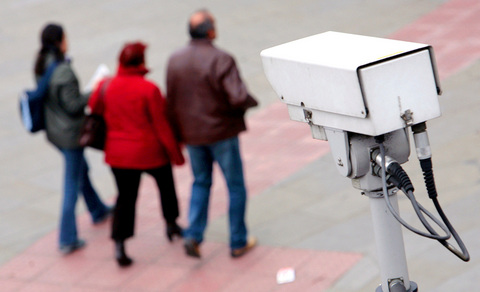
PHOTO: AFP
But despite warnings from experts of a rapid slide into a Big Brother society — the term coming from the novel 1984 by George Orwell about totalitarianism, and not the current reality TV series — the Labour government has embarked on an extension of the program.
It is introducing so-called talking cameras that tell people off for dropping litter or committing anti-social behavior.
Under a new pilot scheme, talking CCTV cameras are to be installed in 20 areas across England.
They have already been used in the town of Middlesbrough, a crime hotspot in the north-east of the country, where anyone seen misbehaving can be told off via a loudspeaker.
Home Secretary John Reid has earmarked nearly £500,000 to fund the expansion.
Defending his scheme against critics, Reid said the cameras were aimed at "the small minority" who "litter our streets, vandalize our communities and damage our properties."
He also announced that competitions would be held at schools in many of the areas for children to become the voice of the cameras.
"By funding and supporting these local schemes, the government is encouraging children to send this clear message to grown ups — act anti-socially and you will face the shame of being publicly embarrassed," Reid said.
The talking cameras were "hugely popular" in Middlesbrough and the vast majority of the people there were backing the scheme, he insisted.
"It helps counter things like litter through drunk or disorderly behavior, gangs congregating. They are the sorts of things that make people's lives a misery. Anything that tackles that is better."
The fight against so-called anti-social behavior has been a main plank of Blair's law-and-order program, but statistics have shown that the measures taken by the government have failed to have the desired effect.
The new talking cameras will be installed in 20 towns and cities all over the country, including three districts in London.
In Middlesbrough, staff in a control center monitor pictures from 12 talking cameras and can communicate directly with people on the street.
Local councilor Barry Coppinger says the scheme has prevented fights and criminal damage and cut litter levels.
"Generally, I think it has raised awareness that the town center is a safe place to visit and also that we are keeping an eye open to make sure it is safe," he said.
But opponent and campaigner Steve Hills said: "Apart from being absurd, I think it's rather sad that we should have faceless cameras barking at us on orders from who?"
A recent study by the government's privacy watchdog, the Information Commissioner, warned that Britain was becoming a "surveillance society."
Commissioner Richard Thomas said excessive use of CCTV and other information gathering was creating a climate of suspicion.
Shami Chakrabati, director of human rights group Liberty, said the report was a clear warning to private and public sectors to curb their appetite for gathering personal information.
"The desire for a little bit of privacy is part of being human and the nation's dignity should not be for sale," she said.

“Taiwan’s Opposition Leader Comes to US With a Message Straight Out of Beijing” read a May 31 headline in the Wall Street Journal. Top US administration officials and members of Congress almost certainly read the WSJ, and if there was a bullet point takeaway that people in Washington should absorb ahead of Chinese Nationalist Party (KMT) Chair Cheng Li-wun’s (鄭麗文) arrival in DC on June 9, that headline is it. The last few columns have discussed this very topic, and the timing is not coincidental. While those top officials likely do not read the Taipei Times, judging by the number

With weighty, anxiety-inducing geopolitical topics dominating the headlines, checking in on the wild and weird state of local politics can take some of the edge off. This November’s elections will determine who will be in charge of fixing potholes in your neighborhood, not the potholes in Taiwan’s complicated geopolitical space. Recently, after an online interview with a Taipei-based journalist, I commented that Taipei journalists never go further than the MRT can take them. He laughed and agreed. Naturally, the Taipei mayoral race is eating up much of the press attention. TAIPEI CITY Democratic Progressive Party (DPP) candidate Puma Shen (沈伯洋) has

Audiences in Leicester, Cardiff, London and Sheffield will this month gather to watch a series of black-and-white Taiwanese-language films made more than 70 years ago. On the surface, these screenings commemorate the seventieth anniversary of taiyupian (台語片) — Taiwanese-language cinema. Yet the significance of these events extends far beyond nostalgia or film history. They represent a remarkable chapter in Taiwan’s ongoing effort to recover, preserve and reinterpret a cultural heritage that was once thought to have largely disappeared. The centerpiece of the program is the Ho Chi-ming (何基明) directed Xue Pinggui and Wang Baochuan (薛平貴與王寶釧), a film produced in 1955 and

In December of 2008 Lee E-tin (李乙廷), a Miaoli county legislative hopeful, was convicted of vote-buying. Rather than buy votes retail, voter by voter, in the usual manner, Lee had done it wholesale, in a commendably efficient manner: he had visited local temples and made donations to gain their support. Because he did not normally make donations to temples, the court ruled he was attempting to improperly influence voter behavior. The case indicates how important temples are in influencing political life. Both judge and politician appeared to see them in the same way. Beijing sees them that way as well. Democratic Progressive


 RSS
RSS