


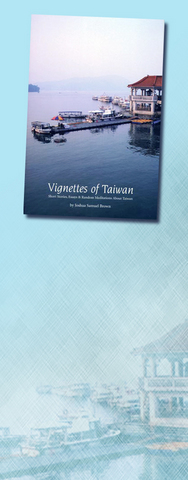
Vignettes of Taiwan is a collection of anecdotes, travel impressions and photos put together by an American who's currently 36, but was only 24 when he arrived in Taiwan in 1994. He relates how he spent some time teaching English without a work permit, took a three-year break, part of it in China, then returned to Taiwan to embark on life as a freelance writer.
In the process of reading we also learn that the author spent many years as a New York bike messenger, and that he's of Jewish descent, a fact that endeared him to the Hakka family he lodged with in Shuangxi on the outskirts of Hsinchu. He describes himself as only ever bringing his "Taiwan steady" back to stay there overnight, and enduring a nasty earthquake only to find that his cat had kittened during it.
Brown has the freelancer's instincts in so far as even the smallest incident is seen as providing a peg strong enough to hang a story on. Thus, asking someone who may have been an Atayal, or perhaps an Ami, the way to Taitung, he goes on to outline how Taiwan's aboriginal population was first driven into the foothills by the Hakkas, then high into the central mountains when the Hakkas were in turn driven into the foothills by Han Chinese arriving from Fukien.
Elsewhere he finds himself on Green Island — which "will probably never make Asian tourism's A-list" — and encountering Vice-President Annette Lu (呂秀蓮), only to discover that the person in question is a transvestite celebrity-impersonator recording a skit on Lu's incarceration there for TV.
("Room service was terrible, darling!")
There's an unusually frank piece on Western women's success or otherwise in Taiwan's dating game. The old adage that on the whole Western men enjoy Asia while Western women don't is partly lent support to here, but with an ironic twist that goes some way at least to save the Western female face.
Many familiar topics are covered, but there's no harm in that. Brown writes with freshness and apparent honesty, and several of his items end with a clever punch-line. One story concludes with a sardonic reference to "the cut-throat politics of the world of Taiwanese kindergartens," while another, on the advisability of going to a Hsin Beitou love-hotel with someone you're already attached to, concludes with the aphorism "Love, like advice, is best appreciated when freely given."
Some of the pieces, it must be said, feel dated today. Brown includes one on elections that was written in 2001, and begins one sentence, "President Chen Shui Bian's (陳水扁) term in office has so far been ... ." Not much insight there from our current perspective. Another, on trying to cycle up Five Finger Mountain from the North Taiwan town of Chudong, dates from 1995. But the author is perfectly open about the book's origins, and on the whole nothing important is lost by the inclusion of less-than-recent material.
Vignettes of Taiwan is smartly produced, with classy color photos, several of them featuring the author. Most of the pieces in it are light-hearted and mildly satirical. This, then, is a useful and in places stylish addition to the limited number of books available in English on modern-day Taiwan.
Things Taiwanese have remained on my mind all week. I may be the last person on the planet to have read Yann Martel's Life of Pi, the Man Booker Prize winning novel describing life adrift in the Pacific accompanied by a Royal Bengal tiger. It's an amazing work, exceptionally readable but with a profound message. What I didn't expect was that one important minor character would be Taiwanese.
When Pi eventually makes landfall in Mexico he's questioned by some Japanese businessmen concerned with insurance claims on the vessel whose wreck caused Pi to take to the life-raft. They refuse to believe his fantastic story, which includes an account of a floating island that consumes humans who venture onto its shores. So Pi makes up another, more conventional, story to please the businessmen. Instead of the highly-colored truth of an orangutan, a hyena and the tiger, he invents a tale of aggression and brutality that his questioners immediately understand as "real." This alternative story includes a Taiwanese boy who ends up being slaughtered and eaten by the vicious ship's cook.
The Taiwanese, in his early 20s, is described as follows. "He was beautiful. He had no facial hair at all and a clear, shining complexion. His features — the broad face, the flattened nose, the narrow, pleated eyes — looked so elegant. I thought he looked like a Chinese emperor."
This must be one of the more significant appearances of Taiwan in English-language literature to date. And Life of Pi does fall into the category of literature. It's major on two counts. First, it advances the possibilities of the novel, having for most of its duration no protagonists other than the narrator and a tiger. Its main precursor in this is Robinson Crusoe, though there are echoes of Gulliver's Travels as well.
Far more importantly, though, it's a meditation on the current status of religion. Martel thinks that the contemporary supremacy of a scientific and atheistic view of the world in the West is inadequate to the nature of reality. Our planet is, he believes, gorgeously rich in ways that science can't explain, and doesn't attempt to explain. That richness — and unexpectedness — is represented by the life on the raft. The alternative narration Pi offers to the Japanese, by contrast, represents the account of life offered by science — bleached of all color, boringly predictable, and by implication motivated only by greed, self-interest and the mechanics of pain and pleasure.
Literary shipwrecks have been seen as symbolic of the death of religion ever since Moby Dick. The point that Life of Pi so brilliantly encapsulates, however, may not be that although the ship of faith sinks a lifeboat of faith can still survive, but instead that one day the matter-of-fact, rational, vivisecting and godless approach to the world will disappear beneath the waves, but the marvels of actual life will — human destruction of the environment permitting — carry on, and with any luck go on for ever. It's nice to think that future generations will see Taiwan as having had a place in that story.

In late October of 1873 the government of Japan decided against sending a military expedition to Korea to force that nation to open trade relations. Across the government supporters of the expedition resigned immediately. The spectacle of revolt by disaffected samurai began to loom over Japanese politics. In January of 1874 disaffected samurai attacked a senior minister in Tokyo. A month later, a group of pro-Korea expedition and anti-foreign elements from Saga prefecture in Kyushu revolted, driven in part by high food prices stemming from poor harvests. Their leader, according to Edward Drea’s classic Japan’s Imperial Army, was a samurai

The following three paragraphs are just some of what the local Chinese-language press is reporting on breathlessly and following every twist and turn with the eagerness of a soap opera fan. For many English-language readers, it probably comes across as incomprehensibly opaque, so bear with me briefly dear reader: To the surprise of many, former pop singer and Democratic Progressive Party (DPP) ex-lawmaker Yu Tien (余天) of the Taiwan Normal Country Promotion Association (TNCPA) at the last minute dropped out of the running for committee chair of the DPP’s New Taipei City chapter, paving the way for DPP legislator Su
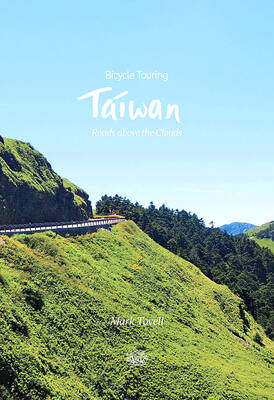
It’s hard to know where to begin with Mark Tovell’s Taiwan: Roads Above the Clouds. Having published a travelogue myself, as well as having contributed to several guidebooks, at first glance Tovell’s book appears to inhabit a middle ground — the kind of hard-to-sell nowheresville publishers detest. Leaf through the pages and you’ll find them suffuse with the purple prose best associated with travel literature: “When the sun is low on a warm, clear morning, and with the heat already rising, we stand at the riverside bike path leading south from Sanxia’s old cobble streets.” Hardly the stuff of your

Located down a sideroad in old Wanhua District (萬華區), Waley Art (水谷藝術) has an established reputation for curating some of the more provocative indie art exhibitions in Taipei. And this month is no exception. Beyond the innocuous facade of a shophouse, the full three stories of the gallery space (including the basement) have been taken over by photographs, installation videos and abstract images courtesy of two creatives who hail from the opposite ends of the earth, Taiwan’s Hsu Yi-ting (許懿婷) and Germany’s Benjamin Janzen. “In 2019, I had an art residency in Europe,” Hsu says. “I met Benjamin in the lobby


 RSS
RSS