


"I never really had [the] talent to do the creative side [of performance]," said Ping Heng (平珩), who has just stepped down from a two-and-a-half year stint as artistic director at Chiang Kai-shek Cultural Center. "I think you have to be crazy to become an artist and I always think I never push myself [hard enough]."
Instead, she pursued a career as an artistic director maintaining a grueling schedule of twelve-hour days, six days a week. During her stint at the center, Ping also oversaw a number of festivals and ran her own dance company.
Her next mission is to increase the profile of mid- to small-size companies by encouraging collaborations with international artists, both at home and abroad.

PHOTO: NOAH BUCHAN, TAIPEI TIMES
With many cities throughout Taiwan planning to build government funded theaters, now is a propitious time to increase the profile of local performance art companies.
Ping questions the practicality of building large theaters, particularly the one planned for Kaohsiung, which will be larger than Taipei's National Theater.
"People in the south don't have the habit to pay for [large-scale] performances," she said. "They will go to free performances but to make a regular visit every month is not a habit yet."
Rather than building large theaters, Ping is lobbying local governments to focus on medium sized theaters. "We have experimental theater and big theater … companies who can use the national theater are the top companies. But what we need are more … 800 to 1,000 seat-theaters, like the Metropolitan Hall (城市舞台)."
As a graduate student at New York University's Tisch School studying ballet back in the early 1980s, Ping and other Taiwanese expats were looking for a way to take what they learned in the classroom to the stage.
After graduating, Ping returned to Taiwan and started Taipei Dance Workshop (皇冠舞蹈工作室).
The concept of an artist workshop was so revolutionary back in 1984, there wasn't even an accepted Chinese translation for the phrase.
Ping's Taipei Dance Workshop attracted artists from abroad who would come to Taiwan and do workshops with local actors and dancers, teaching them different styles of dance or theater.
The workshop taught Ping how to work with different performers, collaborate with choreographers and push younger performers to become more professional.
"During the 1980s we did not have a lot of performing arts companies. People [would] go to class and then they wouldn't have any opportunities to do performances … . We [created] those opportunities," she said.
Once she had a pool of dancers to work with she founded her own company, Dance Forum Taipei (舞蹈空間舞蹈團), in 1989. The company is an open forum for various artists to come together to present and study their ideas. The company has had over 500 performances throughout the world. Building on the success of Dance Forum Taipei, she teamed up with like-minded artists and established the Asia Arts Network (亞洲藝術網絡), a network of theater and dance groups throughout Asia that promoted exchange programs.
"I think for cultural policy of which performance art is a part, you have to have a long-range vision." But Ping says up until the mid-nineties, there was little cultural policy to speak of at the national level, especially when it came to performance art.
To counter this problem, Ping and other members of the artistic community came up with Performance Arts Alliance (表演藝術聯盟) in 1999, a lobby group for the performance arts, of which she was chairperson for the first four years.
"That was the first time that a performance art group learned how to talk to both government [officals] and legislator[s]," she said.
Having helped develop a local dance scene, Ping and her associates sought to persuade legislators and government officials that the local performing arts could raise the country's international profile.
"We believe that culture is the most powerful weapon for Taiwan especially if you bring your performance group abroad. That's the best way for people to see Taiwan," she said.

In late October of 1873 the government of Japan decided against sending a military expedition to Korea to force that nation to open trade relations. Across the government supporters of the expedition resigned immediately. The spectacle of revolt by disaffected samurai began to loom over Japanese politics. In January of 1874 disaffected samurai attacked a senior minister in Tokyo. A month later, a group of pro-Korea expedition and anti-foreign elements from Saga prefecture in Kyushu revolted, driven in part by high food prices stemming from poor harvests. Their leader, according to Edward Drea’s classic Japan’s Imperial Army, was a samurai

The following three paragraphs are just some of what the local Chinese-language press is reporting on breathlessly and following every twist and turn with the eagerness of a soap opera fan. For many English-language readers, it probably comes across as incomprehensibly opaque, so bear with me briefly dear reader: To the surprise of many, former pop singer and Democratic Progressive Party (DPP) ex-lawmaker Yu Tien (余天) of the Taiwan Normal Country Promotion Association (TNCPA) at the last minute dropped out of the running for committee chair of the DPP’s New Taipei City chapter, paving the way for DPP legislator Su

It’s hard to know where to begin with Mark Tovell’s Taiwan: Roads Above the Clouds. Having published a travelogue myself, as well as having contributed to several guidebooks, at first glance Tovell’s book appears to inhabit a middle ground — the kind of hard-to-sell nowheresville publishers detest. Leaf through the pages and you’ll find them suffuse with the purple prose best associated with travel literature: “When the sun is low on a warm, clear morning, and with the heat already rising, we stand at the riverside bike path leading south from Sanxia’s old cobble streets.” Hardly the stuff of your
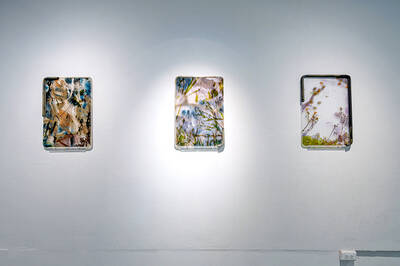
Located down a sideroad in old Wanhua District (萬華區), Waley Art (水谷藝術) has an established reputation for curating some of the more provocative indie art exhibitions in Taipei. And this month is no exception. Beyond the innocuous facade of a shophouse, the full three stories of the gallery space (including the basement) have been taken over by photographs, installation videos and abstract images courtesy of two creatives who hail from the opposite ends of the earth, Taiwan’s Hsu Yi-ting (許懿婷) and Germany’s Benjamin Janzen. “In 2019, I had an art residency in Europe,” Hsu says. “I met Benjamin in the lobby


 RSS
RSS