


As fathers age, the risk of abnormal offspring may rise.
When it comes to fertility and the prospect of having normal babies, it has always been assumed that men have no biological clock — that unlike women, they can have it all, at any age.
But mounting evidence is raising questions about that assumption, suggesting that as men get older, they face an increased risk of fathering children with abnormalities. Several recent studies are starting to persuade many doctors that men should not be too cavalier about postponing marriage and children.
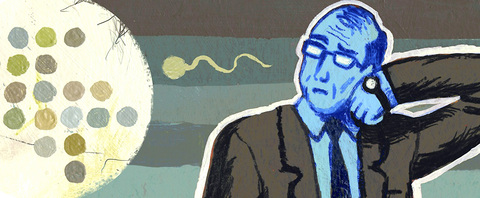
ILLUSTRATION: NY TIMES NEWS SERVICE
Until now, the problems known to occur more often with advanced paternal age were so rare they received scant public attention. The newer studies were alarming because they found higher rates of more common conditions — including autism and schizophrenia — in offspring born to men in their middle and late 40s. A number of studies also suggest that male fertility may diminish with age.
"Obviously there is a difference between men and women; women simply can't have children after a certain age," said Dr. Harry Fisch, director of the Male Reproductive Center at New York-Presbyterian Hospital/Columbia University Medical Center and the author of The Male Biological Clock.
"But not every man can be guaranteed that everything's going to be fine," Fisch said. "Fertility will drop for some men, others will maintain their fertility but not to the same degree, and there is an increased risk of genetic abnormalities."
It's a touchy subject. "Advanced maternal age" is formally defined: women who are 35 or older when they deliver their baby may have "AMA" stamped on their medical files to call attention to the higher risks they face. But the concept of "advanced paternal age" is murky. Many experts are skeptical about the latest findings, and doctors appear to be in no rush to set age guidelines or safety perimeters for would-be fathers, content instead to issue vague sooner-rather-than-later warnings.
"The problem is that the data is very sparse right now," said Larry Lipschultz, a specialist in the field of male infertility and a past president of the American Society for Reproductive Medicine. "I don't think there's a consensus of what patients should be warned about."
And many men maintain their fertility, said Rebecca Sokol, president of the Society of Male Reproduction and Urology.
"If you look at males over 50 or 40, yes, there is a decline in the number of sperm being produced, and there may be a decline in the amount of testosterone," Sokol said. But by and large, she added, "the sperm can still do their job."
Some advocates welcome the attention being paid to the issue of male fertility, saying it is long overdue and adding that it could level the playing field between men and women in the premarital dating game.
"The message to men is: 'Wake up and smell the java,'" said Pamela Madsen, executive director of the American Fertility Association, a national education and advocacy group. "It's not just about women anymore, it's about you too. It takes two to make a baby, and men who one day want to become fathers need to wake up, read what's out there and take responsibility."
Analyses of sperm samples from healthy men have found changes as men age, including increased fragmentation of DNA, and some studies outside the US have noted increased rates of some cancers in children of older fathers.
Geneticists have been aware for decades that the risk of certain rare birth defects increases with the father's age. One of the most studied of these conditions is a form of dwarfism called achondroplasia, but the list also includes neurofibromatosis, the connective-tissues disorder Marfan syndrome, skull and facial abnormalities like Apert syndrome, and many other diseases and abnormalities.
"We have counseled for quite a long time that as paternal age increases, there is an increased frequency in new mutations," said Joe Leigh Simpson, president-elect of the American College of Medical Genetics.
Some studies suggest that the risk of sporadic single-gene mutations may be four to five times higher for fathers who are 45 and older, compared with fathers in their 20s, Simpson said. Overall, having an older father is estimated to increase the risk of a birth defect by 1 percent, against a background 3 percent risk for a birth defect, he said.
Even grandchildren may be at greater risk for some conditions that are not expressed in the daughter of an older father, according to the American College of Medical Genetics. These include Duchenne muscular dystrophy, some types of hemophilia and fragile-X syndrome.
A recent study on autism attracted attention because of its striking findings about a perplexing disorder. Researchers analyzed a large Israeli military database to determine whether there was a correlation between paternal age and the incidence of autism and related disorders. It found that children of men who became a father at 40 or older were 5.75 times as likely to have an autism disorder as those whose fathers were younger than 30.
"Until now, the dominant view has been, 'Blame it on the mother,' " said Avi Reichenberg, the lead author of the study, published in September in The Archives of General Psychiatry. "But we found a dose-response relationship: The older the father, the higher the risk. We think there is a biological mechanism that is linked to aging fathers."
The study controlled for the age of the mother, the child's year of birth and socioeconomic factors, but researchers did not have information about autistic traits in the parents.
A study on schizophrenia found that the risk of illness was doubled among children of fathers in their late 40s when compared with children of fathers under 25, and increased almost threefold in children born to fathers 50 and older. This study was also carried out in Israel, which maintains the kind of large centralized health databases required for such research. In this case, the researchers used a registry of 87,907 births in Jerusalem between 1964 and 1976, and linked the records with an Israeli psychiatric registry.
Researchers controlled for the age of the mother but did not have information on family psychiatric history.
But studies elsewhere had similar findings, she said: an increase in schizophrenia among offspring of older fathers.
Meanwhile, scientists have reported that sperm counts decline with age, and that sperm begin to lose motility and the ability to swim in a straight line. The researchers also reported a steady increase in sperm DNA fragmentation as men grew older.
The changes are gradual, rather than precipitous, said Brenda Eskenazi, director of the Center for Children's Environmental Health Research at the School of Public Health at the University of California, Berkeley.
Unlike women, who are born with a lifetime supply of eggs, men are constantly making new sperm. But the spermatogonia — the immature stem cells in the testes that replenish sperm — are constantly dividing and replicating, with each round of division creating another possibility for error.
So what's a guy to do?
"I think what we're saying is that men, too, need to be concerned about their aging," Eskenazi said. "We don't really know what the complete effects are of men's age on their ability to produce viable, healthy offspring."
Fisch says healthy habits, regular exercise and a balanced diet may help preserve fertility. He advises against smoking and using anabolic steroids and hot tubs, all of which can damage sperm.
If pressed, he said, "I would tell people, 'If you're going to have kids, have them sooner rather than later.'"

In late October of 1873 the government of Japan decided against sending a military expedition to Korea to force that nation to open trade relations. Across the government supporters of the expedition resigned immediately. The spectacle of revolt by disaffected samurai began to loom over Japanese politics. In January of 1874 disaffected samurai attacked a senior minister in Tokyo. A month later, a group of pro-Korea expedition and anti-foreign elements from Saga prefecture in Kyushu revolted, driven in part by high food prices stemming from poor harvests. Their leader, according to Edward Drea’s classic Japan’s Imperial Army, was a samurai

The following three paragraphs are just some of what the local Chinese-language press is reporting on breathlessly and following every twist and turn with the eagerness of a soap opera fan. For many English-language readers, it probably comes across as incomprehensibly opaque, so bear with me briefly dear reader: To the surprise of many, former pop singer and Democratic Progressive Party (DPP) ex-lawmaker Yu Tien (余天) of the Taiwan Normal Country Promotion Association (TNCPA) at the last minute dropped out of the running for committee chair of the DPP’s New Taipei City chapter, paving the way for DPP legislator Su

It’s hard to know where to begin with Mark Tovell’s Taiwan: Roads Above the Clouds. Having published a travelogue myself, as well as having contributed to several guidebooks, at first glance Tovell’s book appears to inhabit a middle ground — the kind of hard-to-sell nowheresville publishers detest. Leaf through the pages and you’ll find them suffuse with the purple prose best associated with travel literature: “When the sun is low on a warm, clear morning, and with the heat already rising, we stand at the riverside bike path leading south from Sanxia’s old cobble streets.” Hardly the stuff of your

Located down a sideroad in old Wanhua District (萬華區), Waley Art (水谷藝術) has an established reputation for curating some of the more provocative indie art exhibitions in Taipei. And this month is no exception. Beyond the innocuous facade of a shophouse, the full three stories of the gallery space (including the basement) have been taken over by photographs, installation videos and abstract images courtesy of two creatives who hail from the opposite ends of the earth, Taiwan’s Hsu Yi-ting (許懿婷) and Germany’s Benjamin Janzen. “In 2019, I had an art residency in Europe,” Hsu says. “I met Benjamin in the lobby


 RSS
RSS