


The merriment of Mardi Gras is like the exaggerated greasepaint smile of a sad clown in a celebratory city still mired in miseries.
For the sake of the Big Easy's psyche and pocketbook, the Carnival goes on this week, as big and brassy as before Hurricane Katrina devastated this storied place 18 months ago.
There are as many parades and balls as ever as the extended celebration moves toward its climax next week on Fat Tuesday. Hotels are booked nearly solid.

PHOTOS: NY TIMES NEWS SERVICE
But Mardi Gras could be the institution most back to normal in a New Orleans where violent crime and a lagging recovery have already changed the commerce and culture forever.
"This one event is very healthy," said Arthur Hardy, a historian and publisher of an authoritative Mardi Gras guide. He said that other than the Saints, who were "abnormally good" in making the National Football League playoffs, Mardi Gras is probably closer to pre-Katrina standards than any other aspect of life here.
Before Katrina flooded New Orleans in early September 2005, the city's population was about 444,000. The Louisiana Recovery Authority found the population is now about 191,000, not even half of what it was.
Instead of continuing to grow as former residents return, the population has hit a "plateau" and could even tilt the other way, said Elliott Stonecipher, a Louisiana demographic and political analyst. A recent study of moving van companies "quite frankly showed an out-migration," he said.
Because "the city lost 108,000 housing units" in Katrina, said Greg Rigamer, a demographer with CCR & Associates in New Orleans, it will remain a much smaller city for many years. A population of 300,000 in five years "might be realistic," he said.
Riding down streets in the Ninth Ward and Lakeview, lined with ruined houses and deserted except for National Guard patrols, it's hard to believe that a year and a half have passed since Katrina.

On Lamanche Street, clothes and a Spider-Man sleeping bag are still in tree limbs where floodwaters deposited them. Power wires are still down in front of the Holy Family Spiritualist Church, where someone left Mardi Gras beads on a statue of the Virgin Mary.
In a drying scrapbook on the driveway of a demolished house in the Ninth Ward are pictures of a family's vacation to Atlanta and student IDs from a daughter's years at Dillard University.
One resident who did return home to New Orleans only a few months after Katrina was Stacy Brundrick, an accountant. But she moved to Birmingham, Alabama after city services were slow to resume, and crime spiked.
"When people call and ask me when I'm moving back, I jokingly tell them 'When I don't need a bulletproof vest any more,'" she said.
She has come back for Mardi Gras, though, and will ride in a parade Saturday as a member of the all-female Iris Krewe.
"I will always love New Orleans," she said. "But a lot of young professionals are like me. I have a friend who says he wavers every day on whether to stay or to leave."
There were 162 killings in New Orleans in 2006, "and one conviction. That's ugly," said Peter Scharf, director of the Center for Society, Law and Justice at the University of New Orleans. There were 21 more murders in the first 42 days of this year.
The murders of Helen Hill, a well-known local filmmaker, and brass band musician Dinerral Shavers destroyed the illusion that killings were concentrated in certain neighborhoods, Scharf said. "The truth is now there are really not that many safe places in the city."
Celebrating her first Mardi Gras, one-year-old Sophia Funderburk was safe — at least from beads thrown from floats — inside a plastic box enclosing her seat atop a ladder beside St. Charles Avenue. The protective bubble was modeled after the Popemobile, her parents said.
Hope Funderburk was pregnant with Sophia when Katrina hit, and the family lived with friends for a year while their flooded house was being rebuilt. They're back at home now — but most of their neighbors aren't.
"In our neighborhood, maybe a third are back. A third are not coming back. The other third hasn't returned and is still deciding whether to come back," said Funderburk, watching the parade with her daughter and husband, Tim. With fewer residents and deserted houses, what was an "up-and-coming neighborhood" has become much more dangerous, she said.
"New Orleans has always had crime, but it's come closer to our home now," she said. "We've had robberies and shootings on our block."
Most of the shootings are still "bad guys killing bad guys," said Jimmy Keen, a retired homicide squad commander with the New Orleans Police Department. "But you get one innocent victim and everyone says, 'Whoa, this could happen to me.' "
A study by the University of New Orleans titled "Keeping Our People" found that 32 percent of the populace was considering leaving within the next two years.
But crime has not kept away the Mardi Gras crowds.
The French Quarter seemed as jam-packed and bawdy as ever as Carnival kicked off last weekend. Bourbon Street was alive with music — R&B from Funky 544, Dixieland from Papa Joe's, Cajun accordion and fiddle from Fat Catz, and Play That Funky Music, White Boy blaring from seemingly every other bar doorway. Raucous folks on balconies tossed beads down to breast-baring young women below.
A mobile police tower called a Sky Watch, equipped with cameras and searchlights, loomed over the celebrating crowd in the French Quarter, however, and cops are pulling 12-hour shifts.
"Jesus loves you. God wishes that no one will go to hell," evangelist Walter Williams told passersby. He and Paul Gros of the Assembly of God Church in the French Quarter set up a high-tech Christian cross in the middle of Bourbon Street, and Bible verses scrolled across in lighted letters.
Nearby, Bill Young sold beads from a street cart. His big seller is a string of blue-pill beads with a faux bottle of Super Viagra at the bottom.
This is Young's twelfth season of selling Mardi Gras trinkets. "Now it's a tad slow, but it looks good for next week," he said. "It'll be good for the city and for the vendors and the other people who pay the taxes around here."
Indeed, a profitable Mardi Gras is sorely needed by small businesses, said Sandy Shilstone, president of the New Orleans Tourism Marketing Corp. Increasing property insurance rates are the latest financial woe to beset the "mom and pop" store owners that are the foundation of the tourism industry, she said.
"Mardi Gras was a homecoming for New Orleaneans last year," said Shilstone. "This year, we hope it's a homecoming for tourists."
Three friends from Georgia said they did not let the much-publicized crime keep them away from Mardi Gras. However, they stressed that while they dance on Bourbon Street, "we don't get drunk."
"We will be back here again next year for Mardi Gras," vowed Fay Alexander of Thomaston, Georgia She had come with Carolyn Copeland of Woodbury and Brenda Beckham of Griffin.
Mardi Gras has a jargon of its own. This glossary will help you understand what they're talking about in the French Quarter.
MARDI GRAS: French for "Fat Tuesday." It marks the end of Carnival, a period of celebration leading up to Ash Wednesday and the onset of Lent, a Christian season of voluntary self-deprivation that lasts until Easter.
MARDI GRAS COLORS: Purple to represent justice. Green to signify faith. Gold to stand for power.
KREWE: The name given the private organizations or clubs that sponsor the public parades, private balls and other events of Carnival.
FLOATS: The giant rolling artworks that carry krewe members through the city in parades. Every parade gets a new theme every year, so new floats are always needed. Making them is a year-round industry in New Orleans.
THROWS: The beads and other trinkets that krewe members toss out to the crowds that line the route. Members buy their own throws through the krewe, sometimes tossing up to US$500 worth of items during the parade.
DOUBLOONS: Souvenir coins that bear a krewe's insignia one side and that year's parade theme on the other. Plastic doubloons are among the throws, but metal doubloons are also minted and often collected.
NEUTRAL GROUND: The grassy strip in the middle of a boulevard, known elsewhere as a median, is packed with parade watchers during Mardi Gras. On the floats, riders face either the sidewalk or neutral ground to toss out their throws.
MARDI GRAS LADDER: Small children sit in boxes affixed to folding ladders to watch the passing parades. Some ladders have cushions and seat belts, and at least one is equipped with a plastic bubble so the child does not get hit with throws.
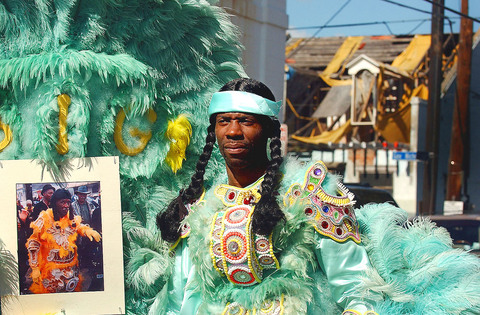
MARDI GRAS INDIANS: Neighborhood clubs of African-American men who dress in elaborate outfits of buckskin, beads and feathered headdresses like Native Americans on Mardi Gras.
MASKS: There is a New Orleans law that adult riders on Mardi Gras floats must wear masks. Another ordinance makes Mardi Gras the only day where people can legally wear masks on the streets.
KING CAKE: An oval, sugary ring of pastry with icing in Mardi Gras colors. A plastic baby is hidden inside the King Cake. The diner who is served the doll in his slice is declared the "king" and has to buy the King Cake for the next party. Mardi Gras historian Arthur Hardy reports that more than 750,000 King Cakes are consumed in Mardi Gras during Carnival.
TO-GO CUPS: Drinking on the streets during Carnival is not only legal in New Orleans, it's practically mandatory -- but never from a glass container. So ask the bartender for a "to-go cup" to take your beer or potent rum Hurricane out to see a parade. To-go cups adorned with krewe insignia are often used as throws.
Source: ARTUUR HARDY'S MARDI GRAS GUIDE

In late October of 1873 the government of Japan decided against sending a military expedition to Korea to force that nation to open trade relations. Across the government supporters of the expedition resigned immediately. The spectacle of revolt by disaffected samurai began to loom over Japanese politics. In January of 1874 disaffected samurai attacked a senior minister in Tokyo. A month later, a group of pro-Korea expedition and anti-foreign elements from Saga prefecture in Kyushu revolted, driven in part by high food prices stemming from poor harvests. Their leader, according to Edward Drea’s classic Japan’s Imperial Army, was a samurai

The following three paragraphs are just some of what the local Chinese-language press is reporting on breathlessly and following every twist and turn with the eagerness of a soap opera fan. For many English-language readers, it probably comes across as incomprehensibly opaque, so bear with me briefly dear reader: To the surprise of many, former pop singer and Democratic Progressive Party (DPP) ex-lawmaker Yu Tien (余天) of the Taiwan Normal Country Promotion Association (TNCPA) at the last minute dropped out of the running for committee chair of the DPP’s New Taipei City chapter, paving the way for DPP legislator Su
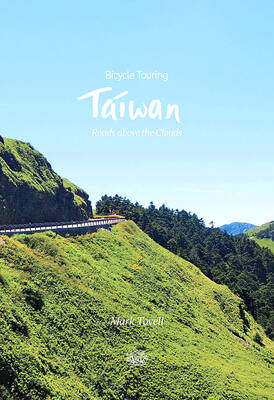
It’s hard to know where to begin with Mark Tovell’s Taiwan: Roads Above the Clouds. Having published a travelogue myself, as well as having contributed to several guidebooks, at first glance Tovell’s book appears to inhabit a middle ground — the kind of hard-to-sell nowheresville publishers detest. Leaf through the pages and you’ll find them suffuse with the purple prose best associated with travel literature: “When the sun is low on a warm, clear morning, and with the heat already rising, we stand at the riverside bike path leading south from Sanxia’s old cobble streets.” Hardly the stuff of your

Located down a sideroad in old Wanhua District (萬華區), Waley Art (水谷藝術) has an established reputation for curating some of the more provocative indie art exhibitions in Taipei. And this month is no exception. Beyond the innocuous facade of a shophouse, the full three stories of the gallery space (including the basement) have been taken over by photographs, installation videos and abstract images courtesy of two creatives who hail from the opposite ends of the earth, Taiwan’s Hsu Yi-ting (許懿婷) and Germany’s Benjamin Janzen. “In 2019, I had an art residency in Europe,” Hsu says. “I met Benjamin in the lobby


 RSS
RSS