


There are certain assumptions that American audiences, perhaps without realizing it, are likely to bring to a movie about World War II. The combat picture has been a Hollywood staple for so long — since before the actual combat was over — that it can sometimes seem as if every possible story has already been told. Or else as if each individual story, from G.I. Joe to Private Ryan, is at bottom a variation on familiar themes: victory against the odds, brotherhood under fire, sacrifice for a noble cause.
But of course there are other, contrasting stories, a handful of which form the core of Letters From Iwo Jima, Clint Eastwood's harrowing, contemplative new movie and the companion to his Flags of Our Fathers, which was released this fall. That film, partly about the famous photograph of American servicemen raising the flag on the barren volcanic island of Iwo Jima, complicated the standard Hollywood combat narrative in ways both subtle and overt. It exposed the heavy sediment of individual grief, cynicism and frustration beneath the collective high sentiments of glory and heroism but without entirely debunking the value or necessity of those sentiments.
Letters, which observes the lives and deaths of Japanese soldiers in the battle for Iwo Jima, similarly adheres to some of the conventions of the genre even as it quietly dismantles them. It is, unapologetically and even humbly, true to the durable tenets of the war-movie tradition, but it is also utterly original, even radical in its methods and insights.
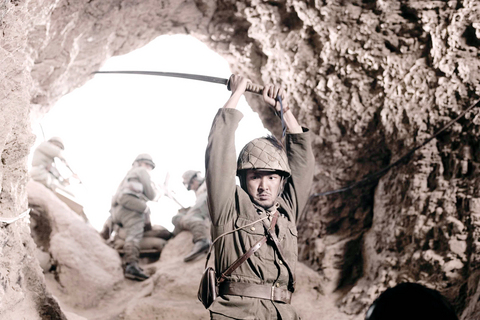
In December 2004, with Million Dollar Baby, Eastwood almost nonchalantly took a tried and true template — the boxing picture — and struck from it the best American movie of the year. To my amazement, though hardly to my surprise, he has done it again; Letters From Iwo Jima might just be the best Japanese movie of the year as well.
This is not only because the Japanese actors, speaking in their own language, give such vivid and varied performances, but also because the film, in its every particular, seems deeply and un-self-consciously embedded in the experiences of the characters they play. Letters From Iwo Jima is not a chronicle of victory against the odds, but rather of inevitable defeat. When word comes from Imperial headquarters that there will be no reinforcements, no battleships, no air support in the impending fight with the US Marines, any illusion of triumph vanishes, and the stark reality of the mission takes shape. The job of these soldiers and their commanders, in keeping with a military ethos they must embrace whether they believe in it or not, is to die with honor, if necessary by their own hands.
The cruelty of this notion of military discipline, derived from long tradition and maintained by force, is perhaps less startling than the sympathy Eastwood extends to his characters, whose sacrifices are made in the service of a cause that the American audience knows to be bad as well as doomed. It is hard to think of another war movie that has gone so deeply, so sensitively, into the mind-set of the opposing side.
PHOTOS COURTESY OF WARNER BROS
Since the fighting that Eastwood depicts is limited to a single, self-contained piece of the Japanese homeland, the bloody roster of Japanese atrocities elsewhere in Asia and the South Pacific remains off screen. But this omission in no way compromises the moral gravity of what takes place before our eyes. Nor does it diminish the power of the film's moving and meticulous vindication of the humanity of the enemy. (Eastwood also, not incidentally, exposes some inhumanity on the part of the American good guys, a few of whom are shown committing atrocities of their own.)
Any modern military organization depends, to some extent, on the dehumanization of its own fighters as well as their adversaries. (In Flags of Our Fathers the Japanese are all but faceless, firing unseen from bunkers and tunnels dug into the mountainside; in Letters From Iwo Jima we see the grueling work and strategic inspiration that led to the digging of those tunnels.)
An army needs personnel, not personalities, and one of the functions of the art and literature of war — especially on film, which exists to consecrate the human face — is to compensate for this forced anonymity by emphasizing the flesh-and-blood individuality of the combatants. Think of the classic Hollywood platoon picture, with its carefully distributed farm boys and city kids, its quota of blowhards and bookworms, all superintended by a wise, crusty commander. Even as they approach stereotype, those characters give names, faces and identities to men who have gone down in history mainly as statistics.
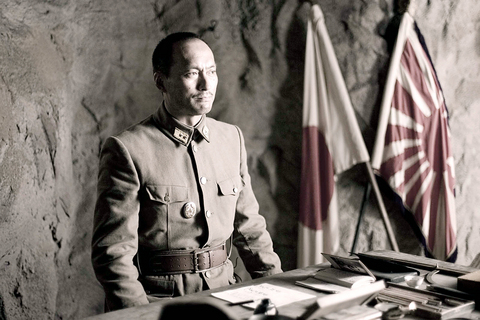
Historians estimate that 20,000 Japanese infantrymen defended Iwo Jima; 1,083 of them survived. (The Americans sent 77,000 Marines and nearly 100,000 total troops, of whom close to 7,000 died and almost 20,000 were wounded.) The Japanese commander was Lieutenant General Tadamichi Kuribayashi, whose illustrated letters to his wife and children, recently unearthed on the island, were a source for Iris Yamashita's script. Played by Ken Watanabe, Kuribayashi, who arrives on Iwo Jima with a pearl-handled Colt and fond memories of the years he spent in America before the war, is a dashing, cosmopolitan figure. He arouses a good deal of suspicion among the other officers for his modern ideas and for the kindness he sometimes displays toward the low-ranking soldiers.
The general is a practical man (those tunnels are his idea) in an impossible circumstance, and Watanabe's performance is all the more heartbreaking for his crisp, unsentimental dignity. He anchors the film — this is some of the best acting of the year, in any language — but does not dominate it. Much as the Imperial Army may have been rigidly hierarchical, Eastwood's sensibility is instinctively democratic. As the battle looms, and even as the bombs, bullets and artillery shells begin to explode, he takes the time to introduce us to Saigo (Kazunari Ninomiya), a guileless baker with no great desire to give his life for the glory of the nation; Lieutenant Ito (Shidou Nakamura), who will settle for nothing else; Baron Nishi (Tsuyoshi Ihara), an Olympic equestrian who once hobnobbed with Mary Pickford and Douglas Fairbanks; and Shimizu (Ryo Kase), who Saigo suspects is an agent of the secret police.
It is customary to use the word epic to describe a movie that deals with big battles, momentous historical events and large numbers of dead. But while some of Eastwood's set pieces depict warfare on a large scale, the overall mood of Letters From Iwo Jima, as the title suggests, is strikingly intimate. Even though the movie has a blunt, emphatic emotional force, Eastwood also shows an attention to details of speech and gesture that can only be described as delicate.
He is as well acquainted as any American director (or actor) with the language of cinematic violence, but he has no equal when it comes to dramatizing the ethical and emotional consequences of brutality. There is nothing gratuitous in this film, nothing fancy or false. There is the humor and the viciousness of men in danger; there is the cool logic of military planning and the explosive irrationality of behavior in combat; there is life and death.
As in Flags of Our Fathers, nearly all the color has been drained from the images, a technique that makes the interiors of the caves and tunnels look like Rembrandt paintings. The anxious faces seem to glow in the shadows, illuminated by their own suffering. At other times, in the hard outdoor light, Tom Stern's cinematography is as frank and solemn as a Mathew Brady photograph.
A few scenes serve as hinges joining this movie to Flags of Our Fathers. While Letters From Iwo Jima seems to me the more accomplished of the two films — by which I mean that it strikes me as close to perfect — the two enrich each other, and together achieve an extraordinary completeness. They show how the experience of war is both a shared and a divisive experience, separating the dead from the living and the winners from the losers, even as it binds them all together.
Both films travel back and forth in time and space between Iwo Jima and the homelands of the combatants. In Flags of Our Fathers the battle itself happens mainly in flashback, since the movie is in large measure about the guilt and confusion that survivors encountered upon their reluctant return home. In Letters From Iwo Jima the battle is in the present tense, and it is home that flickers occasionally in the memories of men who are certain they will not live to see it again.

In late October of 1873 the government of Japan decided against sending a military expedition to Korea to force that nation to open trade relations. Across the government supporters of the expedition resigned immediately. The spectacle of revolt by disaffected samurai began to loom over Japanese politics. In January of 1874 disaffected samurai attacked a senior minister in Tokyo. A month later, a group of pro-Korea expedition and anti-foreign elements from Saga prefecture in Kyushu revolted, driven in part by high food prices stemming from poor harvests. Their leader, according to Edward Drea’s classic Japan’s Imperial Army, was a samurai

The following three paragraphs are just some of what the local Chinese-language press is reporting on breathlessly and following every twist and turn with the eagerness of a soap opera fan. For many English-language readers, it probably comes across as incomprehensibly opaque, so bear with me briefly dear reader: To the surprise of many, former pop singer and Democratic Progressive Party (DPP) ex-lawmaker Yu Tien (余天) of the Taiwan Normal Country Promotion Association (TNCPA) at the last minute dropped out of the running for committee chair of the DPP’s New Taipei City chapter, paving the way for DPP legislator Su

It’s hard to know where to begin with Mark Tovell’s Taiwan: Roads Above the Clouds. Having published a travelogue myself, as well as having contributed to several guidebooks, at first glance Tovell’s book appears to inhabit a middle ground — the kind of hard-to-sell nowheresville publishers detest. Leaf through the pages and you’ll find them suffuse with the purple prose best associated with travel literature: “When the sun is low on a warm, clear morning, and with the heat already rising, we stand at the riverside bike path leading south from Sanxia’s old cobble streets.” Hardly the stuff of your

Located down a sideroad in old Wanhua District (萬華區), Waley Art (水谷藝術) has an established reputation for curating some of the more provocative indie art exhibitions in Taipei. And this month is no exception. Beyond the innocuous facade of a shophouse, the full three stories of the gallery space (including the basement) have been taken over by photographs, installation videos and abstract images courtesy of two creatives who hail from the opposite ends of the earth, Taiwan’s Hsu Yi-ting (許懿婷) and Germany’s Benjamin Janzen. “In 2019, I had an art residency in Europe,” Hsu says. “I met Benjamin in the lobby


 RSS
RSS