


In Miss Potter, Renee Zellweger, her face pickled in cheeriness, is Beatrix Potter, the creator of Peter Rabbit, Squirrel Nutkin and Mrs. Tittlemouse, among other beloved characters in children's literature.
This British author and illustrator, as portrayed by Zellweger, is almost as chipper as Julie Andrews's Mary Poppins, but twice as affected and not half as English-sounding. If Zellweger's shaky English accent carried her through two Bridget Jones movies, portraying an upper-middle-class Victorian woman presents a steeper elocutionary challenge. Her enunciation in Miss Potter lacks the starchy refinement demanded by the role. As she scrunches her face into polite grimaces and trills her phrases, you have the sense of an actor straining not to exhaust a limited repertory of genteel English mannerisms.
In Richard Maltby Jr.'s worshipful screenplay, Potter emerges as a plucky heroine for all seasons: a proto-feminist, a proto-environmentalist and a perfect lady. And from the beginning, this innocuous, fiercely Anglophilic trifle of a movie is too nice for its own good. There was plenty of drama in Potter's life, but the film turns major conflicts and losses into minor setbacks in a charmed, entirely virtuous existence. Even a sudden personal tragedy doesn't devastate this indefatigable font of resilience.
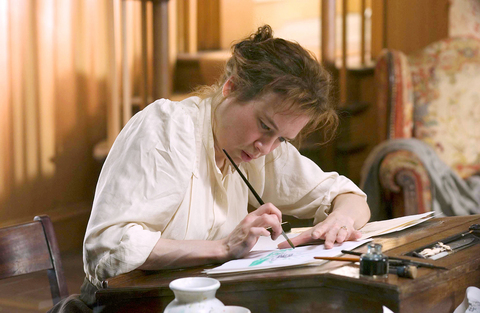
PHOTOS COURTEY OF CMC
Miss Potter is easy on the eyes. The first movie directed by the Australian filmmaker Chris Noonan since his sleeper hit, Babe, 11 years ago, it has the same pastel storybook palette and the same overriding mood of gentleness. Scenes filmed in the English Lake District, where Potter vacationed with her family and studied the local fauna, unfold like heavily captioned pages in a travel brochure.
Any hint of whimsy is welcome. And in the picture's most endearing moments, the author's characters stir to animated life on the page as she communes with them. These touches, of which there are too few, suggest a woman who is much more complicated (and eccentric) than Miss Potter lets on. They also evoke the intensity of the creative process through which Potter invented her classic characters out of childhood pets and closely observed wildlife.
The movie concentrates on only a few years in the life of Potter, who was born in 1866 and privately published her first book, The Tale of Peter Rabbit, in 1901. It proved so popular that she took it back to a publisher who had originally rejected it; he reconsidered once she agreed to reillustrate it in color. Published in 1902, it was an enormous hit, and the money she earned from it and its successors brought her independence from her strait-laced, nouveau-riche Victorian family.
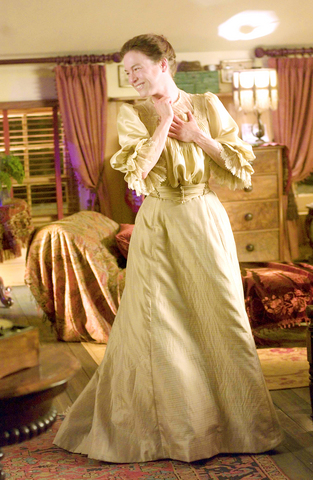
The closest thing to a villain in the movie is Potter's snobbish, social-climbing mother, Helen (Barbara Flynn), a stout, severe matriarch who refuses to recognize her daughter's accomplishments even after she earns fame and fortune for her work. Determined that Beatrix marry wealth, she pressures her to choose a husband from a series of suitors, each more grotesque than the one before. Beatrix will have none of it. Her father, Rupert (Bill Paterson), though more sympathetic, kowtows to the will of the fearsome Helen.
Because her publishers, the brothers Harold and Fruing Warne, have low expectations for The Tale of Peter Rabbit — they dismissively refer to it as her "bunny book" — they hand the project to their younger sibling, Norman (Ewan McGregor). The role of a buttoned-up Victorian editor is a complete turnabout from McGregor's usual rakes, but he inhabits it comfortably. Even after Beatrix and Norman become engaged (over her parents' objections), they continue to address each other as Miss Potter and Mr. Warne.
Potter forms a tight friendship with Warne's unmarried sister, Millie (Emily Watson, emitting mischievous sparks), and their sisterhood — they agree that there's more to a woman's life than marriage and children — gives the story its feminist credentials.
Once Potter achieves financial independence, the movie dawdles on pleasantly as she buys Hill Top, a farm in the Lake District, in 1905, and goes on to become a major landowner in the region in a campaign to preserve the area from developers; again, conflicts are minimized.
She later finds romance with a lawyer, William Heelis (Lloyd Owen), whom she would marry in 1913. Potter, who died in 1943, lived way beyond the time frame of the movie. At her death, she left 14 farms and 1,600 hectares of land to the National Trust, along with her flocks of Herdwick sheep.
This much sweetness and light in a movie is all very well. But there's a reason that recipes for cake and cookies call for a pinch of salt. In Miss Potter, there is only a grain or two — not enough to dilute the sugary overload. The film is the cinematic equivalent of a delicate English tea cake whose substance is buried under too many layers of icing.

In late October of 1873 the government of Japan decided against sending a military expedition to Korea to force that nation to open trade relations. Across the government supporters of the expedition resigned immediately. The spectacle of revolt by disaffected samurai began to loom over Japanese politics. In January of 1874 disaffected samurai attacked a senior minister in Tokyo. A month later, a group of pro-Korea expedition and anti-foreign elements from Saga prefecture in Kyushu revolted, driven in part by high food prices stemming from poor harvests. Their leader, according to Edward Drea’s classic Japan’s Imperial Army, was a samurai

The following three paragraphs are just some of what the local Chinese-language press is reporting on breathlessly and following every twist and turn with the eagerness of a soap opera fan. For many English-language readers, it probably comes across as incomprehensibly opaque, so bear with me briefly dear reader: To the surprise of many, former pop singer and Democratic Progressive Party (DPP) ex-lawmaker Yu Tien (余天) of the Taiwan Normal Country Promotion Association (TNCPA) at the last minute dropped out of the running for committee chair of the DPP’s New Taipei City chapter, paving the way for DPP legislator Su
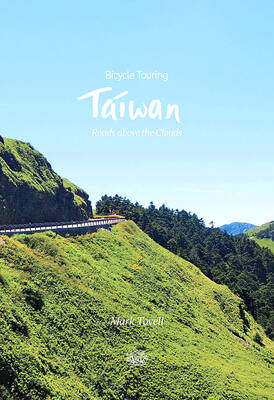
It’s hard to know where to begin with Mark Tovell’s Taiwan: Roads Above the Clouds. Having published a travelogue myself, as well as having contributed to several guidebooks, at first glance Tovell’s book appears to inhabit a middle ground — the kind of hard-to-sell nowheresville publishers detest. Leaf through the pages and you’ll find them suffuse with the purple prose best associated with travel literature: “When the sun is low on a warm, clear morning, and with the heat already rising, we stand at the riverside bike path leading south from Sanxia’s old cobble streets.” Hardly the stuff of your

Located down a sideroad in old Wanhua District (萬華區), Waley Art (水谷藝術) has an established reputation for curating some of the more provocative indie art exhibitions in Taipei. And this month is no exception. Beyond the innocuous facade of a shophouse, the full three stories of the gallery space (including the basement) have been taken over by photographs, installation videos and abstract images courtesy of two creatives who hail from the opposite ends of the earth, Taiwan’s Hsu Yi-ting (許懿婷) and Germany’s Benjamin Janzen. “In 2019, I had an art residency in Europe,” Hsu says. “I met Benjamin in the lobby


 RSS
RSS