


"Listen to this," Daniel Levitin said. "What is it?" He hit a button on his computer keyboard and out came a half-second clip of music. It was just two notes blasted on a raspy electric guitar, but I could immediately identify it: the opening lick to the Rolling Stones' Brown Sugar.
Then he played another, even shorter snippet: a single chord struck once on piano. Again I could instantly figure out what it was: the first note in Elton John's Benny and the Jets.
Levitin beamed. "You hear only one note, and you already know who it is," he said. "So what I want to know is: How we do this? Why are we so good at recognizing music?"
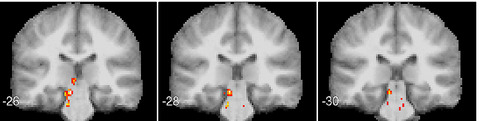
PHOTO: NY TIMES NEWS SERVICE
This is not merely some whoa-dude epiphany that a music fan might have while listening to a radio contest. Levitin has devoted his career to exploring this question. He is a cognitive psychologist who runs the Laboratory for Music Perception, Cognition and Expertise at McGill University in Montreal, perhaps the world's leading lab in probing why music has such an intense effect on us.
"By the age of 5 we are all musical experts, so this stuff is clearly wired really deeply into us," said Levitin, an eerily youthful-looking 49, surrounded by the pianos, guitars and enormous 16-track mixers that make his lab look more like a recording studio.
This summer he published This Is Your Brain on Music, a layperson's guide to the emerging neuroscience of music. Levitin is an unusually deft interpreter, full of striking scientific trivia. For example we learn that babies begin life with synesthesia, the trippy confusion that makes people experience sounds as smells or tastes as colors. Or that the cerebellum, a part of the brain that helps govern movement, is also wired to the ears and produces some of our emotional responses to music. His experiments have even suggested that watching a musician perform affects brain chemistry differently from listening to a recording.
Levitin is singular among music scientists for actually having come out of the music industry. Before getting his PhD he spent 15 years as a record producer, working with artists ranging from the Blue Oyster Cult to Chris Isaak. While still in graduate school he helped Stevie Wonder assemble a best-of collection; in 1992 Levitin's sensitive ears detected that MCA Records had accidentally used third-generation backup tapes to produce seven Steely Dan CDs, and he embarrassed the label by disclosing it in Billboard magazine. He has earned nine gold and platinum albums, which he tucks in corners of his lab, office and basement at home. "They look a little scary when you put them all in one place, so I spread them around," he said.
Martin Grant, the dean of science at McGill, compares Levitin's split professional personality to that of Brian Greene, the pioneering string-theory scientist who also writes mass-market books. "Some people are good popularizers, and some are good scientists, but not usually both at once," Grant said. "Dan's actually cutting edge in his field."
Scientifically, Levitin's colleagues credit him for focusing attention on how music affects our emotions, turf that wasn't often covered by previous generations of psychoacousticians, who studied narrower questions about how the brain perceives musical sounds. "The questions he asks are very very musical, very concerned with the fact that music is an art that we interact with, not just a bunch of noises," said Rita Aiello, an adjunct professor in the department of psychology at New York University.
Ultimately, scientists say, Levitin's work offers a new way to unlock the mysteries of the brain: how memory works, how people with autism think, why our ancestors first picked up instruments and began to play, tens of thousands of years ago.
Levitin originally became interested in producing in 1981, when his band — a punk outfit called the Mortals — went into the recording studio. None of the other members were interested in the process, so he made all the decisions behind the board. "I actually became a producer because I saw the producers getting all the babes," he said. "They were stealing them from the guitarists." He dropped out of college to work with alternative bands.
Producers, he noted, were able to notice impossibly fine gradations of quality in music. Many could identify by ear the type of amplifiers and recording tape used on an album.
"So I started wondering: How was the brain able to do this?" Levitin said. "What's going on there, and why are some people better than others? And why is music such an emotional experience?" He began sitting in on neuroscience classes at Stanford University.
"Even back then, Dan was never satisfied with the simple answer," said Howie Klein, a former president of Reprise and Sire Records. "He was always poking and prodding."
By the 1990s Levitin was disenchanted with the music industry. "When they're dropping Van Morrison and Elvis Costello because they don't sell enough records," he said, "I knew it was time to move on." Academic friends persuaded him to pursue a science degree. They bet that he would have good intuitions on how to design music experiments.
They were right. Traditionally music psychologists relied on "simple melodies they'd written themselves," Levitin said. What could that tell anyone about the true impact of powerful music?
For his first experiment he came up with an elegant concept: He stopped people on the street and asked them to sing, entirely from memory, one of their favorite hit songs. The results were astonishingly accurate. Most people could hit the tempo of the original song within a 4-percent margin of error, and two-thirds sang within a semitone of the original pitch, a level of accuracy that wouldn't embarrass a pro.
"When you played the recording of them singing alongside the actual recording of the original song, it sounded like they were singing along," Levitin said.
It was a remarkable feat. Most memories degrade and distort with time; why would pop music memories be so sharply encoded? Perhaps because music triggers the reward centers in our brains. In a study published last year Levitin and group of neuroscientists mapped out precisely how.
Observing 13 subjects who listened to classical music while in an MRI machine, the scientists found a cascade of brain-chemical activity. First the music triggered the forebrain, as it analyzed the structure and meaning of the tune. Then the nucleus accumbus and ventral tegmental area activated to release dopamine, a chemical that triggers the brain's sense of reward.
The cerebellum, an area normally associated with physical movement, reacted too, responding to what Levitin suspected was the brain's predictions of where the song was going to go. As the brain internalizes the tempo, rhythm and emotional peaks of a song, the cerebellum begins reacting every time the song produces tension (that is, subtle deviations from its normal melody or tempo).
"When we saw all this activity going on precisely in sync, in this order, we knew we had the smoking gun," he said. "We've always known that music is good for improving your mood. But this showed precisely how it happens."
The subtlest reason that pop music is so flavorful to our brains is that it relies so strongly on timbre. Timbre is a peculiar blend of tones in any sound; it is why a tuba sounds so different from a flute even when they are playing the same melody in the same key. Popular performers or groups, Levitin argued, are pleasing not because of any particular virtuosity, but because they create an overall timbre that remains consistent from song to song. That quality explains why, for example, I could identify even a single note of Elton John's Benny and the Jets.
"Nobody else's piano sounds quite like that," he said, referring to John. "Pop musicians compose with timbre. Pitch and harmony are becoming less important."
Levitin's work has occasionally undermined some cherished beliefs about music. For example recent years have seen an explosion of Baby Mozart videos and toys, based on the idea — popular since the 1980s — that musical and mathematical ability are inherently linked.
But Levitin argued that this could not be true, based on his study of people with Williams syndrome, a genetic disorder that leaves people with low intelligence. Their peak mental capacities are typically those of young child, with no ability to calculate quantities. Levitin once asked a woman with Williams to hold up her hand for five seconds; she left it in the air for a minute and a half. "No concept of time at all," he said, "and definitely no math."
Yet people with Williams possess unusually high levels of musical ability. One Williams boy Levitin met was so poorly coordinated he could not open the case to his clarinet. But once he was holding the instrument, his coordination problems vanished, and he could play fluidly. Music cannot be indispensably correlated with math, Levitin noted, if Williams people can play music. He is now working on a study that compares autistics — some of whom have excellent mathematical ability, but little musical ability — to people with Williams; in the long run, he said, he thinks it could help shed light on why autistic brains develop so differently.
Not all of Levitin's ideas have been easily accepted. He argues, for example, that music is an evolutionary adaptation: something that men developed as a way to demonstrate reproductive fitness. (Before you laugh, consider the sex lives of today's male rock stars.) Music also helped social groups cohere. "Music has got to be useful for survival, or we would have gotten rid of it years ago," he said.

In late October of 1873 the government of Japan decided against sending a military expedition to Korea to force that nation to open trade relations. Across the government supporters of the expedition resigned immediately. The spectacle of revolt by disaffected samurai began to loom over Japanese politics. In January of 1874 disaffected samurai attacked a senior minister in Tokyo. A month later, a group of pro-Korea expedition and anti-foreign elements from Saga prefecture in Kyushu revolted, driven in part by high food prices stemming from poor harvests. Their leader, according to Edward Drea’s classic Japan’s Imperial Army, was a samurai

The following three paragraphs are just some of what the local Chinese-language press is reporting on breathlessly and following every twist and turn with the eagerness of a soap opera fan. For many English-language readers, it probably comes across as incomprehensibly opaque, so bear with me briefly dear reader: To the surprise of many, former pop singer and Democratic Progressive Party (DPP) ex-lawmaker Yu Tien (余天) of the Taiwan Normal Country Promotion Association (TNCPA) at the last minute dropped out of the running for committee chair of the DPP’s New Taipei City chapter, paving the way for DPP legislator Su

It’s hard to know where to begin with Mark Tovell’s Taiwan: Roads Above the Clouds. Having published a travelogue myself, as well as having contributed to several guidebooks, at first glance Tovell’s book appears to inhabit a middle ground — the kind of hard-to-sell nowheresville publishers detest. Leaf through the pages and you’ll find them suffuse with the purple prose best associated with travel literature: “When the sun is low on a warm, clear morning, and with the heat already rising, we stand at the riverside bike path leading south from Sanxia’s old cobble streets.” Hardly the stuff of your

Located down a sideroad in old Wanhua District (萬華區), Waley Art (水谷藝術) has an established reputation for curating some of the more provocative indie art exhibitions in Taipei. And this month is no exception. Beyond the innocuous facade of a shophouse, the full three stories of the gallery space (including the basement) have been taken over by photographs, installation videos and abstract images courtesy of two creatives who hail from the opposite ends of the earth, Taiwan’s Hsu Yi-ting (許懿婷) and Germany’s Benjamin Janzen. “In 2019, I had an art residency in Europe,” Hsu says. “I met Benjamin in the lobby


 RSS
RSS