


Myanmar has the dubious distinction of playing host to the world's longest-running civil war — it began with independence in 1948 and still goes on — and its most durable military dictatorship. If not for North Korea, Burma might also claim top honors in two other categories — most isolated and most xenophobic — but it could still win the prize for most misunderstood.
Geographically remote, politically retrograde, economically backward, Burma, today called Myanmar, struggles on, burdened by one of the largest armies on the planet and desperate for help. In The River of Lost Footstep, Thant Myint-U offers at least a little understanding, "an introduction to a country whose current problems are increasingly known but whose colorful and vibrant history is almost entirely forgotten."
Thant looks at Myanmar from an unusual vantage point. His maternal grandfather, U Thant, who served as secretary-general of the UN in the 1960s, belonged to the first generation of Burmese nationalists who assumed control of the government after the British left in 1948.
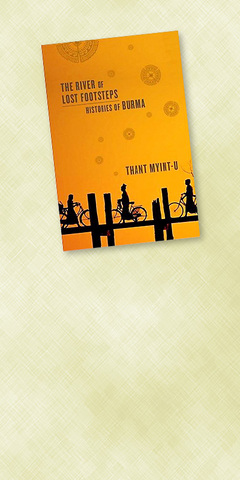
Throughout the author's childhood, spent in New York, notable figures from the Burmese anti-colonial movement and the military government of General Ne Win paid visits to the family residence. The River of Lost Footsteps is therefore, in its later chapters, a kind of family history, made even more personal in the years after 1988, when the author became involved in the fledgling Burmese democracy movement
Part history, part memoir, part polemic, with a little travelogue thrown in, The River of Lost Footsteps begins at the beginning of all the troubles: the overthrow of the last royal dynasty in 1885, and the absorption of Burma into British-ruled India. Typically, Burma never even counted as a principal actor in the unfolding dream of empire. It was a sideshow, an afterthought, destined by geography to be a footnote to India or China.
Myanmar's junior status would be a recurrent theme to the present day. "To the extent that it was thought about at all, it had the image of an exotic and dreamy backwater, a gentle Buddhist country, lost in time and quietly isolated, hardly the sort of location for a foreign policy crisis," Thant writes. He refers to the international response to the democracy movement of 1988, but the quotation could be applied to Burmese events at any time over the last several centuries.
The Burmese, of course, have always seen things differently. Thant, after setting the stage for the takeover by the British, tries to put the Burmese point of view back into the picture by retelling their history, in the hope that it might explain their present predicament. Thant, who wrote his doctoral dissertation at Cambridge on 19th-century Burmese history, does not tell the back story well.
His narrative is choppy and often hard to follow. It feels dutiful, and never really regains momentum until the British re-enter, but several important points do come across. The Burmese, who conquered all of present-day Laos and Thailand in the 16th century, regarded themselves as a great conquering race and their military as a source of national pride.
It was Burmese military hubris that led to the first war between Burma and Britain, from 1824 to 1826, a disaster for the Burmese. National pride made the Raj period doubly humiliating. It was bad enough to endure the slights and the snubs, especially for the educated class that revered British culture and the British political system, but to be nothing more than a minor Indian province was truly upsetting.
U Thant, first Burmese member of the Left Book Club, fervent admirer of the Labor politician Stafford Cripps, makes an ideal symbol for his grandson's sensitive reading of the Raj period. An elite that might have furthered British aims was systematically alienated and insulted.
The British, generalizing from their experience with the Gurkhas of Nepal, recruited their army from the mountainous tribal regions. The Burmese, mighty warriors in their own mind, were dismissed as insufficiently martial — childlike and lazy in fact. "It was a policy choice that rankled deeply in the Burmese imagination, eating away at their sense of pride and turning the idea of a Burmese army into a central element of the nationalist dream," Thant writes.
The closer he draws to the present, the more spirited Thant becomes. He has an understated, British sense of humor (Ne Win is introduced as "playboy, tyrant, numerologist and onetime post office clerk") and a subversive attraction to strange details that might not necessarily advance his story but most certainly ornament it.
He gives the ingredients for the house cocktail served at the Pegu Club in Rangoon, and notes that Rudyard Kipling never got anywhere near Mandalay. One would love to hear more about the mysterious, if irrelevant, Olive Yang, described by Thant as a "bisexual warlady" who developed a tough reputation while still at convent school, where she was rumored to carry a revolver in her handbag. Thant needs to release his inner Paul Theroux more often.
Burmese independence came, of course, as an afterthought to India's -- yet another insult dealt by history. Almost nothing has gone right since. Civil war, the military takeover of the government and a ruinous attempt to create a unique brand of Burmese socialism have brought Burma to its knees.
Thant eloquently and mournfully recites the dismal history of the last half century and, in analyzing the country's nascent democracy movement, holds out only the slimmest of hopes for a better future. It will not come through economic and diplomatic sanctions, of that he is convinced. Trade and more engagement, especially more tourism, might let in badly needed light and air. But trying to topple the regime by isolating it would, he argues, be disastrous.
"Much more than any part of Burmese society," he writes, "the army will weather another 40 years of isolation just fine."

In late October of 1873 the government of Japan decided against sending a military expedition to Korea to force that nation to open trade relations. Across the government supporters of the expedition resigned immediately. The spectacle of revolt by disaffected samurai began to loom over Japanese politics. In January of 1874 disaffected samurai attacked a senior minister in Tokyo. A month later, a group of pro-Korea expedition and anti-foreign elements from Saga prefecture in Kyushu revolted, driven in part by high food prices stemming from poor harvests. Their leader, according to Edward Drea’s classic Japan’s Imperial Army, was a samurai

The following three paragraphs are just some of what the local Chinese-language press is reporting on breathlessly and following every twist and turn with the eagerness of a soap opera fan. For many English-language readers, it probably comes across as incomprehensibly opaque, so bear with me briefly dear reader: To the surprise of many, former pop singer and Democratic Progressive Party (DPP) ex-lawmaker Yu Tien (余天) of the Taiwan Normal Country Promotion Association (TNCPA) at the last minute dropped out of the running for committee chair of the DPP’s New Taipei City chapter, paving the way for DPP legislator Su
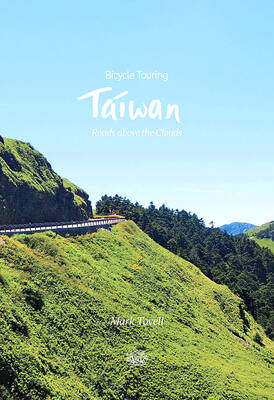
It’s hard to know where to begin with Mark Tovell’s Taiwan: Roads Above the Clouds. Having published a travelogue myself, as well as having contributed to several guidebooks, at first glance Tovell’s book appears to inhabit a middle ground — the kind of hard-to-sell nowheresville publishers detest. Leaf through the pages and you’ll find them suffuse with the purple prose best associated with travel literature: “When the sun is low on a warm, clear morning, and with the heat already rising, we stand at the riverside bike path leading south from Sanxia’s old cobble streets.” Hardly the stuff of your

Located down a sideroad in old Wanhua District (萬華區), Waley Art (水谷藝術) has an established reputation for curating some of the more provocative indie art exhibitions in Taipei. And this month is no exception. Beyond the innocuous facade of a shophouse, the full three stories of the gallery space (including the basement) have been taken over by photographs, installation videos and abstract images courtesy of two creatives who hail from the opposite ends of the earth, Taiwan’s Hsu Yi-ting (許懿婷) and Germany’s Benjamin Janzen. “In 2019, I had an art residency in Europe,” Hsu says. “I met Benjamin in the lobby


 RSS
RSS