


"So much of the world is advertising, and because of that, individuals feel that they have to present themselves as a package." It is one of the most-quoted things Jeff Koons has said.
Fresh off the plane from New York (and back on it again in under 12 hours), he had clearly given some thought to his self-presentation for an eight-hour stretch that was going to take in a picture session, interview, a private view of his latest work at the most bijoux of the American dealer Larry Gagosian's several spaces in London, a public grilling at the Serpentine Gallery, followed by a dinner at which he would be expected to, if not scintillate, at least give value to the assembled collectors and museum people in an impenetrable, Warholian, Sphinx-like manner. One of the great showman self-promoters of the past 20 years, the bridge between Andy Warhol and Damien Hirst, Koons is aware that, in a world geared to the shock of the new, spooky ordinariness — wife, children, a gee-whizz love of life and the everyday vulgar and unexceptional — can command garrulous attention.
The persona Koons had chosen to come packaged in was, like the work that has made him one of America's most influential living artists, fugitive and particularly difficult to read. The neat business suit, the clubman's tie and the salt-and-pepper brush-cut hair suggested both the head buyer in the men's apparel department at Bloomingdale's and a retired astronaut still out of joint with life on Earth.
PHOTOS: NY TIMES NEWS SERVICE
"I believe in advertisement and media completely," Koons has said. "My art and personal life are based on it." In an interview many years ago he described his idea of pleasure: dining with a group of friends, he recalled, he was moved to propose a toast. How lucky he was, he announced, to be in a beautiful place, surrounded by people he liked. As he stood there, he remembered, in a state of bliss, it was like being in an advertisement.
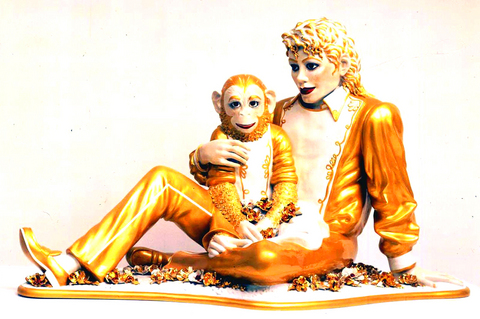
Koons had already brought ad campaigns — for alcohol and Nike trainers — into his work, and with his factory-fresh vacuum cleaners in neon-lit Perspex cases, and luxury objects switched straight from showroom to gallery, he seemed to equate artworks with commodities directly. Some critics interpreted his work as a critique of consumer-capitalism: he had returned the Duchamp-inspired readymade to its status as a product. For others, such as Benjamin Buchloh, Koons was "only pretending to engage in a critical annihilation of mass-cultural fetishization." In reality, he was acting out what Walter Benjamin had predicted for capitalist society: the cultural need to compensate for the lost aura of art and artist with "the phony spell" of the commodity and the star. By 1992, after marrying the Hungarian-born Italian ex-porn star Ilona Staller (known as La Cicciolina), he had achieved the kind of crossover celebrity only previously experienced by the artist with whom he has most in common, Warhol.
Show Koons a camera and an audience, and he effortlessly snaps into "Jeff Koons" mode. He is disarming, shy, eloquent, charming, intriguingly wacko — preternaturally knowing, yet awkward and alarmingly innocent; the whole package. Produce a notebook, however, and ask him about his work in a conventional interview situation, and something within him freezes, a light clicks off.
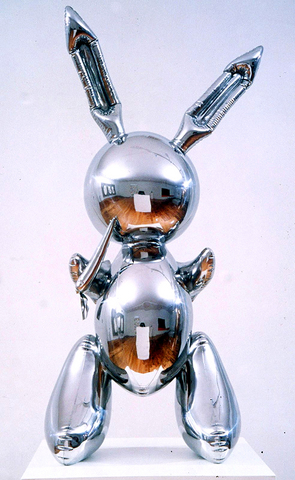
The Gagosian Gallery in London's Mayfair is a tiny space, no deeper than a department-store window. From the street, Koons's newest piece, Cracked Egg (Blue), looked like the beginning of an up-market window display that would be completed with bewigged mannequin models later. The sculpture is made of high chromium stainless steel that has been engineered to standards no less precise, and to a finish even more reflectively immaculate, than on the cars in the Porsche showroom a few doors away. The new work is in two parts — a 1.8m-tall, mirror-laminated egg and its jagged "lid" — and is a continuation of the Celebration series that Koons began in the mid-1990s. Previous works in the series include kitschy inflated Valentine hearts and fake satin ribbons and bows, as well as Koons' signature sculpture, the balloon dog — "like a balloon that a clown would maybe twist for you at a birthday party."
It has been claimed that the works in Celebration "conjure up a positive fundamental view not unlike the boundless trust with which a child looks at the world." As a boy in the provincial backwater of York, Pennsylvania, where his father was an interior decorator, Koons, who went on to be a Wall Street broker, earned pocket money by selling gift wrappings and chocolates door-to-door. "I'd present the product, and people would buy it, and it was nice," he once told David Sylvester. "I felt it was a way of meeting people's needs. So I was always good in sales."
Cracked Egg is the only work in the Celebration series in which fracture or assault of the shiny, happy surface has taken place. Koons is on record as saying that he never consciously sits down to try to create a work that is optimistic but has a dark side. He wants his work to be "a support system for people to feel good about themselves, to have their life be as enriching as possible, to make them feel secure — I don't tend to be pulled towards the idea of making a menacing work." But Cracked Egg, in its shatteredness and sharp edges, seems to cry out for a reading that invokes the spirit of post-Sept. 11 America, specifically the sense of violation evident even now in New York, the city where Koons lives and works.

"It's interesting," he says. "They're all about holidays — the hanging heart Valentines, Thanksgiving, maybe even Christmas. The egg is about Easter, birth and rebirth, in art-historical terms the Botticelli Venus. But with the egg there's a sense of loss. There was an abduction. My son was abducted. By my wife. I'm supposed to be able to see him, but I'm not able to. It's complicated. We're supposed to be able to talk, but we can't. I started the Celebration works right before Ludwig was abducted. I continued with them because I wanted to let my son know I was thinking about him. He's 14 now. When he turns 18 I hope the first thing he'd want to do is get on a plane."
Ludwig was born in 1992, the year after Koons married Staller. In addition to a son, their collaboration produced Made in Heaven, a collection of sexually explicit photographs and kitschy sculptures of Koons and Staller that marries the pornographic (Dirty — Jeff on Top, Blow Job) to the teeth-rottingly banal (Cherubs, Three Puppies). The photographs haven't lost their power to shock. There was a frisson even among the predominantly young, laidback Serpentine audience when the painting Ilona's Asshole flashed up on multiple video monitors. This was followed by disbelieving glances when Koons confided that "what I love about the picture are the pimples on Ilona's ass. That openness, generosity, the sense of self-acceptance." He later told me that the works in Made in Heaven were inspired by Masaccio's The Expulsion — "the guilt and shame on Adam and Eve's faces in the painting. I wanted to make work that showed what it was like to be tranquil and not feel shame about the body. Whatever anybody's history is, it's perfect. It can't be any different. I would tie this to nature."
Koons' interlocutors in Rem Koolhaas's semi-inflated pavilion in front of the Serpentine Gallery were Koolhaas himself and the gallery's co-curator, Hans Ulrich Obrist. The two European intellectuals took it in turns to try to penetrate beyond his very American resolve to be "really friendly, and really positive and optimistic." The American pop artists were not much interested in ideas. Pop art was about "liking things," as Warhol once said. Koons, who says his art is "about aspects of entertainment" and believes that "salespeople are on the front line of culture," is the true inheritor of that tradition. "You know, Hans Ulrich," he would begin, smiling sweetly, gently refusing a question on the Baudrillardian reading of the commodity-as-sign. Or: "Well, Rem, the answer to that is quite simple: the money didn't come." I was repeatedly reminded of something he once told Sylvester: "My painting is really, for me, about my background. I was trying to show that I come from a provincial background. Eventually, over a period of time, the provincial always wins."
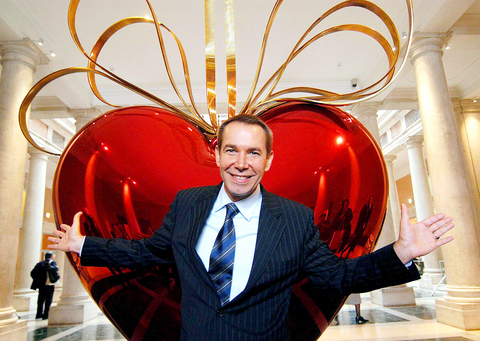
PHOTO: EPA
Koons' father had a furniture showroom, which one day would be a living room, and a week later a kitchen. "The fact that Jeff grew up around commercialism and marketing, and the fact that a kitchen wasn't really a kitchen — wasn't really anything — resonates with the hollowness we have today," his friend Tom Ford, the former creative director of Gucci, has said.
Koons has remarried. He spends time with his wife and their three children on the farm that used to belong to his grandfather in the countryside close to where he grew up in Pennsylvania. John Updike's family farm, the setting for many of his novels, is also in Pennsylvania, at Shillington. Is Koons' farm anywhere nearby? This draws a blank. "I don't read books," Koons says. "I only see magazines and newspapers. Images. The flood of images. I enjoy narrative through the visual. The great thing about art is that it brings all the disciplines of the world together — literature, philosophy, psychology, science. But, you know, I only really like to be in the studio with the people I regard as my extended family, my assistants. You try very much to be in the moment, looking at everything in the world all the time, putting it into play."
Dennis Potter wrote for television, the great indiscriminate disseminator of the visual, so I try a Potter quote on him: "Capitalism now is about selling all of you to all of you. But they don't know what it is they're selling. The only object is to keep in the game. Which is to keep selling something. And one day we're going to find out what it is."
"I'm not interested in capitalism at all," says Koons. "I'm not interested in objects ... I'm interested in people."

In late October of 1873 the government of Japan decided against sending a military expedition to Korea to force that nation to open trade relations. Across the government supporters of the expedition resigned immediately. The spectacle of revolt by disaffected samurai began to loom over Japanese politics. In January of 1874 disaffected samurai attacked a senior minister in Tokyo. A month later, a group of pro-Korea expedition and anti-foreign elements from Saga prefecture in Kyushu revolted, driven in part by high food prices stemming from poor harvests. Their leader, according to Edward Drea’s classic Japan’s Imperial Army, was a samurai

The following three paragraphs are just some of what the local Chinese-language press is reporting on breathlessly and following every twist and turn with the eagerness of a soap opera fan. For many English-language readers, it probably comes across as incomprehensibly opaque, so bear with me briefly dear reader: To the surprise of many, former pop singer and Democratic Progressive Party (DPP) ex-lawmaker Yu Tien (余天) of the Taiwan Normal Country Promotion Association (TNCPA) at the last minute dropped out of the running for committee chair of the DPP’s New Taipei City chapter, paving the way for DPP legislator Su
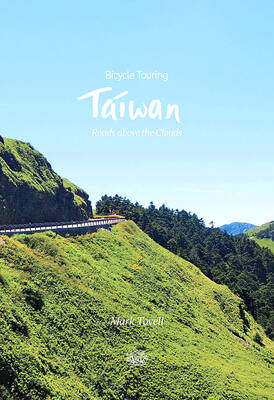
It’s hard to know where to begin with Mark Tovell’s Taiwan: Roads Above the Clouds. Having published a travelogue myself, as well as having contributed to several guidebooks, at first glance Tovell’s book appears to inhabit a middle ground — the kind of hard-to-sell nowheresville publishers detest. Leaf through the pages and you’ll find them suffuse with the purple prose best associated with travel literature: “When the sun is low on a warm, clear morning, and with the heat already rising, we stand at the riverside bike path leading south from Sanxia’s old cobble streets.” Hardly the stuff of your

Located down a sideroad in old Wanhua District (萬華區), Waley Art (水谷藝術) has an established reputation for curating some of the more provocative indie art exhibitions in Taipei. And this month is no exception. Beyond the innocuous facade of a shophouse, the full three stories of the gallery space (including the basement) have been taken over by photographs, installation videos and abstract images courtesy of two creatives who hail from the opposite ends of the earth, Taiwan’s Hsu Yi-ting (許懿婷) and Germany’s Benjamin Janzen. “In 2019, I had an art residency in Europe,” Hsu says. “I met Benjamin in the lobby


 RSS
RSS