


To drive in Britain is to measure out your trip in speed cameras. As inevitable as road signs and as implacable as the meanest state trooper, they lurk everywhere, the government's main weapon against impatient drivers.
It is a shame that so many people hate them.
Among the ways that motorists have made this clear: spraying the cameras with paint; knocking them over; covering them in festive wrapping paper and garbage bags; digging them up; shooting, hammering and firebombing them; festooning them with burning tires; and filling their casings with self-expanding insulation foam that, when activated, blows them apart from the inside out.
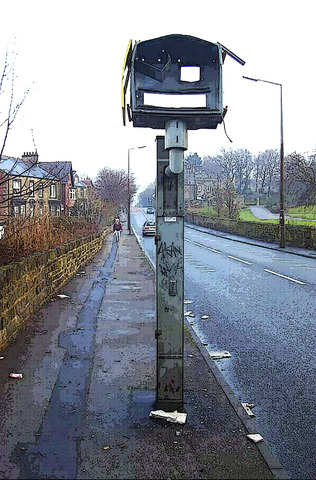
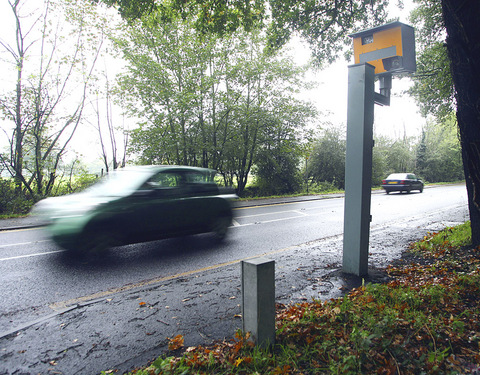
PHOTOS: NY TIMES NEWS SERVICE
Visual examples can be seen on the Web site of a vigilante group called Motorists Against Detection, which displays color photographs of smashed, defaced and burned-out cameras — pornography for the anti-camera movement.
In a nation that is estimated to have some 4 million surveillance cameras — more per capita than any other in the world, civil liberties groups say — there are currently as many as 6,000 spots for speed cameras, annoying drivers in the country and in the city, on highways, urban arteries, service roads, suburban streets and rural lanes.
“Speed cameras can't detect tail-gating, bad driving, drink driving or drug driving,” said a spokesman for the group, explaining his objections. An occasional contributor to British radio debates about traffic regulations, he uses the name Captain Gatso — after the most common form of speed camera — because, he says, he wants to avoid arrest.
The government does not keep figures on camera vandalism, so it is impossible to confirm Captain Gatso's claim that the group, known more commonly as MAD, has attacked more than 1,000 cameras, or that its members are “grown-up people, with normal jobs, who are cheesed off,” rather than hooligans engaging in “willy-nilly childish vandalism.”
But if there is a battle between motorists and speed cameras, the cameras are surely winning.
The government says the cameras have been a resounding success, reducing speed by an average of 3.5kph at speed-camera sites, reducing the numbers of people speeding at the sites by 31 percent and reducing by 42 percent the number of people killed or seriously injured at the sites. In public opinion surveys, they point out, a majority of Britons say they support having cameras on the roads. But theory is one thing; practice is another. People like to drive fast, and bridle at being told what to do. About 2 million are caught by the speed cameras a year, generating more than US$200 million in fines.
“It's incredibly difficult to get people to come to terms with slowing down here,” said Francis Ashton, the road safety manager for the city of Nottingham. “In the States, you have much slower speed limits and there's more of a culture of sticking to the speed limit.”
The cameras detect cars that are exceeding the speed limit, often with radar technology, and take flash photographs of the license plates; a ticket is then issued. A speeding offense adds three points to a driver's license. Because drivers who amass 12 points in three years are punished with six-month driving bans, people go to enormous lengths to avoid detection.
In a recent case, 28-year-old Craig Moore, an engineer from South Yorkshire, ran into trouble when, in the words of a spokesman for the Greater Manchester Police, “instead of just accepting that he had been caught traveling above the speed limit, Moore decided to blow the camera apart.”
Using something called thermite, a pyrotechnic substance often used in underwater welding, Moore succeeded in wrecking the camera, but unfortunately for him, its hard drive survived — along with videotape of his van driving toward it and then driving away, as the picture dissolved in a cloud of fiery sparks. He was sentenced to four months in jail.
In another instance, John Hopwood, a motorist from Stockport who was caught speeding twice in one trip by two different cameras, saw the camera flashes, then tried to avert the second ticket by taking a 64kph sign from a road in Manchester and reinstalling it on a lamppost on a 48kph road in Rochdale, 16km away. He was caught and sentenced to 56 days in jail.
Even if they agree that speed limits are necessary, many motorists resent having to obey them all the time. They say they hate being constantly on the lookout for cameras and accuse the government of treating them like roadside cash machines. “It's just a road tax,” said Ian Murray, a sales clerk at an army-navy surplus store in Kelvedon Hatch. He understands the need for cameras in residential areas, he said, but feels aggrieved when he sees them on the highway, where the national speed limit is 113kph, but where the fast lane generally clips along at 128kph or higher.
“What happens is you see the speed camera, and you put on your anchor and drop your speed, and then when you get past it you speed up again,” Murray said. Also, he said, the cameras cause people to brake suddenly, endangering themselves and the people behind them.
Paul Smith, head of an anti-camera group called the Safe Speed Road Safety Campaign, said that drivers spend so much time scouring the roadside for cameras that they forget to pay attention to the road.
“We've got a nation of people who have one eye looking out for the next speed camera, another looking for a speed limit sign and another looking at the speedometer — which is a bit of a shame, when you only have two eyes,” he said.
Camera technology has moved on considerably since the 1990s, when the first speed cameras were installed in Britain. Now, in addition to the standard cameras that photograph the speeding cars' license plates, there are cameras that can accurately photograph drivers' faces — so that they cannot claim someone else was driving at the time the speeding took place — and cameras that work in teams, calculating average speeds along a stretch of road.
Of course, for every ingenious new camera, there is an ingenious new camera-thwarting device. These include constantly updating global positioning system equipment that alerts drivers to speed camera locations and a special material that, when sprayed on a license plate, is said to make it impervious to flash photographs.
There are also the low-tech methods of covering a license plate with mud and altering its letters with black electrical tape.
But in the end, the effort is not worth it, said Vincent Yearley, a spokesman for the Institute of Advanced Motorists, a road-safety organization.
“A lot of drivers feel alienated by speed cameras,” Yearley said. “But the best way to deal with a speed camera is simply to comply with the law, and not to set fire to it.”

In late October of 1873 the government of Japan decided against sending a military expedition to Korea to force that nation to open trade relations. Across the government supporters of the expedition resigned immediately. The spectacle of revolt by disaffected samurai began to loom over Japanese politics. In January of 1874 disaffected samurai attacked a senior minister in Tokyo. A month later, a group of pro-Korea expedition and anti-foreign elements from Saga prefecture in Kyushu revolted, driven in part by high food prices stemming from poor harvests. Their leader, according to Edward Drea’s classic Japan’s Imperial Army, was a samurai

The following three paragraphs are just some of what the local Chinese-language press is reporting on breathlessly and following every twist and turn with the eagerness of a soap opera fan. For many English-language readers, it probably comes across as incomprehensibly opaque, so bear with me briefly dear reader: To the surprise of many, former pop singer and Democratic Progressive Party (DPP) ex-lawmaker Yu Tien (余天) of the Taiwan Normal Country Promotion Association (TNCPA) at the last minute dropped out of the running for committee chair of the DPP’s New Taipei City chapter, paving the way for DPP legislator Su

It’s hard to know where to begin with Mark Tovell’s Taiwan: Roads Above the Clouds. Having published a travelogue myself, as well as having contributed to several guidebooks, at first glance Tovell’s book appears to inhabit a middle ground — the kind of hard-to-sell nowheresville publishers detest. Leaf through the pages and you’ll find them suffuse with the purple prose best associated with travel literature: “When the sun is low on a warm, clear morning, and with the heat already rising, we stand at the riverside bike path leading south from Sanxia’s old cobble streets.” Hardly the stuff of your

Located down a sideroad in old Wanhua District (萬華區), Waley Art (水谷藝術) has an established reputation for curating some of the more provocative indie art exhibitions in Taipei. And this month is no exception. Beyond the innocuous facade of a shophouse, the full three stories of the gallery space (including the basement) have been taken over by photographs, installation videos and abstract images courtesy of two creatives who hail from the opposite ends of the earth, Taiwan’s Hsu Yi-ting (許懿婷) and Germany’s Benjamin Janzen. “In 2019, I had an art residency in Europe,” Hsu says. “I met Benjamin in the lobby


 RSS
RSS