


Inaugurated with the aim of becoming a platform for new Asian talent, the Asian Network of Documentary (AND) was initiated this year by a group of professionals from Pusan International Film Festival in South Korea, Yamagata International Documentary Film Festival in Japan, Bangkok International Film Festival in Thailand and Taiwan International Documentary Festival (TIDF, 台灣國際紀錄片雙年展).
“Following the model of the Pusan Promotion Plan (PPP), AND attempts to provide comprehensive support to documentary filmmakers through funding and technical and marketing advice,” said Jane Yu (游惠貞), TIDF's director.
Without a doubt, Taiwan's documentary film industry has come a long way since the mid-1980s, and is now an active member of the international market.

PHOTOS COURTESY OF TIDF
Before the lifting of martial law in 1987, newsreels, public service and propaganda films constituted documentary films. Undercurrents of local voices had been present in works made by members of the intelligentsia from the Theater (劇場) magazine in 1960s and the Fragrant Formosa series (芬芳寶島) that focused on Taiwan's folk customs and landscapes in the 1970s, according to Lin Jui-yu (林睿育), one of the creators of A Retrospective Collection of Documentary Films From Taiwan With Films From the Early 1930s to Today (台灣當代影像-從紀實到實驗), a collection of films and accompanying discourses which examine the history of local non-fiction cinema.
The emergence of the Green Squad (綠色小組) in the mid-1980s was a landmark in Taiwan's documentary cinema. Rebelling against the oppressive state machine and encouraged by the availability of affordable and easy-to-operate equipment, the group epitomized a new generation of filmmakers eager to record street protests unleashed by the loosening of political controls.
Meanwhile, thriving filmmakers' groups — such as the Full Shot Foundation (全景傳播基金會), a documentary filmmaker workshop established in 1988 and Multidimensional Workshop (多面向藝術工作室) founded by scholar and respected filmmaker Lee Daw-ming (李道明) in 1989 — shone the spotlight on social issues such as environmental problems and the emerging Aboriginal movements.

In the 1990s, the Integrated Community Development Project (社區總體營造), initiated by the Council for Cultural Affairs (文建會), stimulated a new wave of social projects and called for the preservation of the country's disappearing cultural heritage. This changing social milieu also encompassed innovation in local documentary filmmaking.
“After the era of protest ended, cultural workers turned to communities for local cultural and historical surveys and unearthed a great amount … of documents that had been hitherto unknown. Historical and cultural perspectives thus became a trend in documentary works,” said Kuo Jen-ti (郭珍弟), a veteran female documentary filmmaker whose oeuvre covers various social issues.
In 1996, Tainan National University of the Arts (國立台南藝術大學), adhering to the left-wing tradition that sees the documentary genre as a tool for social critique, launched the Graduate Institute of Sound and Images Studies in Documentary. The establishment of Public Television Service (PTS) and TIDF soon followed in 1998.
Within five years, documentary films changed from education tools to works of entertainment aired on showcase channels. An era of diversification soon followed.
“Like many Third World countries, Taiwan's documentary cinema began with street protests ... but now documentary filmmakers no longer slash the system with axes and shout in front of a microphone,” said Yang Li-chou (楊力州), a veteran documentary filmmaker and chairman of the Taiwan Documentary Development Association (中華民國紀錄片發展協會).
More and more young filmmakers now see the genre as a medium of self-expression. Both Tainan National University of the Arts and View Point (紀錄觀點) [Taiwan's only permanent channel that provides financial and technical support and airing time to documentaries] help train this new breed of filmmakers.
Yet voices of dissent have arisen in recent years, wagging their fingers at academia for nurturing a clique of directors that makes self-indulgent works about themselves, their families and friends.
For Yang, the resources available to film directors determine the form and content of their work. The limitations of students' works are the inevitable result of training that requires students to produce films single-handedly.
Full Shot, led by Wu Yi-feng (吳乙峰), has been attacked by critics who say the works produced by the workshop set the standard for the documentary mainstream, and only focus on individuals struggling with everyday life.
“Such films are both documentary cinema's strength and weakness ... . Films appealing to the public's sentiments enjoy great popularity, but you can't just have one type of documentary,” Yu said.
But for Yang, Full Shot has pursued its founders' beliefs and has made an indelible contribution to Taiwan's documentary cinema.
“The workshop has a devoted great deal of time and effort in promoting documentary films in colleges and communities around the island over the last 10 years … . The public's acceptance of documentary films in the past couple of years is by no means a sudden phenomenon but a result of years of plowing and weeding,” Yang said.
The “sentimental” genre of documentary films that focuses on individual narratives found recent box-office success with films such as Jump! Boys (翻滾吧!男孩) and My Football Summer (奇蹟的夏天). Both movies focus on the stories of lovable protagonists told through a feature film-like narration. The warm reaction from audience members proves the strategy works.
“It is the same with the rest of the world. It's always the soft, warm, easy-to-digest productions that enjoy commercial success and that is why alternative avenues like PTS are vital the sustainable development of documentary cinema,” Yu said.
Though the future is bright, it is commonly agreed by film pundits that Taiwan's documentary cinema still has a long way to go before it can really make it to into the international mainstream.
“People now have different expectations for documentary films. Directors also have different designs for their works and adopt different work models to achieve their goals. We are looking at the irreversible trend towards diversification,” said director Kuo.

In late October of 1873 the government of Japan decided against sending a military expedition to Korea to force that nation to open trade relations. Across the government supporters of the expedition resigned immediately. The spectacle of revolt by disaffected samurai began to loom over Japanese politics. In January of 1874 disaffected samurai attacked a senior minister in Tokyo. A month later, a group of pro-Korea expedition and anti-foreign elements from Saga prefecture in Kyushu revolted, driven in part by high food prices stemming from poor harvests. Their leader, according to Edward Drea’s classic Japan’s Imperial Army, was a samurai

The following three paragraphs are just some of what the local Chinese-language press is reporting on breathlessly and following every twist and turn with the eagerness of a soap opera fan. For many English-language readers, it probably comes across as incomprehensibly opaque, so bear with me briefly dear reader: To the surprise of many, former pop singer and Democratic Progressive Party (DPP) ex-lawmaker Yu Tien (余天) of the Taiwan Normal Country Promotion Association (TNCPA) at the last minute dropped out of the running for committee chair of the DPP’s New Taipei City chapter, paving the way for DPP legislator Su
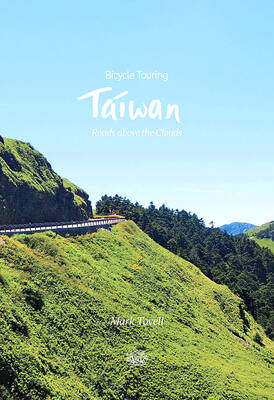
It’s hard to know where to begin with Mark Tovell’s Taiwan: Roads Above the Clouds. Having published a travelogue myself, as well as having contributed to several guidebooks, at first glance Tovell’s book appears to inhabit a middle ground — the kind of hard-to-sell nowheresville publishers detest. Leaf through the pages and you’ll find them suffuse with the purple prose best associated with travel literature: “When the sun is low on a warm, clear morning, and with the heat already rising, we stand at the riverside bike path leading south from Sanxia’s old cobble streets.” Hardly the stuff of your
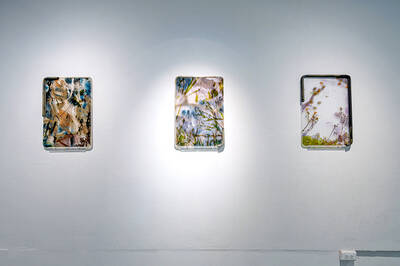
Located down a sideroad in old Wanhua District (萬華區), Waley Art (水谷藝術) has an established reputation for curating some of the more provocative indie art exhibitions in Taipei. And this month is no exception. Beyond the innocuous facade of a shophouse, the full three stories of the gallery space (including the basement) have been taken over by photographs, installation videos and abstract images courtesy of two creatives who hail from the opposite ends of the earth, Taiwan’s Hsu Yi-ting (許懿婷) and Germany’s Benjamin Janzen. “In 2019, I had an art residency in Europe,” Hsu says. “I met Benjamin in the lobby


 RSS
RSS