


As Dan Firger, a law student at New York University, strolls from class to class during the course of his day or pauses for a breather in Washington Square Park, his mobile phone is routinely buzzing inside his messenger bag. He can often guess who it is: Google.
Six to eight times a day, text messages pop up, courtesy of Google Calendar, a free daily organizer introduced this year. The program can scan appointments and send reminders of coming events.
Google is everywhere in Firger’s life. He scours the Web with its search engine; he chats with friends in Bolivia using Google Talk; and he receives e-mail messages on a Google Gmail account.

PHOTO: NY TIMES NEWS SERVICE
“I find myself getting sucked down the Google wormhole,” Firger said with equal parts resentment and admiration. “It’s all part of Google’s benign dictatorship of your life.”
It seems almost quaint to recall how people used to think Google was everywhere, back around 2003, when its search engine became a cultural phenomenon and a verb. Since then, in a push for global ubiquity, Google has introduced more than two dozen applications and tools. And last week it bought YouTube, the 18-month-old video-sharing site, one of the most habit-forming services on the Web.
While the company says it will keep the YouTube name and Web address, the acquisition gives Google’s regular users — 41 percent of those who search the Internet, according to Nielsen/NetRatings — one more reason to feel they are living on Planet Google.
Since the dawn of personal computing, software makers have sought to be not just providers of products, but universes unto themselves, into which users merge a piece of their identity. Consumers label themselves Macintosh people or derive a psychic sense of belonging from an e-mail address that places them at aol.com or yahoo.com.
Marketing experts consider a Web site an experience — different from using a product like a soft drink — because it’s someplace you go, an arena in which you live out your life. And in this way many people develop a sense of intimacy within it, even trust.
People may think they use Google because they like it, but really, “it’s the reverse,” said Rashi Glazer, a business professor at the University of California, Berkeley, and a director of its Center for Marketing and Technology. “You use something and in seeing yourself using it, you say to yourself, ‘Hey, I’m using it all the time, must be because I’m loyal to it.’ It becomes a virtuous circle.”
Donna Hoffman, a founder of eLab 2.0, a research center at the University of California, Riverside, that studies online consumer behavior, said that Google has, in the minds of many users, “become one with the Internet,” achieving a meta-status because as the most-used search engine, “it literally augments your brain. I don’t have to remember quite a few things now because Google can remember them for me. Google is an additional memory chip.”
Some people give their brains over to Google willingly, in part because they accept the anti-corporate credo of the company’s founders, Larry Page and Sergey Brin: Do no evil.
“I really think of them as the good guys’ response to the evil empire,” said Donald Hubin, a philosophy professor at Ohio State University, referring to Microsoft. Hubin said he uses one Google program or another hundreds of times a day: Gmail, Google Calendar, Google Earth, Picasa or Google Scholar, which allows academics to troll for books and peer-reviewed papers.
“Microsoft always seems to be trying to force you to do things their way, like when they released the version of Windows with Internet Explorer embedded, forcing you to use it,” Hubin said, explaining how he could develop a sense of intimacy with one Internet behemoth yet view another with distrust.
Like Apple, Google has lured the young and the early adopters by making the utilitarian — say, Gmail — seem hip. Part of the allure stems from the clean Euro-minimalist design of its applications. Part of it stems from the company’s reputation for innovation.
Google is “very leading edge, very young and very appealing to 20- and 30-year-olds,” said Russell Winer, a professor of marketing at the Stern School of Business at NYU. “If you walked around with a Google T-shirt, people would think that’s a hip thing to wear.”
Some Google disciples, mainly younger ones, are in denial that Google is a huge corporation, out to make money from them, said John Perry Barlow, a founder of the Electronic Frontier Foundation in San Francisco and a fellow at the Berkman Center for Internet and Society of Harvard Law School.
“They see a couple of basically OK young guys — and they still are, in my opinion — join forces with a truly decent older guy and resolve not to be ‘evil.”’ Barlow wrote by e-mail, referring to Brin, Page and Eric Schmidt, Google’s chief executive. “How cool is that? What they don’t understand is that once a company sells its soul to the stockholders — which it must at that point — good versus evil is no longer a practical consideration. Google has already crossed that Rubicon.”
Google has had its share of controversies. In January it rankled free-speech advocates by agreeing to censor its search service in China to gain a greater foothold there. While Google may seem ubiquitous thanks to its dominance of Internet searches — Yahoo is in second place — the company lags far behind in areas like e-mail and chat, partly because it is a recent entrant.
Still, few in Silicon Valley would discount Google’s potential to become a larger part of more people’s daily lives. While Yahoo was, according to figures released last month by comScore Media Metrix, the American market leader in users, with 129.7 million, the company grew only 5 percent in users over the previous year. But Google, now at 107.4 million, grew by 23 percent.
The expansion of Google’s reach into so many areas of people’s lives has some worried. Other than the US National Security Agency, said Kevin Bankston, a lawyer at the Electronic Frontier Foundation, “I don’t think any entity has ever been in a position to collect so much private data about people.
“This kind of profile-building, if it was being done by authorities in a Communist regime, people would immediately object.”
For its part, the company takes “the responsibility of holding our users’ data very seriously,” said an e-mail message from Courtney Hohne, a spokeswoman for Google, which is based in Mountain View, California. “We’re thinking about user privacy constantly, literally from the earliest stages of product design.”
In its fight for mind share — of the overall market and of the consciousness of users — Google seems poised to extend itself even further.
Many users seem committed to the company, even when they are skeptical of its reach. Firger, the law student, acknowledged feeling a “weird tension” about his love of Google’s products and his fear about its omnipresence in his life.
“I don’t know if I want all my personal information saved on this massive server in Mountain View, but it is so much of an improvement on how life was before, I can’t help it,” he said.
Toni Carreiro, a Web designer in San Rafael, California, and a self-described Google addict, said that the elegant simplicity of Google’s design is a blank slate upon which she can impose her own personality: It’s not there to sell you on anything, just to help you, while other sites, she said, are full of blinking ads and clutter.
“They have all this animation going,” she said. “I just want my stuff. That’s what Google gives you — ‘me.’”

Taiwan’s English education system is being pulled apart by three opposing forces. Bilingual Nation 2030 pulls students toward English and global communication. Artificial Intelligence (AI) readiness pulls them toward digital judgment, verification and AI-mediated work. But Taiwan’s old exam culture pulls them back toward memorization, grammar drills, timed reading and correct answers. If the education system keeps using old exams to define success, it risks producing graduates who are neither genuinely bilingual nor genuinely AI-ready, but trained for tasks machines can already perform. The first force is Bilingual Nation 2030. Launched in 2018, the policy aimed to “help Taiwan’s workforce connect

It seems every few days one bumps into one of those “real man” comments in which Taiwan is urged to “face reality” or similar, and “make a deal,” with the speaker implying that soon it will be too late. “Deal” advocates always present themselves as having a superior grip on reality, and the manly ability to make the “hard choice.” Their testosterone-laden language often echoes that of Taiwan sellout advocates. Note that such commentary always specifies a process (“make a deal, work with, make progress”), never the end state of what occupation by a violent authoritarian colonialist state will entail. In

“Taiwan’s Opposition Leader Comes to US With a Message Straight Out of Beijing” read a May 31 headline in the Wall Street Journal. Top US administration officials and members of Congress almost certainly read the WSJ, and if there was a bullet point takeaway that people in Washington should absorb ahead of Chinese Nationalist Party (KMT) Chair Cheng Li-wun’s (鄭麗文) arrival in DC on June 9, that headline is it. The last few columns have discussed this very topic, and the timing is not coincidental. While those top officials likely do not read the Taipei Times, judging by the number
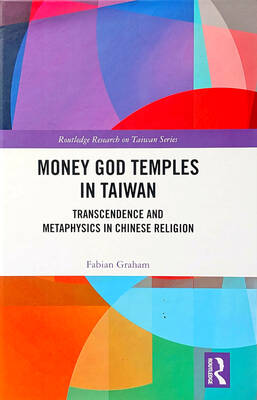
As someone who normally steers clear of books with “transcendence” or “metaphysics” in their subtitles, this reviewer — a casual observer of local belief systems since the 1990s — found Fabian Graham’s Money God Temples in Taiwan a challenging read. Those who’ve only dipped their toes into temple culture will likely need to parse several sections with special care if they’re to keep up with the author, a British ethnographic researcher whose previous books have investigated religious practices among ethnic Chinese in Southeast Asia. This scholarly volume examines a facet of Taiwan’s religious landscape that didn’t exist a century ago, and


 RSS
RSS