


"Where do you go after the Himalaya?" asked maestro Chien Wen-pin (簡文彬) at the party after Wagner’s four-part marathon. Mountain climbers would make the ascent again, perhaps from a different angle. This is hardly an option, though, for the no doubt exhausted and emotionally drained National Symphony Orchestra (NSO), not to mention the Taiwanese soloists, some of whom sang three or even four roles, all of them new, and all in a language they had rarely encountered before.
The first thing to say about the pioneering venture is that everyone involved considered it a major success. That they’d gone the course at all was part of it, but the audiences on all four nights greeted the concluding bars with wild applause, possibly also congratulating themselves on having endured so long. Adverse criticism was hard to come by. Pretty much everyone thought it had been a success for Taiwan, a milestone for the NSO, and a plume in the cap of Chien.
Even the three European critics and one musicologist who attended were united in feeling this had been a considerable achievement. Ulrich Ruhnke, editor of the German-language magazine for musicians Orchester, told me he thought the youthful NSO had achieved wonders, even if some minor highlights were overlooked.
This wasn’t an overwhelming, cataclysmic Ring cycle, but instead one marked by deference to an indisputable masterpiece, and endless attention to detail. Among the visiting soloists were some of the greatest Wagnerian voices currently working. Linda Watson’s Brunnhilde, everywhere supremely strong, was most remarkable last Friday night, in Act Three of Siegfried. You’re starved of women’s voices in Siegfried till then, with the exception of the Woodbird (nimbly sung by Lo Ming-fang, 羅明芳), so to hear Watson at her best from the first moment she opened her mouth, and from then on until the curtain fell, was extremely intoxicating. This was Wagnerian singing as it was envisaged by the composer when he constructed these titanic works, and the audience could hardly believe it was hearing it here in the Furthest East.
Equally majestic, though, was Hans-Peter Konig’s Hagen. He doesn’t appear until Gotterdammerung, but then the effect is overwhelming. Konig must have been compared to a bear too many times for comfort, but his voice was like the noblest of that species braying out and echoing among mountains on a cold winter morning. Many in the audience had never realized that a human being could sing quite like that. Konig was Brunnhilde’s truest male counterpart.
Robert Hale’s Wotan completed the trio of truly awesome singers. He has a long role, and his character is marvelously complex — the ruler riven with doubts, the faithless husband brought to heel by an insistent wife. But the Alberich of Franz-Josef Kapellmann could hardly have been bettered either. As for Wolfgang Neumann, Loge in Rheingold and Siegmund in Walkure, he to was very strong, especially in the first role. Alan Woodrow’s Siegfried wasn’t quite in the same class, but he certainly had his moments too. Taipei was extraordinarily lucky to have all six of them, and without them this Ring would have been impossible.
It was the local singers who surprised, however, with Chen Pei-chi (陳珮琪) the most astonishing. She has come an enormous way in the last four years. Her low contralto tones were ideally suited to Erda, but she showed she had dramatic power too as Fricke and Waltraute, and even as the First Norn. She was the most impressive of the local soloists of either sex.
Chen Mei-ling (陳美玲), too, was a major surprise, and wonderful as Sieglinde. We’d heard her in Rheingold as Freia, and she was to reappear in Gotterdammerung as Gutrune (as well as the Third Norn), but her Sieglinde was her masterpiece. She’s surely destined to sing a lot more Wagner now.
Of the men, Wu Bai Yu His (巫白玉璽) made a capable Gunther (he’d earlier been heard as Donner) and Liau Chong-boon (廖聰文) was very forceful as both Fafner and Hunding. As for Lin Chien-chi (林健吉), he was probably the most amiable Mime ever. Many people over the years have felt uneasy with Siegfried’s treatment of him, and this interpretation was this especially welcome.
The problem with this Ring, very memorable though it undoubtedly was, was that the foreign soloists, who had sung their parts countless times before and so knew them by heart, were able to move about, and act, in a way the local singers, forced to stay by their music-stands, were unable to do. This created an imbalance that wasn’t fair to the locals, who in one or two cases were nearly the equals of their distinguished visiting counterparts.
The production of Wang Jun-jieh (王俊傑) and Li Huan-hsiung (黎煥雄) was probably as good as could be managed in the circumstances — with the orchestra on stage there was little room for much else. Costumes would have added a lot, but in the space available scenery was scarcely possible. The projections that took its place were adequate, though raising laughs on a couple of occasions, probably when people recognized the images as those of their own domestic screen-savers.
As for the NSO itself, it played with extraordinary clarity and even fervor. Wagner likes to mix sadness and high-pitched drama, but they were up to even this trick. As for maestro Chien himself, he shaped every phrase, hour after hour, with loving concentration and care. He knew the music intimately, and breathed its very spirit. He has a great future ahead of him, and one day he will conduct one of the truly great Ring cycles. Unfortunately, that event is unlikely to take place in Taipei.
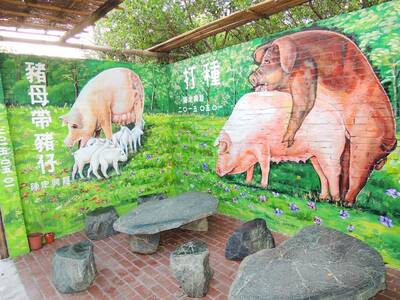
May 6 to May 12 Those who follow the Chinese-language news may have noticed the usage of the term zhuge (豬哥, literally ‘pig brother,’ a male pig raised for breeding purposes) in reports concerning the ongoing #Metoo scandal in the entertainment industry. The term’s modern connotations can range from womanizer or lecher to sexual predator, but it once referred to an important rural trade. Until the 1970s, it was a common sight to see a breeder herding a single “zhuge” down a rustic path with a bamboo whip, often traveling large distances over rugged terrain to service local families. Not only

Ahead of incoming president William Lai’s (賴清德) inauguration on May 20 there appear to be signs that he is signaling to the Chinese Communist Party (CCP) and that the Chinese side is also signaling to the Taiwan side. This raises a lot of questions, including what is the CCP up to, who are they signaling to, what are they signaling, how with the various actors in Taiwan respond and where this could ultimately go. In the last column, published on May 2, we examined the curious case of Democratic Progressive Party (DPP) heavyweight Tseng Wen-tsan (鄭文燦) — currently vice premier
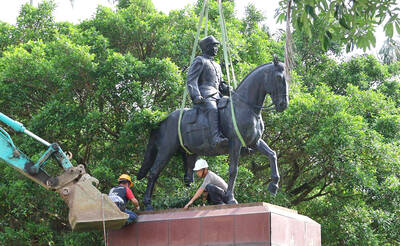
The last time Mrs Hsieh came to Cihu Park in Taoyuan was almost 50 years ago, on a school trip to the grave of Taiwan’s recently deceased dictator. Busloads of children were brought in to pay their respects to Chiang Kai-shek (蔣中正), known as Generalissimo, who had died at 87, after decades ruling Taiwan under brutal martial law. “There were a lot of buses, and there was a long queue,” Hsieh recalled. “It was a school rule. We had to bow, and then we went home.” Chiang’s body is still there, under guard in a mausoleum at the end of a path

Last week the Directorate-General of Budget, Accounting and Statistics (DGBAS) released a set of very strange numbers on Taiwan’s wealth distribution. Duly quoted in the Taipei Times, the report said that “The Gini coefficient for Taiwanese households… was 0.606 at the end of 2021, lower than Australia’s 0.611, the UK’s 0.620, Japan’s 0.678, France’s 0.676 and Germany’s 0.727, the agency said in a report.” The Gini coefficient is a measure of relative inequality, usually of wealth or income, though it can be used to evaluate other forms of inequality. However, for most nations it is a number from .25 to .50


 RSS
RSS