


When 21 paintings “attributed to Adolf Hitler” were auctioned in Cornwall, south-west Britain on Tuesday, TV crews from all over the world were there, interviewing bluff auctioneer Ian Morris and filming the atmospheric premises of his company, Jefferys, reached through an ancient-looking stone archway and crowded with musty furniture and stuffed birds.
Bidders from Japan, Russia, New Zealand and South Africa turned up to try to pick up a Hitler for their living room walls.
And if the scene wasn’t bizarre enough, “comedy terrorist” Aaron Barshak, who gatecrashed Prince William’s 21st birthday party, briefly evaded the bouncers to get into the auction room and bid ?6 million for a painting before being dragged away.
What a shame this peach of an art news story is based on nothing more than a forger’s clumsy attempt to copy the dreary style of one of the world’s worst artists. Even if the paintings sold were authentic Hitlers, the media’s interest would be an example of our unthinking intoxication with fame and infamy.
But that did not seem to put off the bidders who turned up in force to Lostwithiel. The collection sold for ?118,000, more than double the estimate. The most expensive lot went for ?10,500, a watercolor of the Church of Preux-au-Bois.
But just who was buying the sketches is unclear. One buyer, who identified himself as Carlo from Estonia, said he was working for an east European businessman, whom he would not name. “I had a budget to bid for anything that has Hitler’s signature. I have something to take back.”
A pencil sketch of a chateau was snapped up by a British businessman, who again preferred to remain anonymous, for ?3,800. Another sketch went for ?2,600, the buyer explaining: “I bought these on a whim; I hadn’t intended to bid.
The auctioneers are covering themselves by saying the works are only “attributed,” but to my eye, these are crude and obvious forgeries; it would be amazing if they were anything else. People have been faking Hitler’s paintings since he became chancellor of Germany in 1933.
In fact, there is a link between the paintings on sale tomorrow — apparently done by the young Hitler to earn a little money when he was unemployed before 1914 — and one of the most notorious frauds of modern times.
In 1983, the historian Hugh Trevor-Roper found himself in a bank vault in Germany inspecting a set of notebooks claimed to be the diaries of Adolf Hitler. What convinced him of their authenticity, he said, was the accompanying documents supposedly rescued along with Hitler’s diaries from a plane crash in 1945. The diaries were quickly exposed as a con; what is less well-known is that forged paintings were crucial to that con. Trevor-Roper admitted he was especially swayed by the signature on the paintings — “above all, signed paintings and drawings by Hitler.’’ Like the diaries, that too was the work of the forger Konrad Kujau.
Despite Kujau’s confession, some of these pictures have stayed in the mainstream of historical documents. In a book published as recently as 2004 about cultural politics in Nazi Germany, the author gets very excited about the significance of light in Nazi mythology, and illustrates his argument with a drawing by Hitler of a fist holding a blazing torch. But this is one of hundreds, if not thousands, of “Hitler” art works forged by Kujau. This image is credited to a man who provides a link with the sale in Cornwall.
The story goes that the 21 paintings and drawings signed A Hitler and AH were deposited in a sealed box in Belgium in 1919. The box was rediscovered in the 1980s and examined by “experts”— all now dead. The most distinguished-sounding of these is the Munich authority Dr August Priesack.
Priesack was a Nazi who in the 1930s worked for the central archive of the party, authenticating paintings attributed to the Fuhrer, and then flooding the market. After the war he put himself about as a Hitler expert. In the early 1980s, he was called in by a collector of Hitler paintings. According to Robert Harris’s book Selling Hitler, the man who had really painted them, Kujau, was there; he laughed inwardly, he said, when Priesack looked at one of his works and fondly recalled seeing it back in the days of the Reich.
Knowingly or unknowingly, Priesack became one of the most enthusiastic champions of Kujau’s forgeries as authentic Hitlers. He collaborated with the American collector Billy F Price to compile the only attempt at a catalogue of Hitler’s paintings, published in 1983. (The cultural historian Frederic Spotts estimates that two-thirds of its contents are forgeries.) Priesack is the “document expert” who contributes to authenticating the paintings on sale in Cornwall. His very presence is an alarm bell.
So much for the documents — but even if they were more substantial, I would not believe them. These worthless, execrable, boring, ugly daubs may seem bad enough to be by Hitler — but they contain many elements of modernist style.
Even the dullest painter today can’t help occasionally painting blue on a tree, or rendering a field as a pink blur. Impressionism and expressionism are in the way we see — and in the way the painter of these fakes sees. They are bad, but bad in the way only someone who has absorbed Monet and Van Gogh can be bad. A flare of Fauve color, a tangle of unruly paint, houses that resemble Van Gogh’s and reflections that echo Monet’s — no way did Adolf Hitler paint these. What most strikes you in genuine surviving examples by Hitler is the young man’s obsessive longing to perfectly reproduce what he believes correct. You can’t learn much about Hitler’s personality from his art, because his art has no personality.
When he came to power he waged war on modernism, banning art critics and impounding “degenerate” art. Among the modern movements he condemned as part of the Jewish conspiracy in a speech in Munich in 1937, he lists impressionism. What seems a gentle style to us was hideous to him.
In that speech, Hitler raged that modern artists “see meadows blue, skies green, clouds sulphur yellow, and so on.” The painter of the works in Cornwall can’t help seeing things a little that way, as any artist does now. Bad as they are, there’s a freedom alien to Hitler’s pedantic efforts.
To accept the paintings sold as genuine would mean changing Hitler’s biography. You would have to conclude that when he attacked modern art he was speaking as someone who had tried it out. You would have to believe that, as a soldier in WW1, he encountered and admired Monet and Van Gogh.
Does it matter that the buyers competed to get their hands on forgeries? You could argue that these sick fools are getting what they deserve. Of course they are, but what worries me is our collaboration in their fantasies.
Newspapers have publicized the sale, reproducing these supposed Hitler paintings with little skepticism. In doing this, we help perpetuate a pathetic and horrible market in mementos of the Third Reich which falsifies the history of the 20th century.
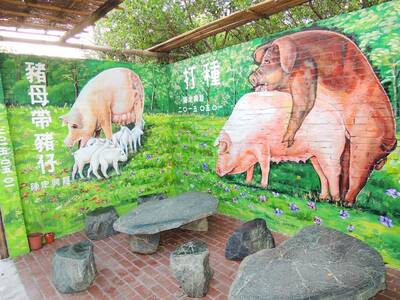
May 6 to May 12 Those who follow the Chinese-language news may have noticed the usage of the term zhuge (豬哥, literally ‘pig brother,’ a male pig raised for breeding purposes) in reports concerning the ongoing #Metoo scandal in the entertainment industry. The term’s modern connotations can range from womanizer or lecher to sexual predator, but it once referred to an important rural trade. Until the 1970s, it was a common sight to see a breeder herding a single “zhuge” down a rustic path with a bamboo whip, often traveling large distances over rugged terrain to service local families. Not only
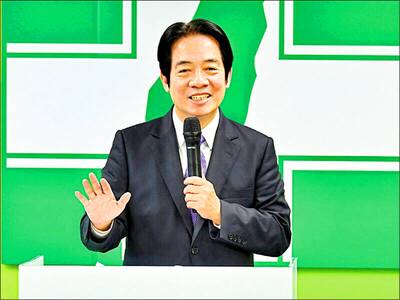
Ahead of incoming president William Lai’s (賴清德) inauguration on May 20 there appear to be signs that he is signaling to the Chinese Communist Party (CCP) and that the Chinese side is also signaling to the Taiwan side. This raises a lot of questions, including what is the CCP up to, who are they signaling to, what are they signaling, how with the various actors in Taiwan respond and where this could ultimately go. In the last column, published on May 2, we examined the curious case of Democratic Progressive Party (DPP) heavyweight Tseng Wen-tsan (鄭文燦) — currently vice premier
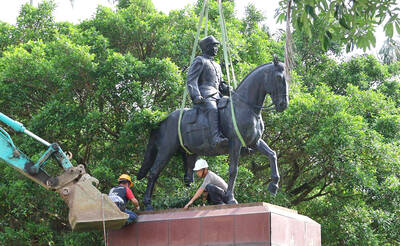
The last time Mrs Hsieh came to Cihu Park in Taoyuan was almost 50 years ago, on a school trip to the grave of Taiwan’s recently deceased dictator. Busloads of children were brought in to pay their respects to Chiang Kai-shek (蔣中正), known as Generalissimo, who had died at 87, after decades ruling Taiwan under brutal martial law. “There were a lot of buses, and there was a long queue,” Hsieh recalled. “It was a school rule. We had to bow, and then we went home.” Chiang’s body is still there, under guard in a mausoleum at the end of a path

Last week the Directorate-General of Budget, Accounting and Statistics (DGBAS) released a set of very strange numbers on Taiwan’s wealth distribution. Duly quoted in the Taipei Times, the report said that “The Gini coefficient for Taiwanese households… was 0.606 at the end of 2021, lower than Australia’s 0.611, the UK’s 0.620, Japan’s 0.678, France’s 0.676 and Germany’s 0.727, the agency said in a report.” The Gini coefficient is a measure of relative inequality, usually of wealth or income, though it can be used to evaluate other forms of inequality. However, for most nations it is a number from .25 to .50


 RSS
RSS