


Captain Jack Sparrow was enjoying the attention as she swaggered around National Taiwan University park, supported by a cast of hundreds dressed up as Hollywood stars, TV and comic personalities or puppets.
Photographers flocked for the shot that would immortalize their favorite model and there were competitions for the best-dressed character. The university gymnasium swarmed with customers buying manga comics, DVDs, pop star pictures and accessories.
The Comic World Taiwan convention earlier this month brought in more than 200,000 people, according to organizers. Another similar exhibition, at the World Trade Center last week, attracted 400,000.
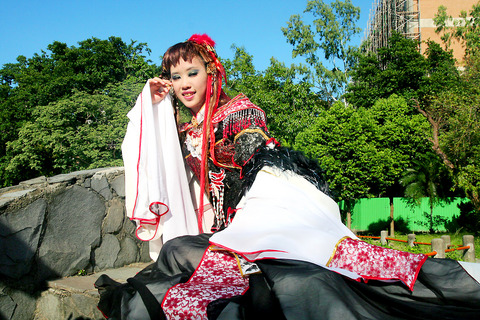
PHOTO: JULES QUARTLY, TAIPEI TIMES
While most of the visitors were guys browsing for anime or computer games, many of them went for the cosplay, which involves role-playing and is mainly practiced by 18- to 25-year-old women.
The word comes from contracting costume and adding play. Wikipedia suggests it began in the US at science fiction fan conventions, but cosplay has flowered most significantly in Japan and has taken root here.
While dressing up as a nurse or soldier is child's play and most people grow out of it before they get to university or take their first job, for these young enthusiasts donning a costume and transforming themselves into an anime heroine or hero is a liberating experience.
They practice their “looks” in bedroom mirrors, make their own costumes, form clubs and come the big day they will take a friend to help make up and meet other like-minded people.
Innocent fun, you would have thought, but not for a professor of psychology at National Taiwan University, who was shocked by the cosplay fans he spotted queuing up to get into the convention.
Professor Huang Guang-guo (黃光國) last week made a splash in the local papers by saying cosplay was degenerate and “as bad as smoking marijuana.”
The 60-year-old said dressing up as comic characters showed that students no longer had any aspirations in society and were therefore retreating into fantasy worlds.
It is tempting, for a minute and if it is in your interest, to agree with him and ask why?
Which is what National Taiwan University student union president Gao Min-lin (高閩琳) did when he responded by saying the reason students enjoy cosplay is because they are disenchanted with politics, society and reality.
Nearer the mark, perhaps, was National Chengchi University professor of education Feng Chao-lin (馮朝霖), who suggested Huang's criticism was the typical result of an older man not understanding the younger generation.
Equating cosplay with drug use is obviously wrong. Most parents would surely be relieved if their children preferred dressing up to puffing the weed, since there are no extant studies that claim looking like an anime character causes emphysema and may lead to class-A substance addiction.
From talking to a number of cosplayers and the businesspeople who rely on them, cosplay seems to be a variant of the desire for young people to explore countercultures through dressing up, like goths, faux punks or the terminally fashionable.
Women cosplayers typically say they want to look cute and be the center of attention, like a star. Since so much of our interaction with society is based on appearance it should be no surprise youngsters want to explore their options.
Learning how to put on clothes, apply makeup (perhaps) and act out a role are valuable skills that practice makes perfect. It's not so different from putting on a business suit and going to the office. Or dressing up to go clubbing.
In Japan cosplay is more developed and there is even a name for adults who slavishly follow cartoon animations and buy comics: otaku.
The Nomura Research Institute has estimated the otaku market is worth US$2.6 billion to the economy and commentators suggest they are a new breed of consumers who want to satisfy aesthetic or emotional needs rather than the desire for status.
Clearly, Taiwan has also generated significant business opportunities related to comic books and the influence of cosplay was recognized two years ago when former president Lee Teng-hui (李登輝) dressed up as an anime character to solicit youth support for his Taiwan Solidarity Union party.
The professor of psychology, I suggest, needs to get in touch with his inner child.
There will be a cosplay convention in Taichung this weekend at the Taichung Elementary School Hall, 153 Taichung Rd, Taichung (台中市台中路153號). It begins at 10am and entrance is NT$150. See www.taconet.com.tw/NANA7777 for further details. For news about other cosplay conventions, stores and clubs go to comic.com.tw.
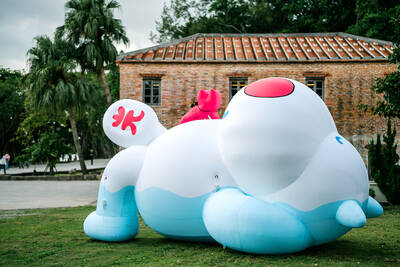
The primaries for this year’s nine-in-one local elections in November began early in this election cycle, starting last autumn. The local press has been full of tales of intrigue, betrayal, infighting and drama going back to the summer of 2024. This is not widely covered in the English-language press, and the nine-in-one elections are not well understood. The nine-in-one elections refer to the nine levels of local governments that go to the ballot, from the neighborhood and village borough chief level on up to the city mayor and county commissioner level. The main focus is on the 22 special municipality
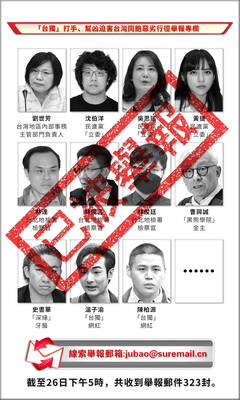
The People’s Republic of China (PRC) invaded Vietnam in 1979, following a year of increasingly tense relations between the two states. Beijing viewed Vietnam’s close relations with Soviet Russia as a threat. One of the pretexts it used was the alleged mistreatment of the ethnic Chinese in Vietnam. Tension between the ethnic Chinese and governments in Vietnam had been ongoing for decades. The French used to play off the Vietnamese against the Chinese as a divide-and-rule strategy. The Saigon government in 1956 compelled all Vietnam-born Chinese to adopt Vietnamese citizenship. It also banned them from 11 trades they had previously
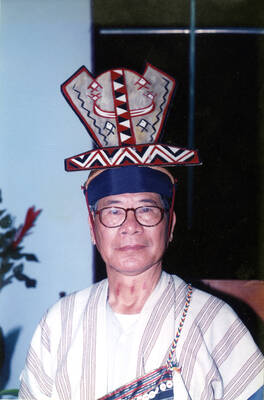
Jan. 12 to Jan. 18 At the start of an Indigenous heritage tour of Beitou District (北投) in Taipei, I was handed a sheet of paper titled Ritual Song for the Various Peoples of Tamsui (淡水各社祭祀歌). The lyrics were in Chinese with no literal meaning, accompanied by romanized pronunciation that sounded closer to Hoklo (commonly known as Taiwanese) than any Indigenous language. The translation explained that the song offered food and drink to one’s ancestors and wished for a bountiful harvest and deer hunting season. The program moved through sites related to the Ketagalan, a collective term for the

As devices from toys to cars get smarter, gadget makers are grappling with a shortage of memory needed for them to work. Dwindling supplies and soaring costs of Dynamic Random Access Memory (DRAM) that provides space for computers, smartphones and game consoles to run applications or multitask was a hot topic behind the scenes at the annual gadget extravaganza in Las Vegas. Once cheap and plentiful, DRAM — along with memory chips to simply store data — are in short supply because of the demand spikes from AI in everything from data centers to wearable devices. Samsung Electronics last week put out word


 RSS
RSS