


It has stood for centuries, a slope of gleaming white houses climbing in steps from the sea like a construction of sugar cubes. It gave this Mediterranean port the nickname la Blanche, the white one. But despite the romance surrounding the old quarter, known as the Casbah and once home to pirates and freedom fighters, it is literally imploding from neglect.
UNESCO has declared it a World Heritage site, and the Algerian government has designated it a protected landmark, to no avail. Closed in on itself, symbolizing the local population’s long isolation from French colonial rulers — and more recently, radical Islam’s retreat from modernity — this seemingly impenetrable agglomeration of houses is falling down.
“More than a third of the houses have collapsed, and at least another third are in an advanced state of deterioration,” said Abdelkader Ammour, secretary general of a foundation that is trying to save the crumbling swatch of hidden courtyards and winding narrow streets. “We don’t want it to disappear.”

PHOTO: NY TIMES NEWS SERVICE
Ammour says the problem isn’t money. “It’s a question,” he said, “of political will.”
Or as Nabila Oulebsir, an Algerian architect who has written extensively on Algiers, says, “The question is whether you reconstruct or construct something new.”
Historic preservation is a luxury for steady times, and Algeria is still feeling its way toward the future from a dark and turbulent past. It has only just righted itself from a decade of fundamentalist Islamic violence. The nation’s focus is now on economic development. But tourism, the great engine of preservation in so many cities, is low on the list of Algeria’s concerns. Algeria doesn’t really need tourists. It has oil. Casbahs, from the Arabic for “fortified place,” exist across North Africa, and many have been beautifully restored. In Algiers the word once referred only to the citadel built above the old city, but it came to mean the old city itself. When people speak of the Casbah, they are referring uniquely to this crowded hillside between the fortress and the sea.
A Phoenician trading post called Ikosim occupied the point of land as early as the sixth century BC. The Romans arrived 500 years later, and the arc of an amphitheater can still be traced in the walls of the buildings in the lower Casbah.
The Vandals eventually chased the Romans away, and a Berber tribe was living there when Buluggin bin Ziri arrived in the 10th century to found a new city on what was left of the old one. He called the new city El Djazair, which means “the islands” in Arabic, referring to the string of islets off the coast that form a natural breakwater for the harbor. From El Djazair came the anglicized name Algiers and later Algeria.
The Berbers built a wall around the city. Five gates closed it off from the world, and gates also closed each end of the city’s narrow streets, although both the wall and the internal gates have long since disappeared.
After the Barbarossa brothers captured the town in 1516, Algiers became a fabled redoubt of Barbary pirates who plied the Mediterranean and the Atlantic. In 1575 Miguel de Cervantes was taken captive on his way back to Spain from a military campaign and spent five years in Algiers before he was ransomed and sent home.
In those days the fortified city was filled with more than 100 fountains, 50 hammams, or public baths, 13 large mosques and more than 100 prayer halls, one for almost every street, so that residents could perform the last of their five daily prayers after the gates were shut for the night. A flutist circulated playing a Turkish melody called a coupe jambe — French for leg cut — to announce the evening curfew.
Little of the old Berber city exists except for the foundations of the oldest mosques and the remnants of the wall that once ringed the city. Earthquakes in 1364 and 1716 largely leveled the town, and most of what is standing today dates from the late Ottoman period.
When the French arrived to colonize the country in 1830, one of the first things they did was cut the city in two with the “rue du Centre” to allow their troops easy access in the event of insurrection. They surrounded the Casbah with colonial-style buildings, destroyed the walls and tore down much of the northern quarter to build the colonial neighborhood of Bab al-Oued.
But the twisting alleys that wind between the mud-brick and stucco houses still follow the original footpaths. Those of the lower part of the town traced the Roman streets, but as the town climbed the hill, the Berbers built houses on either side of gullies that formed natural sewers. The gullies were eventually filled with clay pipes or stone or brick channels, which were later covered to become the streets of the city.
Many of the streets themselves are vaulted by houses. In other places the cantilevered overhangs of houses extend over the street to within inches of one another and now may even touch, having settled with time or as a result of occasional earthquake tremors. Doorways and lintels are carved from buff-colored tuff, a kind of soft volcanic stone.
Pashas, grown rich through the pirate trade, built palaces on the more level ground between the shoreline and the hill. Poorer people had to walk uphill.
But, whether for rich or poor, most of the Casbah’s houses, which date from the Ottoman period of the late 18th century, follow the same pattern: three stories built around a central courtyard ringed by a loggia and a terrace on the roof. The larger houses have spacious courtyards, often with a fountain in the middle, but even most of the more modest houses have courtyards open to the sky.
They are familial cells with unadorned facades enclosing the unseen nuclei of women and children, typical of the Arab-Islamic architecture found all along the southern rim of the Mediterranean. There are few windows in the exterior walls, and those that exist are either small or covered with lattice.
“The home is a feminine space,” said Omar Hachi, an archaeologist working in the Casbah. He owns a spacious courtyard house that he wants to turn into a museum. “Men inhabited public spaces, but the women stayed home.”
The thick walls and filtered light from the courtyards created cool, quiet chambers embellished with the occasional horseshoe arch or twisted column.
But the quiet, private spaces have long since given way to overcrowding. In 1958 the Casbah’s 70 hectares were home to only 30,000 people. Those numbers swelled as the battle for independence gained strength, and people crowded into the city to escape reprisals by the French. More than 80,000 people live in the Casbah today. Each house, intended for a single family, now holds as many as 10 poor families.
“When I change my clothes, I have to wear a robe” for privacy, said Oumedjber Aziouz, 30, who lives in two small whitewashed rooms with six other members of the family on the ground floor of a house whose courtyard measures just 3m2. His father, who moved into the rooms as a boy in 1948, grew up and raised his family there. “All of us were born in this room,” Aziouz said, stretching his arms out to touch both walls to emphasize how cramped the quarters are.
The house was built for one family and now houses three, altogether about 20 people. Sheets hang across the balconies of the narrow central courtyard to give each family a modicum of privacy. Everyone in the house shares a small toilet on the ground floor and bathes in the local neighborhood baths.
A balding man, 60 and retired, lives above Aziouz with his wife and three grown children in one narrow, whitewashed room. A color television is perched atop a wooden chest of drawers at one end of the room, and a wooden cabinet is built into the other. Two foam sofas that fold out into beds at night are the only other furniture. The family cooks and eats at a gas burner on their small loggia.
“I have asked for a new house twice in the past 10 years,” the man said, revealing a gap where his eyeteeth should be. He declined to give his name. Like others living on his narrow street, he was told at the housing office that he had already been given a new apartment as part of a government plan to ease crowding.
None of the residents have been able to get more information on the ghost homes, which they assume were given away in return for bribes. “They sold our houses to other people,” the man said.
But the psychic difficulties of overcrowding aren’t as troubling as the physical danger of living in the rickety structures of the Casbah, residents say. “I’m afraid all the time,” said Mohammed ben Aissa, 86, standing in the gloom of the narrow footpath outside his home. He said three neighbors died when their house collapsed nearby a few years ago. A good shake would bring much of the Casbah down.
Yet Ammour, of the Casbah Foundation, created by volunteers in 1990 to save the old city, said that some people had intentionally damaged their homes by knocking out pillars or breaking down walls to increase their chances of being assigned new ones. “It’s an ongoing battle to stop people from destroying houses,” he said.
The foundation is the successor to a series of defunct associations that have sought to preserve the area since independence. It got off to a slow start because the effort coincided with the brutal civil war that engulfed the nation after the military canceled elections in 1991 to stave off a victory by fundamentalists. “The Casbah was infested by terrorists, and so we lost eight years,” Ammour said.
In 1991 the foundation did get the Casbah registered with the UN Educational, Scientific and Cultural Organization as a World Heritage site, and in 1998 the government passed a law requiring the protection of state patrimony. But it took until 2003 for the association to get the Casbah declared a protected site under the law.
The municipal government commissioned an exhaustive study of the Casbah and divided its dense urban landscape into five sectors. A plan was drawn up to relocate the population of successive sectors to allow renovation to proceed.
In the sector called Sidi Ramdane, 500 families were moved out several years ago, freeing 189 buildings for renovation. Less than 10 percent were restored before the project was suspended. Another 300 families were relocated from a second sector, Souk el Djemaa. But that project too soon bogged down over disputes about what should be repaired and what should be torn down.
With the municipal government, the Algerian Culture Ministry and various nongovernmental organizations squabbling over what to do, Ammour said, the next logical step would be to create an independent entity with the power to make decisions. “Now we’re fighting for an authority to control the site,” he explained.
Another complication is figuring out who owns what and getting all of the property holders to support a preservation plan. Ownership of many of the houses has been fragmented through inheritance, making decisions difficult and in some cases impossible. The foundation recently completed a survey of all the owners it could find and registered more than 4,200 for 1,200 different properties.
Most owners have moved out of the Casbah and now rent their buildings for nominal sums. They spend little on maintenance because the buildings generate so little income; each room rents for only 500 dinars to 1,500 dinars, or US$7 to US$20, a month.
But the longer the preservation is postponed, the greater the peril to the historic district. Ammour said the foundation was battling both gravity and the threat of land speculation: The Casbah occupies prime real estate overlooking the sea, and developers have already proposed building luxury apartment blocks and even office towers on the scenic hillside.
If the political stalemate persists, neglect will eventually do the work of the wrecking ball, and the storied lair of the Ottoman corsairs will disappear forever.
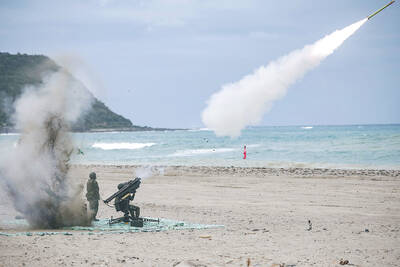
In late October of 1873 the government of Japan decided against sending a military expedition to Korea to force that nation to open trade relations. Across the government supporters of the expedition resigned immediately. The spectacle of revolt by disaffected samurai began to loom over Japanese politics. In January of 1874 disaffected samurai attacked a senior minister in Tokyo. A month later, a group of pro-Korea expedition and anti-foreign elements from Saga prefecture in Kyushu revolted, driven in part by high food prices stemming from poor harvests. Their leader, according to Edward Drea’s classic Japan’s Imperial Army, was a samurai

The following three paragraphs are just some of what the local Chinese-language press is reporting on breathlessly and following every twist and turn with the eagerness of a soap opera fan. For many English-language readers, it probably comes across as incomprehensibly opaque, so bear with me briefly dear reader: To the surprise of many, former pop singer and Democratic Progressive Party (DPP) ex-lawmaker Yu Tien (余天) of the Taiwan Normal Country Promotion Association (TNCPA) at the last minute dropped out of the running for committee chair of the DPP’s New Taipei City chapter, paving the way for DPP legislator Su
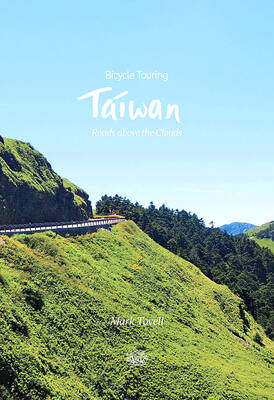
It’s hard to know where to begin with Mark Tovell’s Taiwan: Roads Above the Clouds. Having published a travelogue myself, as well as having contributed to several guidebooks, at first glance Tovell’s book appears to inhabit a middle ground — the kind of hard-to-sell nowheresville publishers detest. Leaf through the pages and you’ll find them suffuse with the purple prose best associated with travel literature: “When the sun is low on a warm, clear morning, and with the heat already rising, we stand at the riverside bike path leading south from Sanxia’s old cobble streets.” Hardly the stuff of your
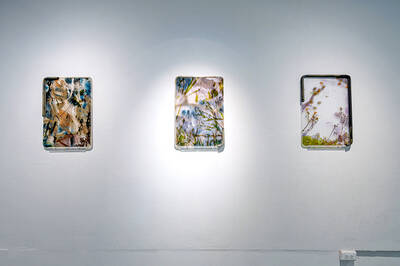
Located down a sideroad in old Wanhua District (萬華區), Waley Art (水谷藝術) has an established reputation for curating some of the more provocative indie art exhibitions in Taipei. And this month is no exception. Beyond the innocuous facade of a shophouse, the full three stories of the gallery space (including the basement) have been taken over by photographs, installation videos and abstract images courtesy of two creatives who hail from the opposite ends of the earth, Taiwan’s Hsu Yi-ting (許懿婷) and Germany’s Benjamin Janzen. “In 2019, I had an art residency in Europe,” Hsu says. “I met Benjamin in the lobby


 RSS
RSS