


Living in the stuffy, bustling atmosphere of metropolitan Taipei, it is often easy to lose sight of the picturesque landscapes that lie right on the city's doorstep. The Bureau of Traffic offers urbanites an alternative method of traveling about Taipei and the chance to enjoy the city's more idyllic settings with its River Cruise; a system of ferry routes with stops at some of the capital's major tourist spots.
The idea for the Blue Highway system (
The ferry system did not succeed. In 2000 the route was revitalized as a tourist attraction.
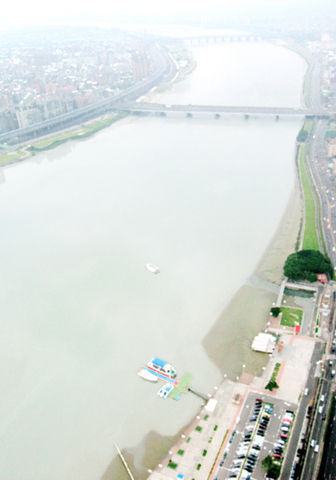
The main trunk of the River Cruise runs along the Danshui River, stretching from its northernmost point at Fisherman's Wharf in Danshui town to its southernmost point at Dadaocheng Wharf (大稻埕碼頭).
The other outpost of the River Cruise connects to the route along the Keelung River to Dajia Wharf (
Ferry rides between wharfs range in price from NT$20 to NT$250 depending on the distance traveled and the time of day. Additionally, from Danshui's Fisherman's Wharf (
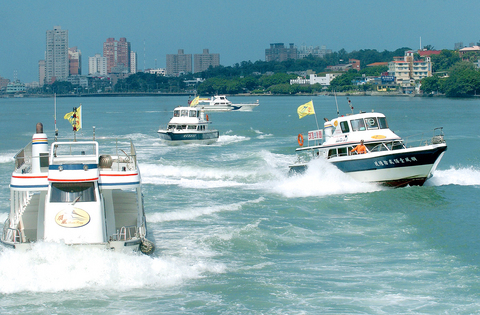
PHOTO: LIU HSIN-DE, TAIPEI TIMES
50-minute sightseeing cruise that takes passengers to the very mouth of the river. Most of the stop-off points connect to cycle ways that line the rivers and bikes can be rented nearby.
Getting started on any one of these routes is relatively easy as most of the wharfs are within walking distance of an MRT station or bus stop. On exiting Danshui MRT station, signs direct passengers to the wharf.
The town's waterfront and Old Street areas offer plenty of distractions for people of all ages, with arcades, stores selling traditional wares, and restaurants and small eateries that feature local specialties such as fish ball soup and steamed crabs and scallops.
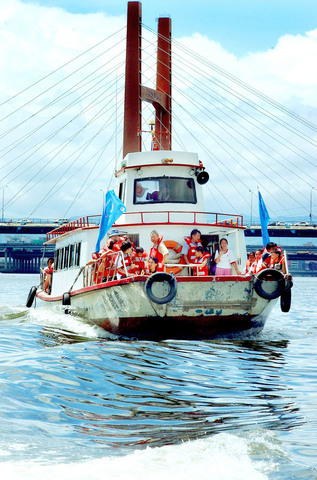
PHOTO: CHEN JUNG-FONG, TAIPEI TIMES
From Danshui Wharf, it is only a 10-minute ferry ride to nearby Fisherman's Wharf and Bali Wharf (八里碼頭). At Fisher-man's Wharf, take a leisurely walk across Lover's Bridge (情人橋) to arrive at the Fish Market, which is filled with vendors eager to let you sample their specialty foods, including sour plum juice and pork jerky. Live fish can be bought from the market's many tanks. The restaurant one floor above will cook fish bought from the market below.
Tourist spots include the Shihsanhang Museum of Archeology (
These three areas surrounding the wharfs on the Blue Highway routes are delightful in their lack of city buzz. The air is refreshing, and the scenery, especially the views of the river and Guanyin Mountain, are quiet reminders of Taiwan's natural beauty.
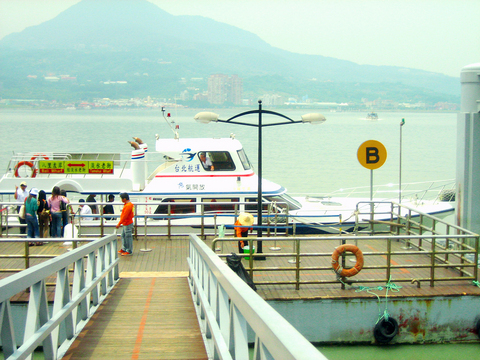
PHOTO: MEAGAN HU, TAIPEI TIMES
The boat ride from Bali or Danshui to Guandu Wharf (
Riding the ferry to Dadaocheng takes you away from the calm of Danshui back into the metropolitan bustle of Taipei. And while the ferry ride is enjoyable along this stretch of the Blue Highway, the inherent charm of this River Cruise is the respite from the city smog that it offers, something that is most noticeable along the Danshui leg of the route.
Dadaocheng Wharf has many points of interest, including the Lin Liu-Hsin Puppet Museum (林柳新紀念偶戲博物館) and Hsiahai City God Temple (霞海城隍廟), located on the well-preserved Dihua Street (迪化街).
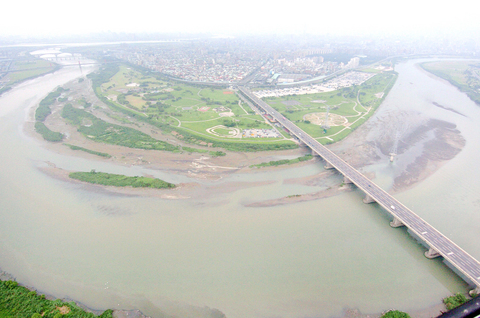
PHOTO: CHAO SHIH-HSUN
It is also possible to take the ferry along Keelung River to the Dajia Wharf.
Here, you can visit Taipei Fine Arts Museum (台北市立美術管館) the Taipei Children's Recreation Center (台北兒童育樂中心), or the nearby amusement park. Perhaps the most scenic areas Dajia Wharf has to offer are the Dajia Riverside Park (大佳河濱公園), which boasts a grand water fountain, as well as the expansive Xinsheng Park (新生公園), which is a great place for group outings and sporting activities.
There are different types of passenger boats to choose from along the Blue Highway, operated by different companies. The 80-seat ferries that ply the route sell snacks and beverages and have plenty of room to enjoy the outdoor surroundings. The seating on the smaller speedboats is enclosed, giving only a limited view of the riverbanks, and the ride tends to be uncomfortably loud and bumpy.
The Blue Highway can be unreliable. On a recent trip this reporter found that ferries were not running from Guandu Wharf, meaning that buses and MRT transportation were required to travel to and from this spot. It's easy enough to do, but certainly a letdown if your aim is to get out on the water.
However, these temporary incon-veniences are to be expected as the Taipei City Government is working to improve the Blue Highway system. Just recently, the Public Works Department spent NT$175 million on constructing new marinas for ferries at the Dajia Wharf. Further improvements the city has in mind include the use of solar-powered boats.
Despite some shortcomings, the Blue Highway is a relatively cheap and convenient way to taste local specialties, take in a number of interesting tourist spots and enjoy the open spaces that the river offers.

In late October of 1873 the government of Japan decided against sending a military expedition to Korea to force that nation to open trade relations. Across the government supporters of the expedition resigned immediately. The spectacle of revolt by disaffected samurai began to loom over Japanese politics. In January of 1874 disaffected samurai attacked a senior minister in Tokyo. A month later, a group of pro-Korea expedition and anti-foreign elements from Saga prefecture in Kyushu revolted, driven in part by high food prices stemming from poor harvests. Their leader, according to Edward Drea’s classic Japan’s Imperial Army, was a samurai

The following three paragraphs are just some of what the local Chinese-language press is reporting on breathlessly and following every twist and turn with the eagerness of a soap opera fan. For many English-language readers, it probably comes across as incomprehensibly opaque, so bear with me briefly dear reader: To the surprise of many, former pop singer and Democratic Progressive Party (DPP) ex-lawmaker Yu Tien (余天) of the Taiwan Normal Country Promotion Association (TNCPA) at the last minute dropped out of the running for committee chair of the DPP’s New Taipei City chapter, paving the way for DPP legislator Su
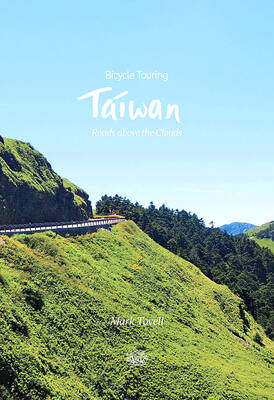
It’s hard to know where to begin with Mark Tovell’s Taiwan: Roads Above the Clouds. Having published a travelogue myself, as well as having contributed to several guidebooks, at first glance Tovell’s book appears to inhabit a middle ground — the kind of hard-to-sell nowheresville publishers detest. Leaf through the pages and you’ll find them suffuse with the purple prose best associated with travel literature: “When the sun is low on a warm, clear morning, and with the heat already rising, we stand at the riverside bike path leading south from Sanxia’s old cobble streets.” Hardly the stuff of your

Located down a sideroad in old Wanhua District (萬華區), Waley Art (水谷藝術) has an established reputation for curating some of the more provocative indie art exhibitions in Taipei. And this month is no exception. Beyond the innocuous facade of a shophouse, the full three stories of the gallery space (including the basement) have been taken over by photographs, installation videos and abstract images courtesy of two creatives who hail from the opposite ends of the earth, Taiwan’s Hsu Yi-ting (許懿婷) and Germany’s Benjamin Janzen. “In 2019, I had an art residency in Europe,” Hsu says. “I met Benjamin in the lobby


 RSS
RSS