


Tasmania is a funny place. Under the land down under, nearly off the map, it has been a synonym for isolation ever since the days when it was known as Van Diemen's Land. As Nicholas Shakespeare puts it in In Tasmania, his rambling, whimsical portrait of the island, "it is like outer space on earth and invoked by those at the `center' to stand for all that is far-flung, strange and unverifiable." There are the animals of course: the possibly extinct, almost mythical Tasmanian tiger, and its cousin, the Tasmanian devil. But the people too -- at least the ones unearthed by Shakespeare -- can lay claim to their own brand of weirdness. "Shakespeare," one Tasmanian repeats, looking at the author in astonishment. "Not Shakespeare? You couldn't possibly be related to the family who make the fishing tackle?"
Who could blame Shakespeare, a British novelist, for taking up residence on the island? It offers breathtaking natural beauty, a pristine rain forest and clean air. "The air of Hobart Town is perfect air," wrote Anthony Trollope, whose ecstatic descriptions of Tasmania in 1873 inspired a mini-migration from Britain. He didn't know the half of it.
Tasmania's far northwest, cleansed by southerly winds, boasts the purest air ever recorded on the planet. All this, and fabulous Tasmanians like Errol Flynn and Merle Oberon.
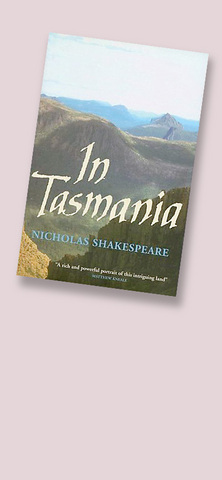
Well, maybe not Merle Oberon. As part of his journalistic assignment, Shakespeare gets on the trail of the Tasmanian tiger and the Oberon legend, manufactured by Hollywood, and still cherished by Tasmanians. It was a great day for the former penal colony within a penal colony when that glamorous actress, in 1978, was persuaded by her fourth husband to revisit the supposed scenes of her birth and childhood.
Oberon nearly suffered a mental breakdown from the strain and eventually blurted out, at an official dinner, that she had been born in Bombay. No worries. She was surrounded by Tasmanians who vividly recalled her and assured her that they knew both her parents well. "In Tasmania, we tell stories to reassure ourselves we have not slipped unnoticed over the rim of the world," a Tasmanian historian wrote of the Oberon affair. In Tasmania brightens up at loony moments like these. If only Shakespeare, a limp, reticent tour guide, could drop his English reserve, the book might have done justice to the place. Tasmania screams out for lavish, Technicolor physical description. It begs for a writer willing to sink his teeth into the place as if it were a juicy steak. The anemic Shakespeare specializes in meaningful pauses and cryptic silences. A pastel watercolorist, a stylistic vegetarian, he is inadequate to the task.
Here and there Tasmanians come to the rescue. Some are contemporary, like the wondrous cricketer David Boon, also known as the Keg on Legs, who upheld a proud Tasmanian tradition when he managed to consume a record-breaking 52 cans of beer on a flight to London in 1989. Some, like Anthony Fenn Kemp, are long dead, and, intriguingly, related to the author.
Kemp, called by some Tasmanians the father of his country and by others "a great Ass," offers Shakespeare an irresistible point of entry into the history of Tasmania and, it turns out, of his own family. Kemp, a thoroughgoing rascal, was the business partner and brother-in-law of Shakespeare's great-great-great-grandfather, whom Kemp defrauded of about a million US dollars in modern money, promising to send back precious cargoes from Tasmania. Instead, Kemp gained a stranglehold on the liquor trade and set up as a local lord, naming his estate Mount Vernon in honor of George Washington, whom he had visited during his radical youth.
Kemp was volatile, underhanded and universally despised. He was also incredibly lucky, always in hot water, but never burned. As Shakespeare riffles through the archives, he develops a sneaking fondness for this man, who, for completely selfish reasons, established the first white settlement on Tasmania.
"A monster and a rogue he may have been, and yet there was something satisfying about the repeated pattern of his life -- one minute facing catastrophe, the next getting off scot free," Shakespeare writes.
Kemp was no Washington. True, he agitated incessantly for Tasmania's administrative independence, but his vision for the future included a law to annul all former laws -- "nothing like a clear stage, and plenty of elbow room," he said -- and a law requiring all citizens to eat 907g of meat daily, "so as to encourage the consumption and raise the price of livestock."
The transformation of Kemp from rascal to revered statesman parallels the equally remarkable transformation of Van Diemen's Land, a byword for hell on earth, to Tasmania, a second Eden. Along the way the Aboriginal population, estimated at 3,000 to 5,000, was reduced in numbers, by 1875, to precisely one.
Or was it? Shakespeare inquires, productively, into the racial politics of Tasmania and discovers a subtle social code at work, not unlike that applied to Creoles in New Orleans. Mixed-race Tasmanians abound, but until the 1970s they referred to themselves as Islanders or half-castes. Everyone knew, but no one talked.
Shakespeare should have spent more time chatting with the locals and feasting his eyes on the world around him. Less time spent in the archives, and carefully polishing each of his lapidary sentences, might have served his purpose better. When at a loss, he could have cracked open a cold one with the Keg on Legs, shed a few inhibitions and let his imagination loose. No matter what he wrote, the Tasmanians would have believed him.

In late October of 1873 the government of Japan decided against sending a military expedition to Korea to force that nation to open trade relations. Across the government supporters of the expedition resigned immediately. The spectacle of revolt by disaffected samurai began to loom over Japanese politics. In January of 1874 disaffected samurai attacked a senior minister in Tokyo. A month later, a group of pro-Korea expedition and anti-foreign elements from Saga prefecture in Kyushu revolted, driven in part by high food prices stemming from poor harvests. Their leader, according to Edward Drea’s classic Japan’s Imperial Army, was a samurai

The following three paragraphs are just some of what the local Chinese-language press is reporting on breathlessly and following every twist and turn with the eagerness of a soap opera fan. For many English-language readers, it probably comes across as incomprehensibly opaque, so bear with me briefly dear reader: To the surprise of many, former pop singer and Democratic Progressive Party (DPP) ex-lawmaker Yu Tien (余天) of the Taiwan Normal Country Promotion Association (TNCPA) at the last minute dropped out of the running for committee chair of the DPP’s New Taipei City chapter, paving the way for DPP legislator Su
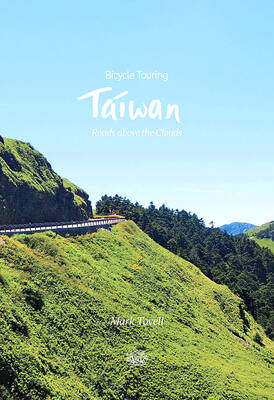
It’s hard to know where to begin with Mark Tovell’s Taiwan: Roads Above the Clouds. Having published a travelogue myself, as well as having contributed to several guidebooks, at first glance Tovell’s book appears to inhabit a middle ground — the kind of hard-to-sell nowheresville publishers detest. Leaf through the pages and you’ll find them suffuse with the purple prose best associated with travel literature: “When the sun is low on a warm, clear morning, and with the heat already rising, we stand at the riverside bike path leading south from Sanxia’s old cobble streets.” Hardly the stuff of your

Located down a sideroad in old Wanhua District (萬華區), Waley Art (水谷藝術) has an established reputation for curating some of the more provocative indie art exhibitions in Taipei. And this month is no exception. Beyond the innocuous facade of a shophouse, the full three stories of the gallery space (including the basement) have been taken over by photographs, installation videos and abstract images courtesy of two creatives who hail from the opposite ends of the earth, Taiwan’s Hsu Yi-ting (許懿婷) and Germany’s Benjamin Janzen. “In 2019, I had an art residency in Europe,” Hsu says. “I met Benjamin in the lobby


 RSS
RSS