


The Beijing People's Art Theater (北京人民藝術劇院) is following up its huge success of 2004 when it brought Teahouse to Taipei with its long-running production of Thunderstorm, an iconic work of modern Chinese drama. The production will complete its booking at the National Theater in Taipei this weekend, presenting a great opportunity to observe solid, old-fashioned stage melodrama.
There is not a lot that is new about the play Thunderstorm. After all, it was written in 1934, and if we draw a comparison with the Western theater, there is certainly not very much from that period that has survived the test of time and changing mores and social concerns. The plays of Terrance Rattigan or J.B. Priestley, major figures in their time, are now rarely revived. More often than not they seem hopelessly dated and can, at best, be appreciated in the spirit of nostalgia for a time of stricter and more comprehensible dramatic conventions. So the question inevitably arises: Why should anyone want to see such an old chestnut?
Thunderstorm, and Cao Yu (
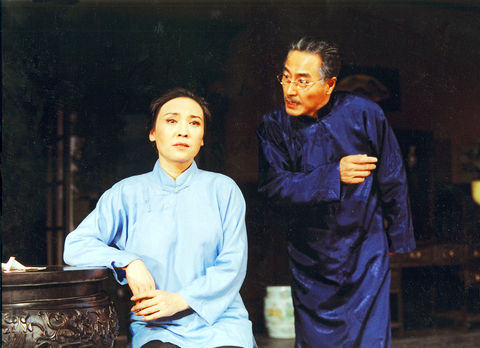
PHOTO COURTESY OF NEW ASPECT
The group has been producing the play on a regular basis since the early 1950s, and is closely associated with the works of Cao Yu. On this occasion, the playwright's daughter Wan Fang (萬方), who adapted another of her father's plays The Wilderness (原野) for performance as a Beijing opera (which was performed at the National Theater last week), has accompanied the group over to Taiwan. At a press conference last week, director Xia Chun (夏淳) lauded the many virtues of the play, which is regarded by many critics as being superbly constructed. Seen now, the adherence to the Aristotelian unities and the contrasts of pacing and mood, lend the play a faintly nostalgic quality, but the fine craftsmanship can still be appreciated.
It is in those elements that the author tries to shock the audience, such as in the revelation of incest within the family, that the play can seem to fall a bit flat.It is in its more banal aspects that the production finds its voice. Its exploration of familial dynamics within an oppressive patriarchal family, a beloved theme of Chinese drama and cinema (think Raise the Red Lantern among many, many others), that the play truly shines, and Gong Lichun's (
Xia said Thunderstorm is a play that evolves, giving each era what it requires. In its original incarnation, Thunderstorm focused on the conflict between an authoritarian capitalist father and a son who wanted to be one with the people (and who was in love with a maid working for the family). The second incarnation, which took shape in the 1980s focused on the question of guilt, and the apportioning of blame for past wrongs. The third incar-nation, which is currently being performed in Taipei, focuses on the struggle of human beings in the face of an implacable fate. In 2004, the Beijing People's Art Theater gave a fine performance of Tea House, and is in fine form with Thunderstorm. In the former, it was the depth of the ensemble's acting that raised the play to a level seldom achieved by local groups, which often lack sufficient depth of talent; however, with this current show, in which the focus will be on bravura performances by star performers, audiences will be able to make direct comparisons with local performers.
What: Cao Yu's Thunderstorm by the Beijing People's Art Theater
When and Where: Today, tomorrow and Sunday at the National Theater; Tuesday and Wednesday at the Jhongli Arts Center (中壢藝術館)
Tickets: NT$500 to NT$3,000 for the National Theater; NT$400 to NT$2,200 for Jhongli Arts Center
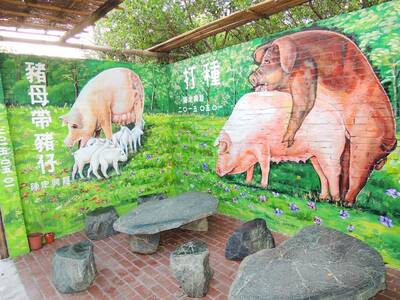
May 6 to May 12 Those who follow the Chinese-language news may have noticed the usage of the term zhuge (豬哥, literally ‘pig brother,’ a male pig raised for breeding purposes) in reports concerning the ongoing #Metoo scandal in the entertainment industry. The term’s modern connotations can range from womanizer or lecher to sexual predator, but it once referred to an important rural trade. Until the 1970s, it was a common sight to see a breeder herding a single “zhuge” down a rustic path with a bamboo whip, often traveling large distances over rugged terrain to service local families. Not only
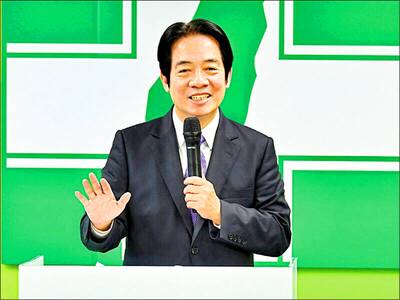
Ahead of incoming president William Lai’s (賴清德) inauguration on May 20 there appear to be signs that he is signaling to the Chinese Communist Party (CCP) and that the Chinese side is also signaling to the Taiwan side. This raises a lot of questions, including what is the CCP up to, who are they signaling to, what are they signaling, how with the various actors in Taiwan respond and where this could ultimately go. In the last column, published on May 2, we examined the curious case of Democratic Progressive Party (DPP) heavyweight Tseng Wen-tsan (鄭文燦) — currently vice premier
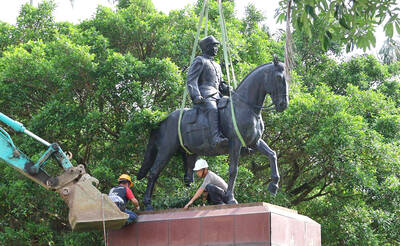
The last time Mrs Hsieh came to Cihu Park in Taoyuan was almost 50 years ago, on a school trip to the grave of Taiwan’s recently deceased dictator. Busloads of children were brought in to pay their respects to Chiang Kai-shek (蔣中正), known as Generalissimo, who had died at 87, after decades ruling Taiwan under brutal martial law. “There were a lot of buses, and there was a long queue,” Hsieh recalled. “It was a school rule. We had to bow, and then we went home.” Chiang’s body is still there, under guard in a mausoleum at the end of a path

Last week the Directorate-General of Budget, Accounting and Statistics (DGBAS) released a set of very strange numbers on Taiwan’s wealth distribution. Duly quoted in the Taipei Times, the report said that “The Gini coefficient for Taiwanese households… was 0.606 at the end of 2021, lower than Australia’s 0.611, the UK’s 0.620, Japan’s 0.678, France’s 0.676 and Germany’s 0.727, the agency said in a report.” The Gini coefficient is a measure of relative inequality, usually of wealth or income, though it can be used to evaluate other forms of inequality. However, for most nations it is a number from .25 to .50


 RSS
RSS