


Friends call him "Mr. Style" and his KTVs, lounge bars and restaurants have defined the entertainment aesthetic of Taipei over the past decade.
British architectural and design consultant Mark Lintott presided over the almost baroque look of VMix KTV on Linsen North Road, the purple wonderland feel of Mint at 101 and the billowy elegance of Le Petit Sherwood Carrera Restaurant.
But he is resistant to the idea of being called a style guru.
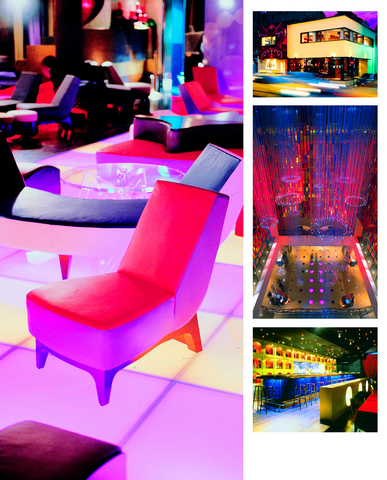
"Style implies a package of ideas you always follow. It's too two-dimensional and skin deep: like buying off the shelf," he says at an interview in his office on Da-an Road in Taipei. "It's not as bad as being called trendy, I guess. That just drives me mad."
A bundle of energy, he fiddles with his PDA phone, twirls around on his chair and completes a Friedensreich Hundertwasser-like doodle of a futuristic building as we talk.
The 46-year-old graduated with a BA in environmental design and earned his spurs at an interior design firm in the 1980s.
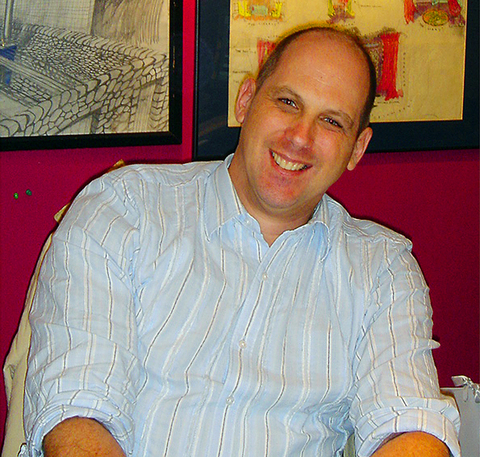
PHOTO COURTESY OF MARC GERRITSEN
"It was eight to nine years of learning the job, basically. From a design point of view it was about balancing an esoteric or intellectual approach with a practical or commercial edge."
His early credits include work for the "eccentric, very short and big on charisma" pop star Adam Ant. He oversaw projects for "socialists with swimming pools" in London and had a hand in the birthplace of punk, at the World End Store belonging to Vivienne Westwood and Malcolm McClaren.
It was an interesting time, he says. "There was a lot of creative energy. I think the UK class system generated a lot of friction and created a dialogue. It's one of the reasons we're so strong culturally."
"Brits have that about them, the desire to question authority ... and the class system, which is quite despicable but also quite positive."
He describes his own background as middle class and "artistic rather than academic."
He went to a boarding school and is grateful that his parents allowed him to follow his own path.
He first encountered what he calls the "architectural anarchy of the ROC" when his company was commiss-ioned to do a job for ATT in 1988.
"I came for a week and stayed for a month. There were two or three other projects I wanted to do and basically the company let me open an office here."
Soon after settling Lintott lost nearly everything. He parted with his old firm and later broke up with his first wife (with whom he has a 19-year-old daughter). Flying solo, he started Mark Lintott Design (mld) in 1991.
"I struggled for a long time but positive aspects outweighed the negative and the practice developed," Lintott says, adding he doesn't regret the move. "I've built four or five times more than I would've done in the same time if I had stayed in London."
Like many expats he has an ambivalent attitude toward both his mother country and adopted country. He enjoys being a big fish in a small pond and has done things here he could not have done at home, like being a model or appearing in films. Yet, there are contradictions.
"I've got no hankering after London as I'm not fussed about recognition. Design in England is snooty and cliquey. Nowadays I question a lot of the value of what they do."
As for Taiwan, he says, "Taipei is not a world-class city. I say that with tremendous disappointment but it's the truth. I mean, just look at the infrastructure. Drive down to Taichung and the road is full of potholes. The toll system doesn't work."
In the next breath, Lintott then admits that if Taiwan was the same as other, more developed countries, then it would not have the same appeal.
"Especially a few years ago there was a fantastic energy, an almost adolescent dynamism here. It was like you could wake up in the morning and open a restaurant or something. Anything."
Lintott just about refrains from saying he loves Taiwan and instead attacks whinging foreigners.
"I don't like their attitude. I'm emotionally attached to Taiwan. I have a loyalty to the place and a lot of luggage here."
Lintott tied the knot again in Las Vegas seven years ago with a Taiwanese-American and they now have a five-year-old daughter.
Domestic and commercial stability has brought him to a point where he has to balance the attraction of new opportunities with the necessity of keeping what he's got.
Though he has worked on projects in China and elsewhere he doesn't want to spend half his life on a plane going from one appointment to another.
"I don't want to put my family at risk and I don't want to jeopardize my business. As a young man you have no loyalty or baggage."
Even so, Lintott describes himself as a person who "grinds on things mentally and who is naturally restless. He has projects in the pipeline that excite him, such as opening a large swanky restaurant, putting out a range of entertainment furniture and opening a London-style members club.
He smiles when he says he wants to reverse the flow and export design to England. It's his competitive edge.
He reckons that he has succeeded because, "What I do has a very definite commercial angle. I'm quite good at that and I always make money for my clients."
This is borne out by the fact that places he has worked on such as Opium Den, Plush and the original Room 18 have done well. People like his aesthetic.
"Design can create a buzz. It could be a beautiful place, but crap commercially because people don't feel comfortable. It's better if it looks like shit but does well."
Asked to come up with a definition of his work, he calls it "eclectic modernism. This is diametrically opposed to postmodernism which was re-appropriating the symbols, objects and features of past architecture and putting it together in blocks, like children's toys. I'm very against that banal and irrelevant attitude."
"[My work] is theatrical, even feminine, an entertainment for people. It should be an illusion, transparent and delightful. This is what people respond to."

In late October of 1873 the government of Japan decided against sending a military expedition to Korea to force that nation to open trade relations. Across the government supporters of the expedition resigned immediately. The spectacle of revolt by disaffected samurai began to loom over Japanese politics. In January of 1874 disaffected samurai attacked a senior minister in Tokyo. A month later, a group of pro-Korea expedition and anti-foreign elements from Saga prefecture in Kyushu revolted, driven in part by high food prices stemming from poor harvests. Their leader, according to Edward Drea’s classic Japan’s Imperial Army, was a samurai

The following three paragraphs are just some of what the local Chinese-language press is reporting on breathlessly and following every twist and turn with the eagerness of a soap opera fan. For many English-language readers, it probably comes across as incomprehensibly opaque, so bear with me briefly dear reader: To the surprise of many, former pop singer and Democratic Progressive Party (DPP) ex-lawmaker Yu Tien (余天) of the Taiwan Normal Country Promotion Association (TNCPA) at the last minute dropped out of the running for committee chair of the DPP’s New Taipei City chapter, paving the way for DPP legislator Su
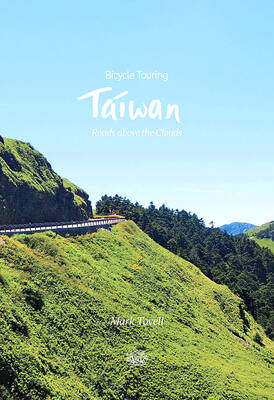
It’s hard to know where to begin with Mark Tovell’s Taiwan: Roads Above the Clouds. Having published a travelogue myself, as well as having contributed to several guidebooks, at first glance Tovell’s book appears to inhabit a middle ground — the kind of hard-to-sell nowheresville publishers detest. Leaf through the pages and you’ll find them suffuse with the purple prose best associated with travel literature: “When the sun is low on a warm, clear morning, and with the heat already rising, we stand at the riverside bike path leading south from Sanxia’s old cobble streets.” Hardly the stuff of your

Located down a sideroad in old Wanhua District (萬華區), Waley Art (水谷藝術) has an established reputation for curating some of the more provocative indie art exhibitions in Taipei. And this month is no exception. Beyond the innocuous facade of a shophouse, the full three stories of the gallery space (including the basement) have been taken over by photographs, installation videos and abstract images courtesy of two creatives who hail from the opposite ends of the earth, Taiwan’s Hsu Yi-ting (許懿婷) and Germany’s Benjamin Janzen. “In 2019, I had an art residency in Europe,” Hsu says. “I met Benjamin in the lobby


 RSS
RSS