


In the depths of a desert canyon, below a massive wall of streaked, multihued stone, Amanda Wicks reached up to touch the gritty rock face. The climbing rope at her waist, a pink cord of knotted nylon, pulled tight as Wicks stepped forward to start the ascent.
"OK, I'm climbing!" she yelled out, signaling her guide a rope's length above, 49m up on a small sloping ledge. Scrub oak and juniper choked a streambed below. Across the canyon, a rare dusting of desert snow coated the hillside, white powder on red sand.
Feet gripped on small edges, fingers on cold stone, Wicks worked through the initial moves. It was 8:30am on a Monday in March. The Nevada sun blazed overhead.

PHOTOS: NY TIMES NEWS SERVICE
The climb, a sheer vertical route, stretched 610m into the sky. It would be well after dark, casinos blinking in the far distant night, when the climbers would return from the summit and again set foot on flat ground.
Wicks, a 25-year-old graduate student at the University of Nevada, Las Vegas, had signed up for a daylong climb in Red Rock Canyon National Conservation Area, a barren, craggy park 27km west of the Las Vegas Strip.
Since the 1970s, when climbers first came to the area, more than 2,000 rock climbing routes have been pioneered on Red Rock Canyon's tall cliffs and sandstone domes. Recent surveys show that more than 100,000 climbers visit Red Rock Canyon each year, according to Jed Botsford, an outdoor recreation planner with the park.
Red Rock is an austere wilderness of arid plains and Joshua trees. Mountain peaks rise thousands of feet off the desert floor. Petroglyphs bake in the sun. Wild burros and desert tortoises track the park's coarse sand.
The strange geology of the region, including giant petrified sand dunes, strata thrusts and sedimentary capstone, make Red Rock Canyon a unique and varied climbing environment. Difficult single-pitch (one rope length) climbs flank roadside crags. The mountain faces, reached via wilderness hiking trails, are among North America's most unrelenting formations: Some cliffs reach above 914m, more than twice the height of the Empire State Building and nearly as sheer.
The route Wicks and her guide chose to climb, a line up the south face of 2,085m Rainbow Mountain, had 13 rope lengths, or pitches, of technical climbing. Its crux section, rated an intermediate grade of 5.9 (the 5 indicates the class of climb; the 9 is in the middle range on a 1-to-15 difficulty scale), requires subtle balance, long reaches and precise footwork on a slab of polished sandstone. "I'm expecting an epic," Wicks had said while lacing her purple climbing shoes at the base of the mountain buttress.
After climbing 48.7m, on the top of the first pitch of the day, Wicks squeezed onto the ledge with her guide, Roxanna Brock, a 39-year-old climber who works for Mountain Skills Rock Climbing Adventures, one of four companies licensed to guide in the park. Carabiners snapped shut as Brock clipped her client into a system of safety lines.
"I'm freezing -- I gotta' get climbing," said Brock, who was working to manage the rope coiled at her feet.
Draped with nylon slings, her harness gear loops stocked with carabiners, cord and protection anchors, Brock began climbing the next section. Their roles leapfrogged: Wicks now belayed the guide as she prepared to ascend an exposed arete.
Brock moved across a ledge and climbed straight up on blank-looking stone, the pink rope trailing between her legs. Slick desert varnish, a shiny rust-brown veneer over cream-colored sandstone, coated the route above. But small cracks and intermittent holds, protruding wartlike from the rock, provided passage up an otherwise smooth surface.
"Whew, it's getting windy up here," Brock said, pulling her body around the outside corner of the dihedral, 61m of air beneath her toes. Her climbing shoes -- two sizes too small for better sensitivity on the rock -- stuck like fly feet to the wall.
Her eyes scanned the route above, fingers moving to lock on tiny holds and smooth pockets. With one hand pinched on a hold, Brock reached down to her waist to pull up a bight of rope, preparing to clip an anchor at eye level on the rock. "Give me some slack," she yelled down to her belayer.
For the next six hours, the two were tethered together, each tied into a respective end of the rope as they climbed the cliff one pitch at a time. Brock led every section, placing cam anchors, clipping the occasional in-situ bolt and jamming metal chocks into cracks for protection in case of a fall; Wicks climbed second, removing the anchors as her guide reeled in rope from a ledge above.
Gear was reorganized methodically at each belay ledge. Brock kept cam anchors up front on harness gear loops; carabiners were stacked farther back on her hips. The rope was coiled and flaked out a dozen times throughout the day to keep it tangle free. Knots were double-checked at every ledge.
Each new pitch began with a compulsory and singsong canting between climber and belayer -- "on-belay; belay-on; climbing; climb-on" -- to ensure both partners were ready, system in sync.
At noon the pair crested 305m. The desert floor became a blur of earthy red and brown and chalky tan. Trees were green fuzzy dots, the hiking trail back toward the car a faint line in the sand.
Depth perception was lost in the airy open space. Mount Wilson, a gargantuan neigh-boring peak a kilometer across the canyon, seemed close enough to spit on. The distant highway and hills, and the tiny cars below, took on all the manicured verisimilitude of a model railroad set.
The steep rock continued, pitch after pitch, an endless slab of upright stone. Clouds dotted the desert sky by 1pm.
"We must be getting close," Wicks said, tying into an anchor at the top of the 11th pitch. A dizzying abyss, wide and windy, expanded out, up, down and side to side from the climbers' stance.
Wicks leaned into the rock, visibly tired and moving slow. But she was upbeat, smiling.
The day's climb, so far more than 457m of vertical rock, was the most Wicks had ever completed. And still the great stone of Red Rock Canyon towered above.
"All right, Roxanna, you're on belay," Wicks said, focusing on the present task. Her hands gripped the climbing rope, ready to feed out the next 48.7m of line while her guide climbed ahead.
A carabiner snapped shut as Brock paused at the first anchor. Tight little shoes tiptoed on a vertical wall. The rope trailed the climber, moving through metal rings and rubbing softly on the rock, a lifeline extending, a quiet whir on the high mountain face.
For your information:
Taiwan has superb rock climbing, and indoor facilities for climbers of all levels.
* The Taiwan Rock Climbing Corp runs outdoor and indoor courses for beginners and more advanced climbers: Call (02) 2767-1233 or visit www.trc.org.tw
* For a list of indoor climbing facilities visit www.indoorclimbing.com/taiwan.html
* For a lowdown on the best outdoor climbing sites visit www.rockclimbing.com/routes/listState.php?CountryStateID=132
* Taichung resident Ron Heinsman has a Web site devoted to rock climbing which features reviews of and information on local rock climbing sites: www.geocities.com/taiwan_rock/twp.html
Source: rockclimbing.com

In late October of 1873 the government of Japan decided against sending a military expedition to Korea to force that nation to open trade relations. Across the government supporters of the expedition resigned immediately. The spectacle of revolt by disaffected samurai began to loom over Japanese politics. In January of 1874 disaffected samurai attacked a senior minister in Tokyo. A month later, a group of pro-Korea expedition and anti-foreign elements from Saga prefecture in Kyushu revolted, driven in part by high food prices stemming from poor harvests. Their leader, according to Edward Drea’s classic Japan’s Imperial Army, was a samurai

The following three paragraphs are just some of what the local Chinese-language press is reporting on breathlessly and following every twist and turn with the eagerness of a soap opera fan. For many English-language readers, it probably comes across as incomprehensibly opaque, so bear with me briefly dear reader: To the surprise of many, former pop singer and Democratic Progressive Party (DPP) ex-lawmaker Yu Tien (余天) of the Taiwan Normal Country Promotion Association (TNCPA) at the last minute dropped out of the running for committee chair of the DPP’s New Taipei City chapter, paving the way for DPP legislator Su
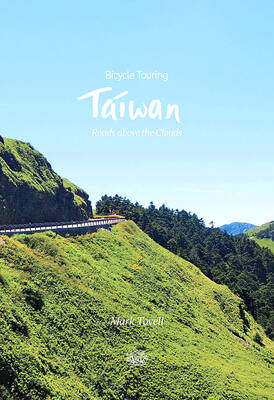
It’s hard to know where to begin with Mark Tovell’s Taiwan: Roads Above the Clouds. Having published a travelogue myself, as well as having contributed to several guidebooks, at first glance Tovell’s book appears to inhabit a middle ground — the kind of hard-to-sell nowheresville publishers detest. Leaf through the pages and you’ll find them suffuse with the purple prose best associated with travel literature: “When the sun is low on a warm, clear morning, and with the heat already rising, we stand at the riverside bike path leading south from Sanxia’s old cobble streets.” Hardly the stuff of your

Located down a sideroad in old Wanhua District (萬華區), Waley Art (水谷藝術) has an established reputation for curating some of the more provocative indie art exhibitions in Taipei. And this month is no exception. Beyond the innocuous facade of a shophouse, the full three stories of the gallery space (including the basement) have been taken over by photographs, installation videos and abstract images courtesy of two creatives who hail from the opposite ends of the earth, Taiwan’s Hsu Yi-ting (許懿婷) and Germany’s Benjamin Janzen. “In 2019, I had an art residency in Europe,” Hsu says. “I met Benjamin in the lobby


 RSS
RSS