


Surrounded by mountains, with lakes and babbling brooks to boot, Meinung (美濃) is the ideal getaway spot. The Hakka town boasts more than just scenic beauty -- the hardworking, familial spirit of traditional Hakka culture also imbues Meinung with oodles of charm.
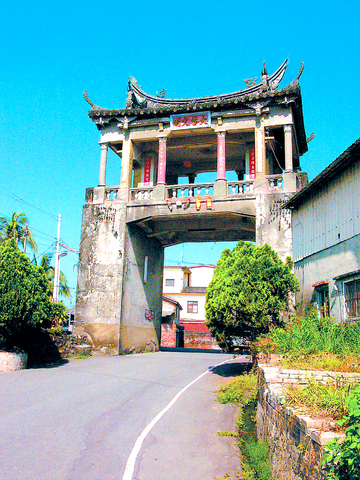
The heart of Meinung's traditional Hakka culture is concentrated on the town's main street, Yungan Road (
Bicycling is an excellent way to take in Meinung's sights. Seven paths, each color coded, are currently open to cyclists. The red line is devoted to cultural relics, the green line has a literary theme, and the blue line offers charming views of the irrigation canals that crisscross the landscape. The far-off silhouettes of mountains, the expanse of rice paddies, and the inverted, watery reflections of Chungcheng Lake (中正湖) have enchanted travelers for years. The delicious Hakka cuisine keeps visitors coming back.
PHOTOS: WU MENG-FANG, TAIPEI TIMES
Blue Hakka tunics
Blue tunics are a Hakka cultural mainstay. In the past, most Hakka women donned the baggy, loose blouse. The tunics were worn until they became dog-eared and tattered, and only then would new ones be bought -- a testament to the Hakka work ethic and their thriftiness. The versatility of the traditional tunic also extended to when one could wear it -- always. Loose-fitting and practical, the tunic was appropriate in both formal and informal circumstances, and comfortable in all seasons.
Of course, the popularity of the tunic has faded: Now Meinung residents rarely wear it, save for at Hakka cultural performances and other special occasions. As a result, Hakka tunic shops have all but disappeared. However, one shop still holds tenaciously to tradition, with its old-style tailoring services and handmade tunics. The Chinhsing Blue Tunic shop (錦興藍衫店) on Yongan Street is the last of its kind. Hsieh Ching-lai (謝景來), a spry nonagenarian, is still behind the scissors in his shop after more than 70 years of fashioning tunics. He was apprenticed at 17 and launched his own tunic-making business in his 20s. At the height of his business, Hsieh taught his trade to over 200 students. Later, however, the rising popularity of Western fashions affected the blue Hakka tunic industry. Although the tunics are not fancy, they are meticulously made and are high quality.
■ Price: NT$2000 per tunic
■ Can be custom-made in about two weeks
■ Chinhsing Blue Tunic Shop telephone: (07) 681 1191
Oilpaper umbrellas
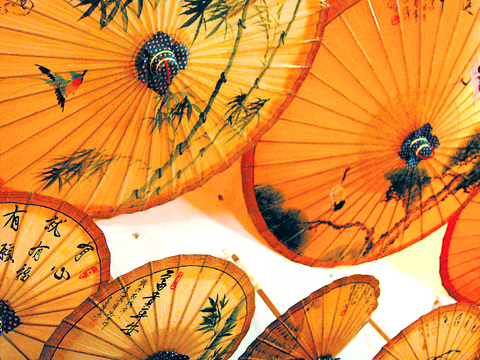
Some folks believe that umbrellas make unlucky gifts. In Meinung, however, umbrellas are elegant, auspicious objects. Oilpaper umbrellas are Meinung's specialty. Moreover, a play on words makes these paper parasols especially propitious. The Chinese words for "paper" (
Hakka oilpaper umbrellas were once practical necessities. Now, such parasols are considered more decorative than useful; nevertheless, they remain popular as mementos of trips to Meinung. Although the umbrellas are fashioned from simple materials like cotton paper, bamboo and twine, the production process is complicated. The bamboo is first boiled in water to leech the sugar from its core, after which it is cut into strips that are to be the umbrella's spokes. Once the spokes are attached to the shaft of the umbrella, concentric circles of twine are added. Then, the cotton paper is fastened to the umbrella's "skeleton." The paper is then decorated with colorful illustrations of natural landscapes, mythical creatures, or other traditional images. Finally, the umbrella is varnished and set out in the sun to dry.
Of course, even today's oilpaper umbrellas retain their practical uses. They still keep folks more or less dry in the rain, but although they're water resistant, they're particularly susceptible to fire. Also, they become brittle if not used regularly, and the oilpaper tends to stick to itself if the parasol remains closed for an extended period.
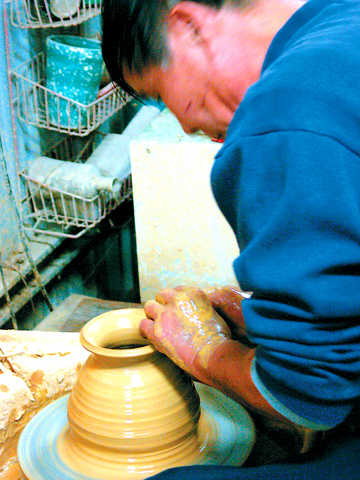
Pottery
A small pottery and ceramics industry sprung up in 1987, when local artist Chu Bang-hsiung (
Potters set up work shops, and seven ceramics shops in the kiln's vicinity. Slowly but steadily, Meinung gained recognition as a center of the ceramic arts. The shops retail a wide variety of ceramics, and although more rustic than sophisticated, they encapsulate the unpretentious spirit of Meinung culture.
Local delicacies: Bantiao noodles
A trip to Meinung wouldn't be complete without sampling bantiao noodles. Made from aged tsailai rice (
■ Meinung Chuang telephone: (07) 681 8989
Sightseeing in Neimen
Separated from the Meinung Township (美濃鎮) by Chishan (旗山鎮) and Shanlin (杉林鄉) townships, Neimen township (內門鄉), on Highway 3 (
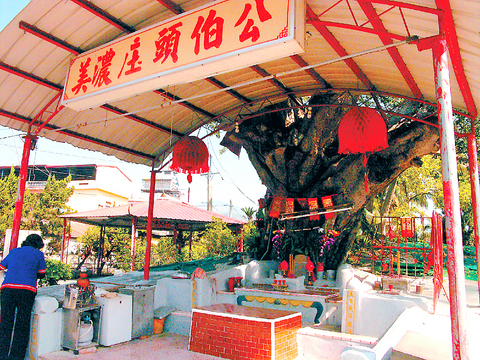
Locals with a big stake in the future, from soon-to-be-wed couples to political candidates, often converge on Neimen's famous Tzuchu Temple (
Tzuchu Temple is the religious center of Neimen. The village hosts performances that combine mock martial arts battles and dance, which are performed by costumed acrobatic troupes. The Songjiang Battle Array (宋江陣) is the most popular of these spectacles. In addition to the traditional battle arrays, Kaohsiung County Government also hosts the Creative Battle Array Competition (創意宋江陣), an annual nine-day contest that attracts hordes of enthusiasts.
In addition to its cultural attractions, Neimen's landscape also contributes to its uniqueness. The eerie Moon World (月世界), a barren landscape covering 100,000 hectares, encircles Neimen with its strange, denuded mountains. Moon World's infertile soil is known in geological terms as "mudstone," originally a clay-like, ocean-floor sediment dredged up on the backs of mountains that were formed through orogenic movement.
Over millions of years the soil was eroded by the elements, becoming mudstone, which is too salty, dry and loose to sustain vegetation.
As its name suggests, Neimen's Moon World, in the vicinity of the 29-kilometer marker on County Road 182 (182
The view from Hill 308, where the townships of Neimen, Lungchi (

In late October of 1873 the government of Japan decided against sending a military expedition to Korea to force that nation to open trade relations. Across the government supporters of the expedition resigned immediately. The spectacle of revolt by disaffected samurai began to loom over Japanese politics. In January of 1874 disaffected samurai attacked a senior minister in Tokyo. A month later, a group of pro-Korea expedition and anti-foreign elements from Saga prefecture in Kyushu revolted, driven in part by high food prices stemming from poor harvests. Their leader, according to Edward Drea’s classic Japan’s Imperial Army, was a samurai

The following three paragraphs are just some of what the local Chinese-language press is reporting on breathlessly and following every twist and turn with the eagerness of a soap opera fan. For many English-language readers, it probably comes across as incomprehensibly opaque, so bear with me briefly dear reader: To the surprise of many, former pop singer and Democratic Progressive Party (DPP) ex-lawmaker Yu Tien (余天) of the Taiwan Normal Country Promotion Association (TNCPA) at the last minute dropped out of the running for committee chair of the DPP’s New Taipei City chapter, paving the way for DPP legislator Su
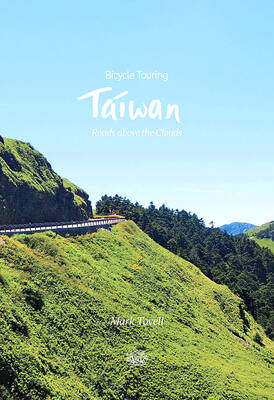
It’s hard to know where to begin with Mark Tovell’s Taiwan: Roads Above the Clouds. Having published a travelogue myself, as well as having contributed to several guidebooks, at first glance Tovell’s book appears to inhabit a middle ground — the kind of hard-to-sell nowheresville publishers detest. Leaf through the pages and you’ll find them suffuse with the purple prose best associated with travel literature: “When the sun is low on a warm, clear morning, and with the heat already rising, we stand at the riverside bike path leading south from Sanxia’s old cobble streets.” Hardly the stuff of your
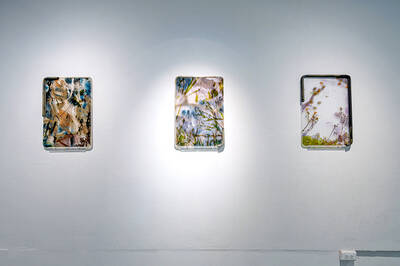
Located down a sideroad in old Wanhua District (萬華區), Waley Art (水谷藝術) has an established reputation for curating some of the more provocative indie art exhibitions in Taipei. And this month is no exception. Beyond the innocuous facade of a shophouse, the full three stories of the gallery space (including the basement) have been taken over by photographs, installation videos and abstract images courtesy of two creatives who hail from the opposite ends of the earth, Taiwan’s Hsu Yi-ting (許懿婷) and Germany’s Benjamin Janzen. “In 2019, I had an art residency in Europe,” Hsu says. “I met Benjamin in the lobby


 RSS
RSS