


It takes Damian Marley just 20 minutes to lose patience with me and ask himself the question I've been skirting around. "You wanna know what it feel like to be a Marley?" he erupts in magnificently defiant Jamaican-English. "It's difficult to explain because that's all I've ever been. I don't know. Because I've never been you, I can't explain how it feels to be you instead of being me. All I do know is that when I was growing up, a lot of people knew my father's name, then knew my name."
And Marley has long been aware of what it means to carry that name. "In my teens I started realizing what 'im [Bob] really meant to the world, as opposed to just being a singer. He's not the Rolling Stones or whatever. To a lot of people, he means much more than that.
"It's spirituality. And when I started to realize that, that's when I began to listen to the music and view the world in a different way."
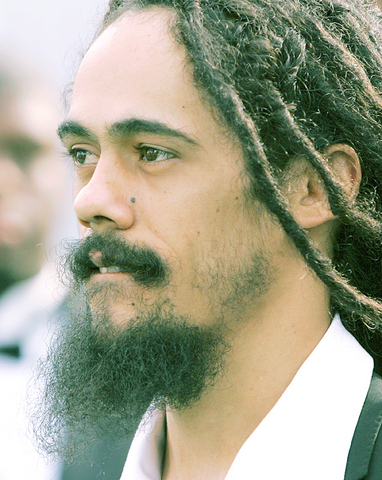
Bob Marley -- "Tuff Gong" -- was 30 when the live version of No Woman No Cry first crashed reggae music into the mainstream charts in 1975. And Damian -- "Jr. Gong" -- isn't the only Marley offspring to attempt to live up to that legacy. However, where his elder siblings (notably Ziggy, with the Melody Makers) have mostly adhered to the sunnier, more palatable One Love and Three Little Birds blueprint, 27-year-old Damian has picked up the simmering anger and harder political content in his father's less well-known music. You can hear it in Welcome to Jamrock, the title track of his third album and Damian's first worldwide hit. An unflinching depiction of Kingston's gun crime and political corruption, it caused outrage within Jamaican tourist agencies -- and, he notes wryly, is currently equally topical in the UK. The approach is winning Jr. Gong celebrity fans (Kanye West described Jamrock as "the song of the year") and has sent the album into the US top 10 -- a feat Tuff Gong managed just once, in 1976, with Rastaman Vibration.
Perhaps the key to the siblings' contrasting approach to the Marley musical legacy lies in their different backgrounds. Four of Marley's musical children come from his marriage to Rita Marley.
However, Damian is the product of Bob's relationship with the 1976 Miss World, Cindy Breakspeare -- and it seems that some elements of Jamaican society have looked down on him as the illegitimate son of a Canadian-Jamaican beauty queen.
"I'll give you one instance," he says. "One time there was a tribute concert to my father. I was on stage but wasn't really prepared. So I did a freestyle lyric on Shabba Ranks' My Daddy Was a Bedroom Bully -- and went on to name my brothers and sisters. I was really saying, `My father had lots of kids, give thanks.' But some of the press had a feast. There was a comment about my mum: `What else can we expect of Damian when he was raised by the woman who was singing Turn Your Lights Down Low (Bob Marley's song, inspired by Breakspeare) in front of Marley's wife Rita?' My mother wasn't even at the concert," he spits, "never mind on stage." Marley, though, is nothing if not mischievously combative. "That kind of thing makes me want to hit back even harder. So now I do even more lyrics like Bedroom Bully." He grins.
Meeting Marley, it's hard not to see him as a natural rebel. Perhaps it's the way his dreadlocks hang down to his knees: he's refused to cut his hair since leaving school in 1997. He also looks younger and more handsome than in photos, his striking features conjuring a vision of Bob Marley played by Johnny Depp.
Bob Marley died (of cancer at the age of 36) when his son was just two, so Damian never really knew him. He has hazy memories of being told "what happened." Of course, there's a vast amount of material in the public domain about Bob, but rather than use it to get a better sense of what his father was like, Damian ignores it.
"I've never read a book about my father," he says. "These books, they're one-sided. What I know of my father is what my mother tells me, or people like [Wailers co-founder] Bunny Wailer, my brothers. I don't need dem books."
Nor would he trace his rebellious character to Bob alone. In fact, he says, it was first triggered by his stepfather, criminal lawyer Tom Vincent, whom Breakspeare married a year after Bob's death, and who also has a history of political engagement.
Vincent taught the youngster to count by tapping a pencil on the table. "I'd go, `One-two-three-five' and get a tap on the knuckles with the pencil. Of course I rebelled." He sees the benefits now, but in childhood there were arguments with his mother and trouble at school.
Marley formed his first band when still at school. Called the Shepherds, they comprised the offspring of other reggae celebrities Freddie McGregor and Third World, and would perform songs by their parents -- plus, inexplicably, a cover of Phil Collins' Another Day in Paradise. Marley cringes. "I hated it. At the time I wanted to be dancehall. My hero was (New York hip-hopper) Jeru the Damaja."
Initially worried that his schoolwork would suffer, his mother glimpsed young Damian's potential when the band got together to rehearse in the living room, and instead of the dirt bike he wanted for his birthday, she bought him music equipment. He recorded his first album in high school and proudly called it Mr Marley, a mark of his growing awareness of Bob's ethereal presence in his life.
Damian had always listened to Bob's music, but initially they were just tunes his mother played, along with the Beatles, Sade, Nat King Cole. As he grew older, he became fascinated by the troubled, isolated voice on songs like Crazy Baldheads and If the Cap Fits, long ignored by the radio but now occasionally featuring in Damian's live set. It was these -- plus the Shabba Ranks, Super Cat and Dennis Brown concerts he attended in his teens -- that most influenced his own lyrics and sound.
You get the sense that for Damian, making political music is a -- possibly subconscious -- way of getting closer to his father. He has, though, been criticized for performing songs such as his father's War. "Some people say, `You didn't have to suffer. You weren't raised in the ghetto,'" he admits. "Or, `His father sang One Love. Why does he say these things?' But my father also sang Burning and Looting. I have never wanted for material things but that doesn't mean I can't make a contribution to other people's lives. I'm part of a community, the world. If I could suffer to help them I would."
He shivers at talk of him filling the chasm left in reggae since Bob's death, but he has undeniably inherited his father's desire to "make a difference." Three decades after Bob Marley united Jamaica's warring politicians, his son talks of his hopes to build schools and refresh neighborhoods. "I want to become a force for change -- even if that means upsetting people," he declares. "I'm thankful it was Jamrock, the track, which opened things up for me. I'm a popular artist who's known as a political artist." Will that continue? He flashes a grin. "Knowing me, more than likely."

In late October of 1873 the government of Japan decided against sending a military expedition to Korea to force that nation to open trade relations. Across the government supporters of the expedition resigned immediately. The spectacle of revolt by disaffected samurai began to loom over Japanese politics. In January of 1874 disaffected samurai attacked a senior minister in Tokyo. A month later, a group of pro-Korea expedition and anti-foreign elements from Saga prefecture in Kyushu revolted, driven in part by high food prices stemming from poor harvests. Their leader, according to Edward Drea’s classic Japan’s Imperial Army, was a samurai

The following three paragraphs are just some of what the local Chinese-language press is reporting on breathlessly and following every twist and turn with the eagerness of a soap opera fan. For many English-language readers, it probably comes across as incomprehensibly opaque, so bear with me briefly dear reader: To the surprise of many, former pop singer and Democratic Progressive Party (DPP) ex-lawmaker Yu Tien (余天) of the Taiwan Normal Country Promotion Association (TNCPA) at the last minute dropped out of the running for committee chair of the DPP’s New Taipei City chapter, paving the way for DPP legislator Su
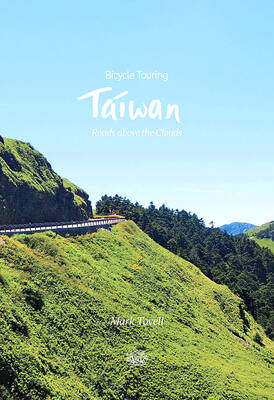
It’s hard to know where to begin with Mark Tovell’s Taiwan: Roads Above the Clouds. Having published a travelogue myself, as well as having contributed to several guidebooks, at first glance Tovell’s book appears to inhabit a middle ground — the kind of hard-to-sell nowheresville publishers detest. Leaf through the pages and you’ll find them suffuse with the purple prose best associated with travel literature: “When the sun is low on a warm, clear morning, and with the heat already rising, we stand at the riverside bike path leading south from Sanxia’s old cobble streets.” Hardly the stuff of your

Located down a sideroad in old Wanhua District (萬華區), Waley Art (水谷藝術) has an established reputation for curating some of the more provocative indie art exhibitions in Taipei. And this month is no exception. Beyond the innocuous facade of a shophouse, the full three stories of the gallery space (including the basement) have been taken over by photographs, installation videos and abstract images courtesy of two creatives who hail from the opposite ends of the earth, Taiwan’s Hsu Yi-ting (許懿婷) and Germany’s Benjamin Janzen. “In 2019, I had an art residency in Europe,” Hsu says. “I met Benjamin in the lobby


 RSS
RSS