


Copies of this book are displayed prominently in the Gongguan branch of the Eslite bookstore in Taipei, next to John Banville's The Sea, winner of last year's Man Booker Prize. It wasn't very enthusiastically reviewed when it appeared in hardback, yet it's a wonderful work that gets better the more of it you read.
Hanif Kureishi has enjoyed a very successful career. He was initially welcome material for the multiculturalist critics who wanted to be enthusiastic about a Britain where people from varied ethnic backgrounds flourished happily together. Later, however, he became valued in his own right.
He was born in the UK in 1954, the son of a Pakistani father and an English mother. His father worked in the Pakistan embassy in London, and the family enjoyed a middle-class life in suburban Kent. In a photo on this book's back cover father and son are sitting in a small English garden in pale spring sunlight. Father is smoking his pipe and reading, while the infant Hanif, teddybear in lap, looks on, already with a puzzled expression on his face.

The puzzlement increased as he grew older. After school he went off to a small northern town and set up house with his girl-friend for a year. Then he returned south and dutifully began a course in philosophy at London University. His father wanted him to become a writer, and soon he was succeeding beyond his parents' greatest expectations. Drama was his first preoccupation, and before long he was Writer-in-Residence at London's trendsetting Royal Court Theater.
At 30 he wrote the script for the successful film My Beautiful Laundrette, followed by Sammy and Rosie Get Laid (1987). On one occasion Samuel Beckett gave him ?50 for a course he wanted to enroll in. He apparently wrote for pornographic magazines under the pseudonym Antonia French, but even when writing under his own name was always considered unpredictable and refreshingly cross-cultural.
His father's ambitions were also literary, but more cautiously. In the 1950s most people in Britain thought you should have a regular job and a secure income, and only risk artistic expression after-hours, in amateur theater, for example, or as a weekend novelist. Social barriers, too, were not to be challenged, especially by members of racial minorities enjoying middle-class jobs.
And so it was that Kureishi senior penned novels about his life before he came to the UK. The discovery of one of these manuscripts forms the starting-point for My Ear At His Heart. What will it tell him about his father, Hanif wonders. And in the process of uncovering its secrets, Kureishi manages to reveal a good deal more about himself, which was perhaps what he wanted to do all along.
Early on in the book he writes: "It annoys me, as it might any novelist, to have my own work reduced to autobiography, as though you've just written down what happened." Yet the most controversial moment in Kureishi's career came with the appearance of a novel in 1998 entitled Intimacy, a detailed narrative by a man who was about to leave his wife and children. This is precisely what Kureishi in fact did at the identical time, and unsurprisingly his wife tried to have the book withdrawn immediately after it was published. Fiction and fact, then, are never far apart, both in Hanif Kureishi's books and in the two written by his father that he discusses here.
There are many English son-and-father books, from Edmund Gosse's Father and Son (1907) to J.R. Ackerley's subversive My Father and Myself (1969). Both those authors were gay, as it happens, and Ackerley even discovered that his father had been a homosexual prostitute when young. It's refreshing, therefore, to find a notably non-gay writer like Kureishi meditating on this archetypal relationship. Indeed, he extends the analysis by also writing about his own children, and his emerging father-child relationship with them.
This book's subtitle, Reading My Father, is clearly meant to be taken in two senses. And Kureishi senior does take some understanding. He feels betrayed when his son decides to visit Pakistan, never having been back himself. In fact he lives between two worlds, despising his Asian roots yet desperately attached to an already dying form of English life -- politeness, social deference, cricket and the keeping up of appearances.
Kureishi is astonished to find his father actually wrote about him in his unpublished books. "He ran his fingers through his long black hair," a father-figure writes of his hippie son, "which he had tied at the back with a pink ribbon." Moreover, he also wrote stories specifically about father-son relations, describing, as well as his own children, his own father, an unhappily-married military officer.
But the book eventually leaves the topic of the father for a more interesting area -- Kureishi's own early life in 1970s London. With its evocations of parties, drugs, promiscuous sex and cultural eclecticism, this is fascinating material. At one point he also contacts and meets V.S. Naipaul, another writer with roots in the sub-continent who had a father who was an aspiring writer.
This fine book is essentially about immigrants and their children. In discussing the American son-of-an-immigrant novelist Philip Roth (who he also met), Kureishi has a vision of how first-generation immigrants are unsure of themselves, sexually repressed and excessively conser-vative, but that their integrated off-spring become "fashionable, exotic, hip." This happened with the Jews in the US and was now happening with the Asians in the UK. Hanif Kureishi himself, it should be noted, is both evidence of, and a major contributor to, this very process. But the London he now inhabits was "that chosen home my father knew was there," he sadly concludes, "but could never reach."

In late October of 1873 the government of Japan decided against sending a military expedition to Korea to force that nation to open trade relations. Across the government supporters of the expedition resigned immediately. The spectacle of revolt by disaffected samurai began to loom over Japanese politics. In January of 1874 disaffected samurai attacked a senior minister in Tokyo. A month later, a group of pro-Korea expedition and anti-foreign elements from Saga prefecture in Kyushu revolted, driven in part by high food prices stemming from poor harvests. Their leader, according to Edward Drea’s classic Japan’s Imperial Army, was a samurai

The following three paragraphs are just some of what the local Chinese-language press is reporting on breathlessly and following every twist and turn with the eagerness of a soap opera fan. For many English-language readers, it probably comes across as incomprehensibly opaque, so bear with me briefly dear reader: To the surprise of many, former pop singer and Democratic Progressive Party (DPP) ex-lawmaker Yu Tien (余天) of the Taiwan Normal Country Promotion Association (TNCPA) at the last minute dropped out of the running for committee chair of the DPP’s New Taipei City chapter, paving the way for DPP legislator Su
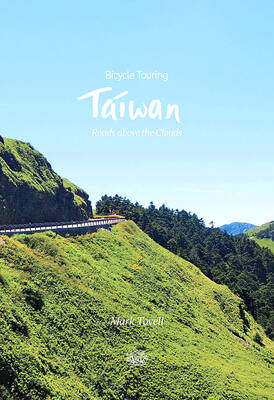
It’s hard to know where to begin with Mark Tovell’s Taiwan: Roads Above the Clouds. Having published a travelogue myself, as well as having contributed to several guidebooks, at first glance Tovell’s book appears to inhabit a middle ground — the kind of hard-to-sell nowheresville publishers detest. Leaf through the pages and you’ll find them suffuse with the purple prose best associated with travel literature: “When the sun is low on a warm, clear morning, and with the heat already rising, we stand at the riverside bike path leading south from Sanxia’s old cobble streets.” Hardly the stuff of your
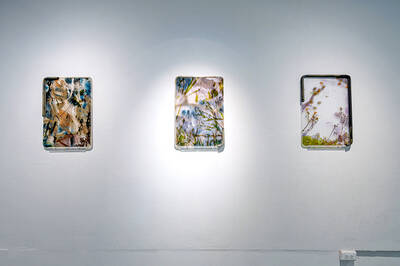
Located down a sideroad in old Wanhua District (萬華區), Waley Art (水谷藝術) has an established reputation for curating some of the more provocative indie art exhibitions in Taipei. And this month is no exception. Beyond the innocuous facade of a shophouse, the full three stories of the gallery space (including the basement) have been taken over by photographs, installation videos and abstract images courtesy of two creatives who hail from the opposite ends of the earth, Taiwan’s Hsu Yi-ting (許懿婷) and Germany’s Benjamin Janzen. “In 2019, I had an art residency in Europe,” Hsu says. “I met Benjamin in the lobby


 RSS
RSS