


The Sudoku craze added another chapter in its phenomenal development last weekend when the gripping number puzzle made its debut as a spectator sport at its inaugural world championships in Italy.
Jana Tylova, a 31-year-old accountant from the Czech Republic, was crowned the queen of Sudoku on Saturday after beating off the challenge of two Americans in a frenetic final round of the two-day event which drew 85 contestants from 22 countries.
But it was the manner of her victory, as she hastily scrawled numbers on a flip chart in front of a room full of tense supporters and spectators, which struck Wayne Gould, the jovial New Zealander known as Suduko's "guru" since transforming the ancient puzzle into a worldwide craze.
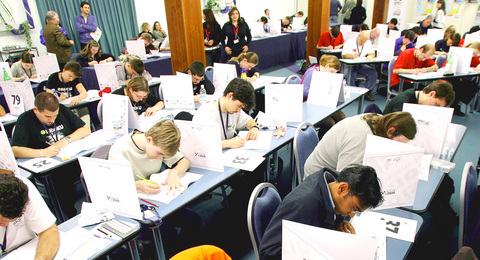
PHOTO: AFP
Watching people think doesn't suggest a spectator sport with lasting appeal, but Gould sees the potential of the flip charts, which he had never seen used before in Sudoku.
One of the Americans, Thomas Snyder, found the unaccustomed attention a little offputting.
"It's something new that I have not done. It was a little distracting standing up in public and having all those photographers trying to get you from every angle, from the front, from behind. etc."
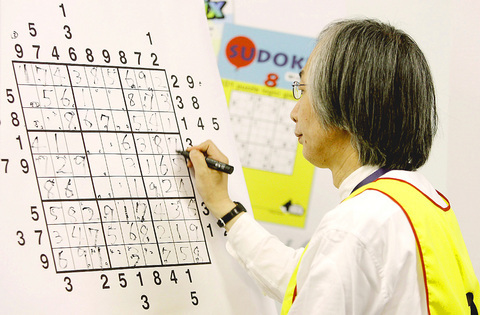
PHOTO: AFP
Gould's advice is that he should get used to it, as the Sudoku craze is here to stay: "I can see the day when video cameras could be fixed to the top of the flip charts.
"It doesn't really suggest itself as a spectator sport, but look at darts," he said, referring to top viewer ratings in Britain for televised darts tournaments.
"It could be like watching grand masters playing chess, only with more action," he said.
Tylova's victory was something of a surprise as she finished only ninth after the first round -- the only woman in the top 18.
Women made up around 30 percent of the competitors and that ratio held true to the end, when the quiet Eastern European joined the two confident, chatty Americans -- Snyder, a 26-year old chemistry graduate student at Harvard University, and Huang Wei-ha, 30, a software engineer at Google.
"These guys are quite exceptional. They're practically off the planet," Gould said. "I can't begin to understand how they do the puzzles. It's all a bit too stressful and serious for me!"
The three finalists, and many of those they left in their wake, are what World Puzzle Championship inventor Will Shortz calls "top solvers." All are veterans of his annual championship in the US.
The fiendishly difficult puzzles ranged from classic Sudoku -- the familiar newspaper style grid of three-by-three boxes -- to more celebral variations such as mechanical Sudoku and extra-regions Sudoku, all worked out against the clock.
Shy or not, Tylova's life is about to change as the new "sport" in which she excels continues to grow.
According to Gould, a 60-year-old retired judge, the impact of her win will be "huge."
Gould said earlier, before the final, that the victory would impact on the winner "more than he realizes. When he dies they'll put in his obituary that he was the first ever world champion.
"He'll just have to open is mouth and say something stupid and people will think it was clever."
Journalists managed to draw a predictable declaration of gender equality from the new champion.
"There is no difference between men and women and I tried to prove that even in logic, men and women are on the same level," she said to loud cheers.
Her tips for enthusiasts was to practise more -- she manages two hours a day when not working or riding her showjumping horse -- and keep up to date with the better Sudoku Web sites.
And there lies the future of Sudoku. Gould says he has made most of his US$1 million from Sudoku via his Web site www.sudoku.com and from his puzzle books.
Will Shortz has caught the wave of Sudoku in the US after Gould popularized it in Britain via the London Times in November 2004, and now has five Sudoku books in the top 150 titles on the current USA Today bestseller list.
"Sudoku is building up a new interest in puzzles and attracting people who didn't do crosswords, but there's a big crossover," Shortz said in Lucca.
"Sudoku is more popular with younger people. You don't have to know anything basically to do it, just the nine numbers. An eight year-old can do it."
Shortz has made "enigmatology" -- the study of puzzles of all kinds -- popular, having parlayed a love of puzzles into a university degree and a lucrative career.

Taiwan has next to no political engagement in Myanmar, either with the ruling military junta nor the dozens of armed groups who’ve in the last five years taken over around two-thirds of the nation’s territory in a sprawling, patchwork civil war. But early last month, the leader of one relatively minor Burmese revolutionary faction, General Nerdah Bomya, who is also an alleged war criminal, made a low key visit to Taipei, where he met with a member of President William Lai’s (賴清德) staff, a retired Taiwanese military official and several academics. “I feel like Taiwan is a good example of

March 2 to March 8 Gunfire rang out along the shore of the frontline island of Lieyu (烈嶼) on a foggy afternoon on March 7, 1987. By the time it was over, about 20 unarmed Vietnamese refugees — men, women, elderly and children — were dead. They were hastily buried, followed by decades of silence. Months later, opposition politicians and journalists tried to uncover what had happened, but conflicting accounts only deepened the confusion. One version suggested that government troops had mistakenly killed their own operatives attempting to return home from Vietnam. The military maintained that the

Jacques Poissant’s suffering stopped the day he asked his daughter if it would be “cowardly to ask to be helped to die.” The retired Canadian insurance adviser was 93, and “was wasting away” after a long battle with prostate cancer. “He no longer had any zest for life,” Josee Poissant said. Last year her mother made the same choice at 96 when she realized she would not be getting out of hospital. She died surrounded by her children and their partners listening to the music she loved. “She was at peace. She sang until she went to sleep.” Josee Poissant remembers it as a beautiful

Before the last section of the round-the-island railway was electrified, one old blue train still chugged back and forth between Pingtung County’s Fangliao (枋寮) and Taitung (台東) stations once a day. It was so slow, was so hot (it had no air conditioning) and covered such a short distance, that the low fare still failed to attract many riders. This relic of the past was finally retired when the South Link Line was fully electrified on Dec. 23, 2020. A wave of nostalgia surrounded the termination of the Ordinary Train service, as these train carriages had been in use for decades


 RSS
RSS