


EMI has recently launched a Classic Archive series of historic performances and music-related films deriving from France's Ideale Audience International stable. They feature many of the top performers from the mid to late-20th century and are consequently of great historical interest. Several are more than that, however, and among these rank the films directed by Bruno Monsaingeon, someone who has made it his specialty to interview and compile cinematic records of the greatest names in the classical field.
A fine example of his art is Yehudi Menuhin: Violin of the Century, originally made in 1994 and now released on DVD. It's absolutely spell-binding. Menuhin was a child prodigy and here we have him in his home on what looks like a Greek island, aged almost 80, reminiscing about his long career. The film lasts two hours and includes a huge amount of historic footage of his performances, all linked together by his fluent and cogent narrative.
Menuhin made a point of reaching out to other musical forms besides the strictly classical and you see him playing with Duke Ellington, Stefan Grappelli, Ravi Shankar, massed Irish fiddlers and Hungarian gypsy violinists. You also watch him doing exercises on the roof of his sun-drenched home, including standing on his head, something which skeptics may compare with his wilder musical escapades.

More seriously, you hear him talking very frankly on Israel and its problems. The state began with a huge wave of good-will, he asserts, but has now largely squandered it. The only political solution is a totally free society of Jews and Palestinians together, all living wherever they like, having religious and mixed schools just as they choose, and sharing Jerusalem as their common capital. No other solution will work in the long term, he insists.
This is a marvelous film, both musically and from a human perspective. Menuhin is honest about many difficult subjects -- his talented but under-achieving sister Hepzibah, his first marriage (briefly touched on), and an American attempt to exclude the flood of European performers expected after 1945, something he refused to go along with. You hear his tart comments on Herbert von Karajan and what a peacock he was when young, and see footage to illustrate it. Composers Edward Elgar and Bela Bartok both appear briefly. In addition there's a bonus section consis-ting of 15 minutes of performances, welcome after the many truncated concert snippets in the main film.
An earlier Monsaingeon film dating from 1972 features the French cellist Paul Tortelier (1914 to 1990). It's actually three half-hour films, presumably made for TV, with the subtitle "Music and Nature." The first item is centered on air, the second water, and the third earth and fire together (perhaps the money was running out). They're in black-and-white and feature the artist at home, teaching, or walking in the country, all in and around the German village where he was then living. Monsaingeon appears himself many times, and on one occasion even accompanies Tortelier on the piano. The four elements are used to link musical items, chats about performing and composition (Tortelier also wrote music), and provide visual motifs drawn from the landscapes near his home.
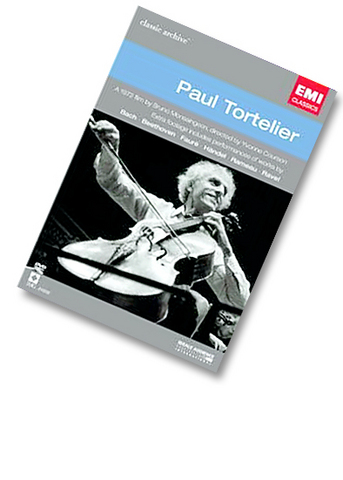
What's extraordinary is Tortelier's youthfulness in all this. He appears and acts as if he's about 30, but when the series was made was actually 58. At other times, though, he looks like a demonic figure by Michaelangelo from the ceiling of the Sistine Chapel. His opinions, too, are trenchant -- he condemns the abstraction of many modern compositions as well as the authoritarianism of French music academies (he preferred the German ones, where artists were respected).
Then follow 40 minutes showing Tortelier performing, first in a concert in Paris (Beethoven's Third Sonata for Cello and Piano, given complete), then, plus wife and children, at the UK's Norwich Festival.
Monsaingeon also directs a 1992 performance by Dietrich Fischer-Dieskau of Schubert's Die Schone Mullerin ("The beautiful Mill Girl") song-cycle. Fischer-Dieskau recorded this sequence many times and was for decades the world leader in Schubert lieder. This is a late version, with Christopher Eschenbach at the piano. It's enjoyable enough, but the real gem is the Bonus item of Fischer-Dieskau coaching a young baritone (Matthias Rettner) in the Count's great aria Vedro mentrio sospiro' from Le Nozze di Figaro. The master's own performance of this can be heard on the fine film of the opera directed by Jean-Pierre Ponelle (DGM 00440 073 4034, reviewed Taipei Times Aug. 4, 2005).

Many other DVDs in the series are recordings of concerts. There's Francis Poulenc playing his own Concerto for Two Pianos (with Jacques Fevrier), Byron Janis playing Prokofiev's Third Piano Concerto and Rachmaninov's Rhapsody on a Theme of Paganini (with half an hour of Julius Katchen playing Brahms most magnificently as a Bonus), and Eugen Jochum conducting Bruckner's mammoth Seventh Symphony in 1980. All are extraordinary, especially the last which almost converted me to Bruckner's boa-constrictor-like late symphonies, first insinuating themselves round you, then crushing you to death in massive climaxes.


In late October of 1873 the government of Japan decided against sending a military expedition to Korea to force that nation to open trade relations. Across the government supporters of the expedition resigned immediately. The spectacle of revolt by disaffected samurai began to loom over Japanese politics. In January of 1874 disaffected samurai attacked a senior minister in Tokyo. A month later, a group of pro-Korea expedition and anti-foreign elements from Saga prefecture in Kyushu revolted, driven in part by high food prices stemming from poor harvests. Their leader, according to Edward Drea’s classic Japan’s Imperial Army, was a samurai

The following three paragraphs are just some of what the local Chinese-language press is reporting on breathlessly and following every twist and turn with the eagerness of a soap opera fan. For many English-language readers, it probably comes across as incomprehensibly opaque, so bear with me briefly dear reader: To the surprise of many, former pop singer and Democratic Progressive Party (DPP) ex-lawmaker Yu Tien (余天) of the Taiwan Normal Country Promotion Association (TNCPA) at the last minute dropped out of the running for committee chair of the DPP’s New Taipei City chapter, paving the way for DPP legislator Su

It’s hard to know where to begin with Mark Tovell’s Taiwan: Roads Above the Clouds. Having published a travelogue myself, as well as having contributed to several guidebooks, at first glance Tovell’s book appears to inhabit a middle ground — the kind of hard-to-sell nowheresville publishers detest. Leaf through the pages and you’ll find them suffuse with the purple prose best associated with travel literature: “When the sun is low on a warm, clear morning, and with the heat already rising, we stand at the riverside bike path leading south from Sanxia’s old cobble streets.” Hardly the stuff of your
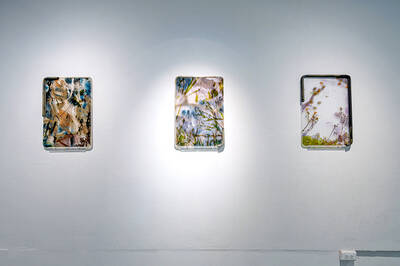
Located down a sideroad in old Wanhua District (萬華區), Waley Art (水谷藝術) has an established reputation for curating some of the more provocative indie art exhibitions in Taipei. And this month is no exception. Beyond the innocuous facade of a shophouse, the full three stories of the gallery space (including the basement) have been taken over by photographs, installation videos and abstract images courtesy of two creatives who hail from the opposite ends of the earth, Taiwan’s Hsu Yi-ting (許懿婷) and Germany’s Benjamin Janzen. “In 2019, I had an art residency in Europe,” Hsu says. “I met Benjamin in the lobby


 RSS
RSS