


Green Ray Theatre Company is back in town again, this time with a new play written and directed by famous Taiwan director Wu Nien-Jen (吳念真). The play titled Those Men in Her Life (她與她生命中的男人們), aims to speak about the historical experiences of Taiwan's previous generations and what it now means to be Taiwanese.
What is a Taiwan identity? What is Taiwan culture and its values?
These are the questions writer and director Wu sets out to address and he aims to do so without pointing fingers or hollering slogans.
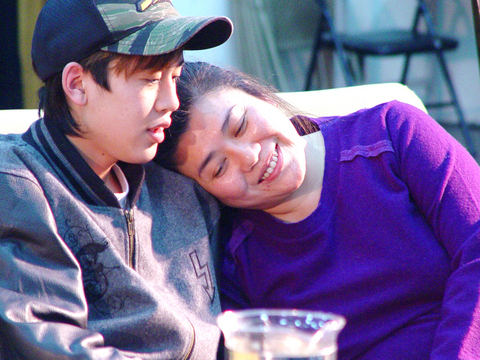
PHOTO COURTESY OF GREEN RAY THEATRE COMPANY
The story is relatively straightforward: As she lies on her deathbed, 79-year-old Yuki, played by Lin Mei Hsiu (林美秀) recollects the events of her life.
The story spanning more than half a century from 1947, when she was 17, is in many ways symbolic of what Taiwan went through and many older people will find a lot to relate to.
As the only daughter of a rich Taiwan family growing up in the Japanese era right before the Chinese Nationalist Party (KMT) came to Taiwan, she received a good education and her family was keen for her to marry an ambitious young man.
She, however, has her eyes set on the young family handyman who never summons up the courage to ask her father for her hand in marriage. Baffled by what she sees as the lack of willpower in men to fight for what they want in life, she reluctantly marries according to her parents wishes.
Later, as her husband becomes increasing successful as a Taiwan politician, she starts learning Mandarin, a sign of the political times.
Her husband, however, picks up bad habits, such as womanizing and becoming increasingly obsessed with the entanglements of politics. As her children grow up, they all leave Taiwan and finally years later, as they return, she realizes that in order to communicate with her grandchildren, she has to learn English.
"Every detail was meticulously prepared by Mr. Wu," explains Green Ray's Joyce Chiou
"When the actors are speaking in the beginning, they speak Taiwanese according to the grammar and poise of the era. It's really about that age and who they are. Later as Mandarin comes in, the way words are delivered evolves and by the time the main characters are interacting with their English-speaking grandchildren, English, spoken from a Taiwanese grammar perspective is used, symbolizing the many sides of life in Taiwan now.
Everything else, from black and white TVs, to old mugs, to the music that represents each character and their generation, all these details about life in Taiwan is what separates Those Men in Her Life apart from any other play, and what hopefully will resonate with the audience."
An interesting subplot is the discovery of a body in the Danshui River after the infamous 228 Incident, which Yuki later dresses and buries in her backyard, believing that her gesture means that the spirit of the deceased will therefore look after the family. During the final years of her life -- as her children are arguing over the inheritance and selling the land to contractors -- she refuses, still insistent on her loyalty to the body still buried.
It will be scenes like these, very Taiwanese in context, that strike home.
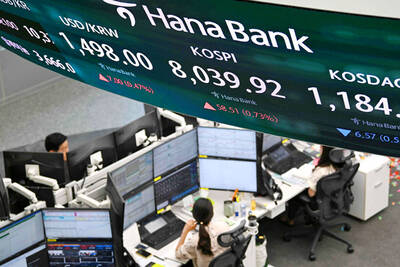
Taiwan’s overtaking of South Korea in GDP per capita is not a temporary anomaly, but the result of deeper structural problems in the South Korean economy says Chang Young-chul, the former CEO of Korea Asset Management Corp. Chang says that while it reflects Taiwan’s own gains, it also highlights weakening growth momentum in South Korea. As design and foundry capabilities become more important in the AI era, Seoul risks losing competitiveness if it relies too heavily on memory chips. IMF forecasts showing Taiwan widening its lead over South Korea have fueled debate in Seoul over memory chip dependence, industrial policy and
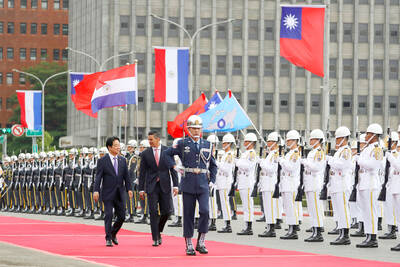
“China wants to unify with Taiwan at the lowest possible cost, and it currently believes that unification will become easier and less costly as time passes,” wrote Amanda Hsiao (蕭嫣然) and Bonnie Glaser in Foreign Affairs (“Why China Waits”) this month, describing how the People’s Republic of China (PRC) is playing the long game in its quest to seize Taiwan. This has been a favorite claim of many writers over the years, easy to argue because it is so trite. Very obviously, if the PRC isn’t attacking Taiwan, it is waiting. But for what? Hsiao and Glaser’s main point is trivial,
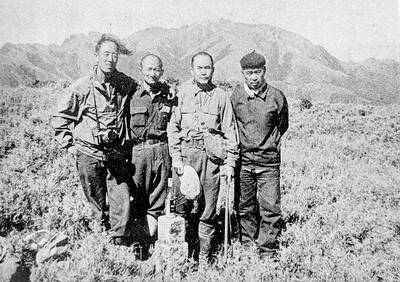
May 18 to May 24 Gathered on Yangtou Mountain (羊頭山) on Dec. 5, 1972, Taiwan’s hiking enthusiasts formally declared the formation of the “100 Peaks Club” (百岳俱樂部) and unveiled the final list of mountains. Famed mountaineer Lin Wen-an (林文安) led this effort for the Chinese Alpine Association (中華山岳協會). Working with other experienced climbers, he chose 100 peaks above 10,000 feet (3,048m) that featured triangulation points and varied in difficulty and character. The list sparked an alpine hiking craze, inspiring many to take up mountaineering and competing to “conquer” the summits. A common misconception is that the 100 Peaks represent Taiwan’s 100 tallest

And so, in the wake of US President Donald Trump’s trip to the People’s Republic of China (PRC), all the experts on the Strait of Hormuz suddenly became experts on US-China-Taiwan relations. The Internet has certainly expanded human knowledge. Lots of these sudden experts made noise this week about Trump’s words after the meeting with PRC dictator Xi Jin-ping (習近平). Trump is going to sell out Taiwan! Longtime Taiwan commentator J. Michael Cole summed the situation up neatly in the Guardian: “We need to keep in mind that he has a tendency to say many things — sometimes contradicting himself within


 RSS
RSS