


In a pilot nation-by-nation study of environmental performance, jointly produced by Yale and Columbia Universities, Taiwan trailed most of Western Europe and Japan, but came out in front of the US which ranked 28th overall, ahead of Russia and South Korea.
The study of environmental performance shows that just six nations -- led by New Zealand, followed by five from northern Europe -- have achieved 85 percent or better success in meeting a set of critical environmental goals ranging from clean drinking water and low ozone levels to sustainable fisheries and low greenhouse gas emissions.
The bottom half of the rankings is largely filled with the countries of Africa and Central and South Asia. Pakistan and India both rank among the 20 lowest-scoring countries, with overall success rates of 41.1 percent and 47.7 percent, respectively.
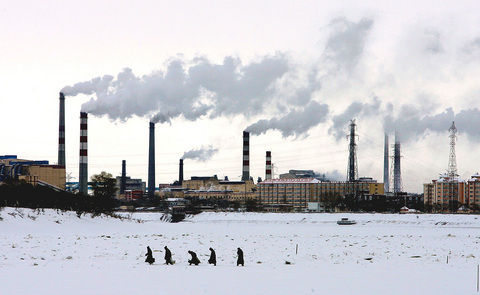
PHOTO: APN
The pilot study, called the 2006 Environmental Performance Index, has been reviewed by specialists both in the US and internationally.
Using a new variant of the methodology the two univer-sities have applied in their Environmental Sustainability Index, produced in four previous years, the study was intended to focus more attention on how various governments have played the environmental hands they have been dealt, said Daniel Esty, the director of the Yale Center for Environmental Law and Policy and an author of the report.
The earlier sustainability measurements "tell you something about long-term trajec-tories," Esty said. "We think this tool has a much greater appli-cation in the policy context."
For instance, Britain ranked 65th in last year's sustainability index, but fifth in the latest study, among the 133 nations measured. Among the reasons for the earlier low ranking, Esty said, was that "they cut down almost all their trees 500 years ago and before," something that modern British governments could not control.
The 16 indicators used in the latest study, the report says, provide "a powerful tool for evaluating environmental investments and improving policy results."
The report was issued during the World Economic Forum, an annual conclave of business and political leaders that met in Davos, Switzerland, the previous week. Esty said the report was also intended as a tool to help monitor progress on the environ-mental issues included among the Millennium Development goals adopted by 189 nations at the UN Millennium Summit meeting.
"It's like holding up a mirror and having someone help you see what you couldn't see before," he said. But the report acknow-ledges "serious data gaps" that resulted in leaving more than 65 countries out of the rankings. In addition, some thorny methodological issues, like how to measure land degradation or loss of wetlands, have no widely accepted solutions, the report noted, and the authors used the best measures they had available.
Like the sustainability index produced last year, the pilot study ranks countries within their geographic peer groups, so that nations in arid regions or tropical ones can be measured against one another. So Belgium's overall ranking of 39, with a 75.9 percent score, can be viewed by region and by issue. Belgium ranks last, for instance, among European countries in protection of its water resources.
Air quality rankings tend to favor less industrialized nations like Uganda, Gabon, Ecuador and Sri Lanka. Among the countries of the Americas, the US ranks in the bottom third on this scale.
In the same group, the US is at the bottom of the scale measuring agricultural, forest and fisheries management, in part because the study is weighted against countries with a high level of crop subsidies. The study's authors say that such subsidies "in agriculture, fish-eries and energy sectors have been shown to have negative impacts on resource use and management practices."
In the area of environmental health, the study measured factors like sanitation, lead exposure and indoor air pollution, a particular concern in the least developed countries, where indoor home fires may be common. In those measures, the richest countries, including the US, Canada,
Australia, New Zealand, Japan, France, Britain, Ireland and the countries of north and central Europe score near 100 percent.
On the same scale, the poorest countries fared worst, with 32 of 37 sub-Saharan African nations, along with Bangladesh, Haiti, Yemen, Tajikistan, Laos, Cambodia and Papua New Guinea scoring at or below 40 percent. Chad and Niger rank last in the world, with scores of 0 percent and 1 percent, respectively.
"In the zone we capture as the field of play, they're at the very bottom," Esty said. "It doesn't mean that nobody there has a toilet. It means a very, very small percent do."
Carbon dioxide emissions from nations with rapid economic expansion, like China and India, are more than double the world average (731 tonnes and 621 tonnes, respectively).

In late October of 1873 the government of Japan decided against sending a military expedition to Korea to force that nation to open trade relations. Across the government supporters of the expedition resigned immediately. The spectacle of revolt by disaffected samurai began to loom over Japanese politics. In January of 1874 disaffected samurai attacked a senior minister in Tokyo. A month later, a group of pro-Korea expedition and anti-foreign elements from Saga prefecture in Kyushu revolted, driven in part by high food prices stemming from poor harvests. Their leader, according to Edward Drea’s classic Japan’s Imperial Army, was a samurai

The following three paragraphs are just some of what the local Chinese-language press is reporting on breathlessly and following every twist and turn with the eagerness of a soap opera fan. For many English-language readers, it probably comes across as incomprehensibly opaque, so bear with me briefly dear reader: To the surprise of many, former pop singer and Democratic Progressive Party (DPP) ex-lawmaker Yu Tien (余天) of the Taiwan Normal Country Promotion Association (TNCPA) at the last minute dropped out of the running for committee chair of the DPP’s New Taipei City chapter, paving the way for DPP legislator Su
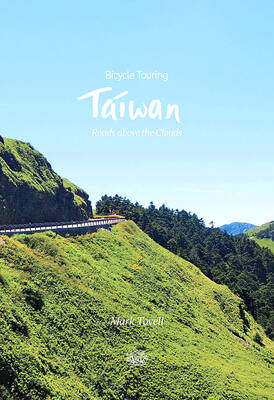
It’s hard to know where to begin with Mark Tovell’s Taiwan: Roads Above the Clouds. Having published a travelogue myself, as well as having contributed to several guidebooks, at first glance Tovell’s book appears to inhabit a middle ground — the kind of hard-to-sell nowheresville publishers detest. Leaf through the pages and you’ll find them suffuse with the purple prose best associated with travel literature: “When the sun is low on a warm, clear morning, and with the heat already rising, we stand at the riverside bike path leading south from Sanxia’s old cobble streets.” Hardly the stuff of your

Located down a sideroad in old Wanhua District (萬華區), Waley Art (水谷藝術) has an established reputation for curating some of the more provocative indie art exhibitions in Taipei. And this month is no exception. Beyond the innocuous facade of a shophouse, the full three stories of the gallery space (including the basement) have been taken over by photographs, installation videos and abstract images courtesy of two creatives who hail from the opposite ends of the earth, Taiwan’s Hsu Yi-ting (許懿婷) and Germany’s Benjamin Janzen. “In 2019, I had an art residency in Europe,” Hsu says. “I met Benjamin in the lobby


 RSS
RSS