


Scripture tells us that young men will see visions and old men will dream dreams. In these tales of Swedenborgians, theosophists, illuminati, Mormons and Freemasons, David Katz gives us much of both as we travel from neoplatonism to American fundamentalism via the Cock Lane Ghost.
Katz, a history professor at Tel Aviv University, sees the occult tradition as a coherent intellectual stream with its beginnings in Plato, flowing through the European Renaissance and industrial revolution to arrive at US fundamentalism with its detailed myth-ology about the End of Days based on an esoteric reading of the Bible.
He takes "occult" to mean hidden from the senses: the belief that there is knowledge accessible by covert means which allows practitioners to know the workings of the universe and even manipulate its operation. The occult tradition is a fusion of three streams of thought, Katz says, in a book for anyone excited by knowledge and the interpretation of ideas. First came the neoplatonists with their view that things had properties which were transferable: using the heart of a brave animal such as a cock or a lion would help promote bravery; eating the breast of loving creatures like sparrows or turtles would induce love.
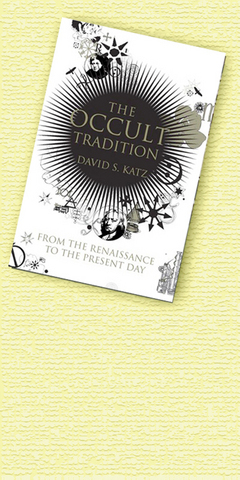
The second store of ancient lore he notes is the mystical contem-plation of the Judaeo-Christian gnostics. Finally come the writings that were supposedly handed down from the (mythical) figure Hermes Trismegistus, who represented a body of knowledge from Egypt, therefore predating Grecian and Roman civilization.
These form a continuous core of belief which over the centuries has informed not just religion and politics but science, too. Katz follows historian Frances Yates in feeling it is not enough to construct a history of science by looking for thinkers in the past who got it "right"; we need to study the period when alchemy was evolving into chemistry and astrology into astronomy to see why experimental choices were made.
That makes this a deeply subversive book. Scientists, if they think about the philosophy of science at all, cleave to a 19th-century narrative which says that in all civilizations as they developed, superstition came first, then religion, then science, which at last was the truth. In fact the founders of modern science were swimming in a stream of occult lore, much of which they retained and passed on to us in disguised form.
Thus Paracelsus claimed to have discovered, by alchemical means, the very building blocks of the universe, and the key to their construction, which was chemistry. He passed on the occult notion of macrocosm and microcosm: anything true in the laboratory must be true in the universe at large. Giordano Bruno was burned at the stake for adhering to an Egyptian world picture with the sun as the centre of the universe and the chief divinity. The heliocentric universe could be analysed by Copernican calculations, but it was based on the Hermetic tradition.
Newton, the man credited with being the first modern scientist, devoted at least half his active working time to the interpretation of esoterica. Newton's conviction was that a misreading of the heavens goes along with a misreading of religion. God provided two alter-native sources of information: the written book of scripture and the visible book of nature. Basic metaphysical truths are obtainable from both.
Coming closer to the present, Katz emphasizes how much of the theory that fed into psychology and psychoanalysis was not about a sexual unconscious but a paranormal one. He invites us, in the 1870s at the height of the supposed battle between religion and science, to a seance which Darwin and Galton attended together. Co-evolutionary theorist Alfred Wallace was preoccupied with spiritualism, eventually to the exclusion of other forms of investigation.
This is a coherent picture of the persistence of weird stuff in the lives of the famous, which will infuriate both believers and sceptics. A great deal in this book has been said before, as Katz acknowledges in his references to other scholars. His unique contributions go to show how the occult tradition continued into the 21st-century world. En route, Katz convincingly explains how India replaced Egypt as the supposed source of all ancient wisdom, a transition which pandered to the race theory popular in the late 19th and early 20th centuries -- it permitted the replacement of a Semitic spiritual ancestry from the Middle East with an Indo-European (Aryan) ascendancy.
So, with the introduction of power politics, the occult approaches its bizarre modern form in the predictions of Armageddon by US fundamentalists. The movement was so called after its emergence between 1909 and 1915 in the form of a dozen pamphlets entitled The Fundamentals which were distri-buted by the American Bible League. They stressed the infall-ible literal truth of the Bible and the concept of the born-again evangelical Christian.
While this is no more than a restatement of basic Protestantism which would be familiar to Martin Luther, the evangelicals have woven into their beliefs a complex theology prophesying the last days of humankind that bears only the most tentative relationship to scripture. Thus we have belief in "the rapture," the bodily disa-ppearance from the earth of true believers in the seven years of tribulations before the second coming of Christ.
In a controversial distinction, Katz differentiates between Christianity as generally practised and its incarnation as fundamentalism, which predicts the future through deciphering a document (the Bible) whose meaning is hidden. Thus, Katz argues, we find US President George W. Bush making speeches which clearly echo prophetic biblical passages from Isaiah and Revelation. Bush is truly preaching to the converted.
Some people's shelves groan with works on mysticism and the occult, and this would make an erudite addition for them. For those who will read only one book on the exegesis of ancient grimoires, this should be it.

In late October of 1873 the government of Japan decided against sending a military expedition to Korea to force that nation to open trade relations. Across the government supporters of the expedition resigned immediately. The spectacle of revolt by disaffected samurai began to loom over Japanese politics. In January of 1874 disaffected samurai attacked a senior minister in Tokyo. A month later, a group of pro-Korea expedition and anti-foreign elements from Saga prefecture in Kyushu revolted, driven in part by high food prices stemming from poor harvests. Their leader, according to Edward Drea’s classic Japan’s Imperial Army, was a samurai

The following three paragraphs are just some of what the local Chinese-language press is reporting on breathlessly and following every twist and turn with the eagerness of a soap opera fan. For many English-language readers, it probably comes across as incomprehensibly opaque, so bear with me briefly dear reader: To the surprise of many, former pop singer and Democratic Progressive Party (DPP) ex-lawmaker Yu Tien (余天) of the Taiwan Normal Country Promotion Association (TNCPA) at the last minute dropped out of the running for committee chair of the DPP’s New Taipei City chapter, paving the way for DPP legislator Su

It’s hard to know where to begin with Mark Tovell’s Taiwan: Roads Above the Clouds. Having published a travelogue myself, as well as having contributed to several guidebooks, at first glance Tovell’s book appears to inhabit a middle ground — the kind of hard-to-sell nowheresville publishers detest. Leaf through the pages and you’ll find them suffuse with the purple prose best associated with travel literature: “When the sun is low on a warm, clear morning, and with the heat already rising, we stand at the riverside bike path leading south from Sanxia’s old cobble streets.” Hardly the stuff of your

Located down a sideroad in old Wanhua District (萬華區), Waley Art (水谷藝術) has an established reputation for curating some of the more provocative indie art exhibitions in Taipei. And this month is no exception. Beyond the innocuous facade of a shophouse, the full three stories of the gallery space (including the basement) have been taken over by photographs, installation videos and abstract images courtesy of two creatives who hail from the opposite ends of the earth, Taiwan’s Hsu Yi-ting (許懿婷) and Germany’s Benjamin Janzen. “In 2019, I had an art residency in Europe,” Hsu says. “I met Benjamin in the lobby


 RSS
RSS