


"When I was young, chemistry had soul. Things went bang, and flash. There were wonderfully colored lights, and the most amazing assortment of smells, some of them wonderful, some of them absolutely disgusting. All that has gone now. The Health and Safety people won't allow it. No wonder children don't want to study science any more," said James Lovelock.
He sat in his study by a river in Devon, in the south west of England, watching the ruin of the world. In front of him, on a large flat panel monitor, there is a climate map of the northern hemisphere, updating constantly with evidence of climate change. All around Greenland there is unfrozen water; though it's early December the North West passage has only just closed.
The room is lined with books and instruments, some of which he has built himself. Behind the monitor, on a window ledge, is what appears to be a little aluminum model of some insect antenna. In fact, it is his most famous instrument, the electron capture detector, an extraordinarily sensitive device, which showed, in the 1960s, that the atmosphere was full of pesticide residues, and in the 1970s that it was full of CFCs.
Both discoveries were hugely important to the Green movement; still more important, perhaps, was his Gaia hypothesis -- the belief that the Earth and its life forms together constitute a single life form, which has maintained itself for more than 3 billion years.
Gaia seems to offer a rational basis for the religious feeling that inspires some environmentalists, but it is not a cuddly deity.
Most life forms -- for much of Gaia's life, all of them -- have been bacteria; and the history of mass extinctions suggests the life of anything larger than a bacterium will always be precarious.
"If there were a nuclear war, and humanity were wiped out, the Earth would breathe a sigh of relief. It doesn't mind radiation. From the planet's viewpoint, it could say `that was a rotten experiment. I'm glad it's over.' Gaia has a destructive side, like Kali," Lovelock said.
Planet's paramedics
His strong support of nuclear power, though, made him a heretic to many Greens. Nuclear power, he says, is much safer than the alternatives, and desperately needed to help us survive the effects of global warming.
"To save ourselves we need to have a proper nuclear program. The Greens don't seem to understand that without electricity, civilization would collapse. Just imagine London without electricity. Within three weeks it would be like Darfur," Lovelock said.
He has no time for the long-term arguments about waste and safety: in a crisis, you do what you need to survive.
"We are like paramedics to the planet. We just have to stabilize things," he said.
Lovelock thinks it is a ludicrous presumption to suppose that we can save the world. Serious climate change is now inevitable, whatever we do: by the middle of the century, he said, the Arctic icecap will have gone; by the end of it, the rain forests will have disappeared too, to be replaced by desolation. The Earth's temperature will have risen by 8℃, as it has before, and it will probably stay there for another 200,000 years.
"In a sense, since we are part of the whole system, you can say we are the consciousness of the planet. We are part of it, we can never consider ourselves as something separate," he said. "To think we could be its stewards is grotesque. We will be struggling against it. We've got to make peace while we're still strong enough to make terms, and not just a rabble. I see Kyoto as like Munich. It's an attempt to buy time before the real struggle starts."
This attitude was shaped by his experience in World War II, as a government scientist and conscientious objector, and by the struggles of his early life.
He was born in Brixton, south London, in 1919, to working-class parents determined their son should better himself. They ran an art gallery on Brixton Hill in their spare time, an enterprise somewhat before its time. The young Lovelock found refuge in the basement of the Brixton library, where the science books were kept.
Going out on a limb
From the age of eight, he would "find great fat tomes of chemistry and take them home to read." He still has the Merck Index, a boxy, well-bound reference book, with thumb holes down the side, describing the history and qualities of almost all the chemicals so far discovered or made.
"You can get it on CD now, of course: a sign that [the index in book form] is coming to the end," he said.
After serving an apprenticeship in a chemical supplies firm in Kensington, he went to Manchester University and from there to the Medical Research Council, where he worked on everything from the prevention of colds to the freezing of sperm. He may have been the first man to use microwaves deliberately for heating frozen things, in his case hamsters. Lovelock's team froze whole live hamsters slowly, then used the microwaves to restore them to life by thawing their hearts before the rest of the animal. This proved, among other things, that memory is preserved in the way that brain cells grow together, since a hamster that had learned to run in a maze would retain the knowledge even after being frozen and resuscitated.
But in the early 1960s he left this well-paid, pensionable post to become a freelance or independent scientist, even though he had four children, the youngest suffering from brain-damage, and a wife with multiple sclerosis. But Lovelock had been working in America, on the space program and told himself he lived next to a huge waterfall of money and all he had to do was to catch a little of the spray.
It worked. By a mixture of inventions and consultancies, he was able to do the work he loved while still supporting his family.
His inventions kept him solvent. Gaia made him famous, and brought him his second wife, Sandy, a much younger American whom he met in a coup de foudre at a conference for "Global leaders" in Oxford, England, while his first wife was dying, and who had read his first book on Gaia. The two seem constantly aware of each other, turning together like birds in a flock.

In late October of 1873 the government of Japan decided against sending a military expedition to Korea to force that nation to open trade relations. Across the government supporters of the expedition resigned immediately. The spectacle of revolt by disaffected samurai began to loom over Japanese politics. In January of 1874 disaffected samurai attacked a senior minister in Tokyo. A month later, a group of pro-Korea expedition and anti-foreign elements from Saga prefecture in Kyushu revolted, driven in part by high food prices stemming from poor harvests. Their leader, according to Edward Drea’s classic Japan’s Imperial Army, was a samurai

The following three paragraphs are just some of what the local Chinese-language press is reporting on breathlessly and following every twist and turn with the eagerness of a soap opera fan. For many English-language readers, it probably comes across as incomprehensibly opaque, so bear with me briefly dear reader: To the surprise of many, former pop singer and Democratic Progressive Party (DPP) ex-lawmaker Yu Tien (余天) of the Taiwan Normal Country Promotion Association (TNCPA) at the last minute dropped out of the running for committee chair of the DPP’s New Taipei City chapter, paving the way for DPP legislator Su
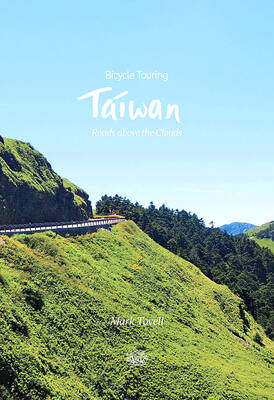
It’s hard to know where to begin with Mark Tovell’s Taiwan: Roads Above the Clouds. Having published a travelogue myself, as well as having contributed to several guidebooks, at first glance Tovell’s book appears to inhabit a middle ground — the kind of hard-to-sell nowheresville publishers detest. Leaf through the pages and you’ll find them suffuse with the purple prose best associated with travel literature: “When the sun is low on a warm, clear morning, and with the heat already rising, we stand at the riverside bike path leading south from Sanxia’s old cobble streets.” Hardly the stuff of your
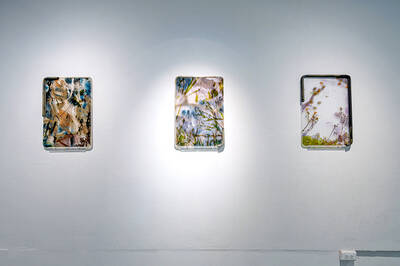
Located down a sideroad in old Wanhua District (萬華區), Waley Art (水谷藝術) has an established reputation for curating some of the more provocative indie art exhibitions in Taipei. And this month is no exception. Beyond the innocuous facade of a shophouse, the full three stories of the gallery space (including the basement) have been taken over by photographs, installation videos and abstract images courtesy of two creatives who hail from the opposite ends of the earth, Taiwan’s Hsu Yi-ting (許懿婷) and Germany’s Benjamin Janzen. “In 2019, I had an art residency in Europe,” Hsu says. “I met Benjamin in the lobby


 RSS
RSS