


In what must be the worst quality recording you've ever heard on CD, Lucia di Lammermoor, recorded live in Turin in 1967 and issued by an obscure German record label, gets under way. After 15 minutes Edgardo enters, in love with an aristocratic woman about to be subjected to a forced marriage who loves him in return.
The young Renata Scotto as the woman, Lucia, is remarkable enough, but she is now joined by someone to match her. It's the young tenor Luciano Pavarotti, aged 32 and possessing a voice that only appears a few times in a century, the classic, wine-glass-breaking, heart-breaking Italian-style tenor.
The recorded sound quickly improves, uncovering a performance of heroic magnificence. Pavarotti's voice is supremely fine, ringing in the higher register, rounded and pure in the lower. The opera, full of echoes of Hamlet (the most influential text on European Romanticism) and based, as so many operas of the period were, on a novel by the Scottish novelist Walter Scott, careers to its tragic conclusion. But Pavarotti was all set to go on to a career that would dominate the next 40 years.
PHOTOS: AP
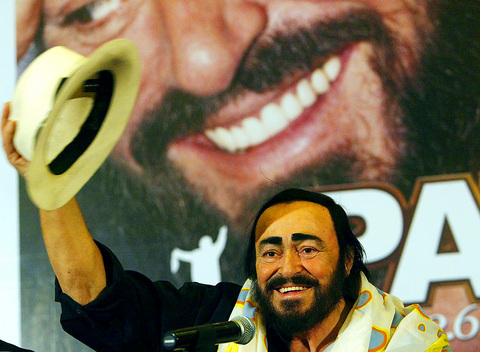
Most people will know him as one of the "Three Tenors," and it's true he is equaled in fame by Placido Domingo and Jose Carreras. Carreras is the more romantic figure and Domingo, in roles such as Otello, the greater tragic actor. Pavarotti on stage, as for instance in Franco Zeffirelli's Don Carlos or in the Metropolitan Opera's L'Elisir d'Amore, both of 1992, appears too innocent to be a dramatic character. He's always, you feel, simply himself, smiling his cherubic smile in some outlandish historical costume. Actors are deceivers, and so they can't be innocents. But Pavarotti is innocence personified, laughing with undisguisable joy as audiences cheer after every concert number and waving his voluminous white handkerchief as if signaling to his mother that he's there and it's time for someone to come along and take him home to bed.
Pavarotti is the most lovable of all the great tenors now passing into history. And if you watch the Three Tenors concert held outdoors in Paris in 1998, you will notice that not only is he the last to appear (something his management probably insisted on), but also that he's the one who gets all the best items to sing.
In a sense he was born too late. The great age of operatic tenors was before electricity allowed all voices to be amplified at the turn of a knob. Then their sheer volume permitted large audiences to hear them and large profits to be made by theater managements. But Pavarotti has never been merely loud, as anyone who watches the DVD of him on the stage of New York's Metropolitan Opera, with James Levine at the piano, in their recital of 1996 will immediately recognize.
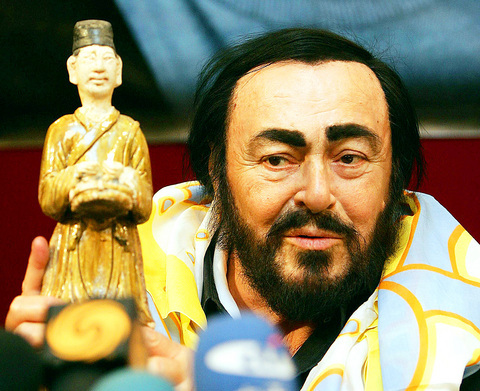
Here there are no crowd-pleasing antics, but instead true artistry. He sings enough operatic rarities to please any connoisseur and everywhere displays himself as a discriminating musician, albeit one with heroic powers.
What does it matter who gives permission for his private jet to land next week at Taichung's airport or that the city's mayor appears in costume in the TV ad for the concert? Luciano Pavarotti is a great presence on the world stage. When some years ago he told China's leaders he didn't like Chinese opera, only the Italian kind, he was being what he is naturally -- innocent, honest, simple and, because of these very qualities, at his best incredibly moving.
What Pavarotti's voice will prove to be like now he's 70 years old is in some senses irrelevant. He's one of the genuinely great, a living treasure. And however much we may smile at him at times, old showman that he is, we ought to love him as well. The world will be poorer when he's gone.
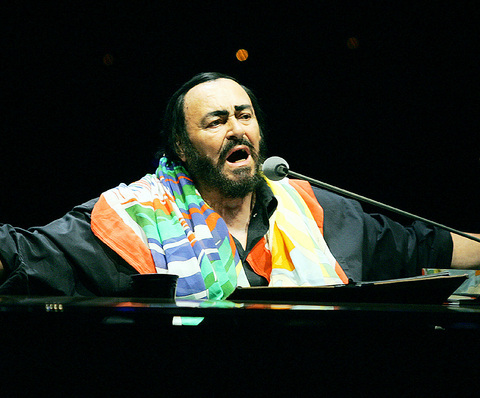
Look again at that Paris Three Tenors DVD, and notice how at the end Pavarotti shows himself as, in the best possible sense, the eternal child. When the crowd is roaring in front of them and the others are clutching their bouquets and clapping back, he can be observed turning away from it all, innocent that he is, looking backwards over his shoulder, and watching the fireworks.
Performance notes:
Luciano Pavarotti's Farewell World Tour (帕華洛帝世界巡迴告別演唱會) is at Taichung Stadium (台中體育場), 271, Lixing Rd, Taichung City (台中市力行路271號), on Wednesday, Dec. 14. Tickets were still available at the time of writing at NT$1,500, NT$2,000, NT$3,000 and NT$5,000, from ERA outlets.

In late October of 1873 the government of Japan decided against sending a military expedition to Korea to force that nation to open trade relations. Across the government supporters of the expedition resigned immediately. The spectacle of revolt by disaffected samurai began to loom over Japanese politics. In January of 1874 disaffected samurai attacked a senior minister in Tokyo. A month later, a group of pro-Korea expedition and anti-foreign elements from Saga prefecture in Kyushu revolted, driven in part by high food prices stemming from poor harvests. Their leader, according to Edward Drea’s classic Japan’s Imperial Army, was a samurai

The following three paragraphs are just some of what the local Chinese-language press is reporting on breathlessly and following every twist and turn with the eagerness of a soap opera fan. For many English-language readers, it probably comes across as incomprehensibly opaque, so bear with me briefly dear reader: To the surprise of many, former pop singer and Democratic Progressive Party (DPP) ex-lawmaker Yu Tien (余天) of the Taiwan Normal Country Promotion Association (TNCPA) at the last minute dropped out of the running for committee chair of the DPP’s New Taipei City chapter, paving the way for DPP legislator Su
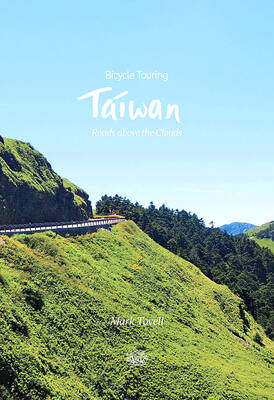
It’s hard to know where to begin with Mark Tovell’s Taiwan: Roads Above the Clouds. Having published a travelogue myself, as well as having contributed to several guidebooks, at first glance Tovell’s book appears to inhabit a middle ground — the kind of hard-to-sell nowheresville publishers detest. Leaf through the pages and you’ll find them suffuse with the purple prose best associated with travel literature: “When the sun is low on a warm, clear morning, and with the heat already rising, we stand at the riverside bike path leading south from Sanxia’s old cobble streets.” Hardly the stuff of your
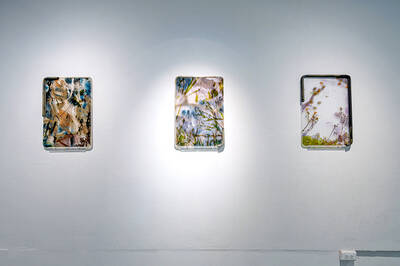
Located down a sideroad in old Wanhua District (萬華區), Waley Art (水谷藝術) has an established reputation for curating some of the more provocative indie art exhibitions in Taipei. And this month is no exception. Beyond the innocuous facade of a shophouse, the full three stories of the gallery space (including the basement) have been taken over by photographs, installation videos and abstract images courtesy of two creatives who hail from the opposite ends of the earth, Taiwan’s Hsu Yi-ting (許懿婷) and Germany’s Benjamin Janzen. “In 2019, I had an art residency in Europe,” Hsu says. “I met Benjamin in the lobby


 RSS
RSS