


An artist who has said of himself, "I have a bad record with destroying things," has won this year's Turner prize.
Simon Starling is no provocateur. Nor was he a shock winner -- the bookies made him the even-money favorite. But none the less, it will come as no surprise to those who regard the Turner prize with disdain that the softly spoken, slightly geekish, rather skeletal figure of Starling has won £25,000 (US$43,000) for dismantling and assembling a wooden shed.
Starling, who was born in 1967, found it on the banks of the Rhine, took it apart, made parts of it into a boat, and used the vessel to carry the remaining parts of it downriver to Basle. It was then reassembled as a shed in a Swiss museum.
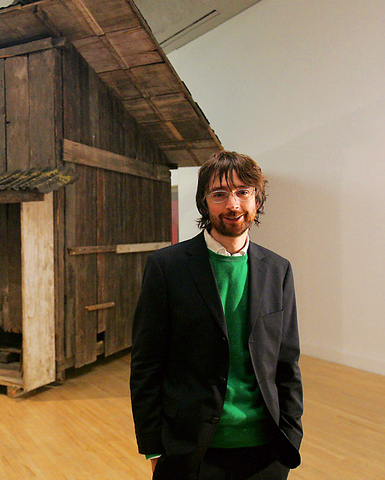
PHOTO: AP
The display of his work at the Turner prize exhibition at Tate Britain in London also includes a makeshift motorized bicycle, which Starling used to ride across the Tabernas desert in southern Spain.
It was powered by hydrogen in lightweight canisters that reacted with oxygen in the atmosphere to produce water as a byproduct. The artist used that in turn to paint a simple watercolor of a cactus he found en route. The watercolor is installed alongside the oversize, makeshift bike.
Starling calls his work a "physical manifestation of a thought process." According to Tate curator Rachel Tant. "He's interested in the creation of objects; he is a researcher, traveler, narrator. He looks at how things got to be the way they are and reasserts a human connection between processes we take for granted."
The prize was awarded on Monday by UK arts minister David Lammy, at a ceremony which one prominent artist referred to as a "school dinner for the British artworld." Lammy said of the prize: "Its true genius is that for a couple of days every year, everyone gets to be an expert, no matter what they think about art."
Traditionalists will be disappointed that the only painter (and, as it happens, the only woman) on the shortlist was denied the top prize. London-based Gillian Carnegie, an early bookies' favorite, apparently paints in an academic style, producing landscapes and portraits. But her works, though they look at first comfortingly old- fashioned, are often disturbing on second view.
Jim Lambie was the artist who many artworld insiders favored to win -- though one distinguished sculptor has dismissed him as a "glorified interior decorator." Whereas last year's Turner prize winner, Jeremy Deller, infuriated some by announcing that he could neither paint nor draw, Lambie has drawn criticism for saying he loved drawing and painting as an art student, but now prefers to stick vinyl tape on floors and make oversize versions of kitsch ornaments.
A gentle, banal piano melody accompanies the installation by Darren Almond, which, with its film of his grandmother watching the dancing in the ballroom at Blackpool and film of a gently bubbling fountain provide, is according to Tant, "a space where everybody can tap into their own memories."
Starling's work is an enjoyable, nomadic, shaggy-dog conceptualism, the trace of a very peculiar way of negotiating the world; but one which, in terms of contemporary art, is also an example of perfect product placement.
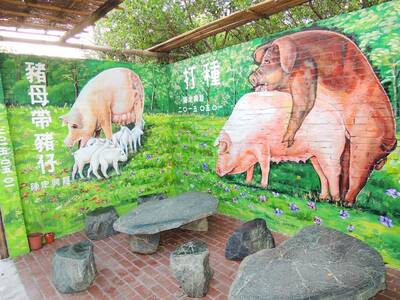
May 6 to May 12 Those who follow the Chinese-language news may have noticed the usage of the term zhuge (豬哥, literally ‘pig brother,’ a male pig raised for breeding purposes) in reports concerning the ongoing #Metoo scandal in the entertainment industry. The term’s modern connotations can range from womanizer or lecher to sexual predator, but it once referred to an important rural trade. Until the 1970s, it was a common sight to see a breeder herding a single “zhuge” down a rustic path with a bamboo whip, often traveling large distances over rugged terrain to service local families. Not only
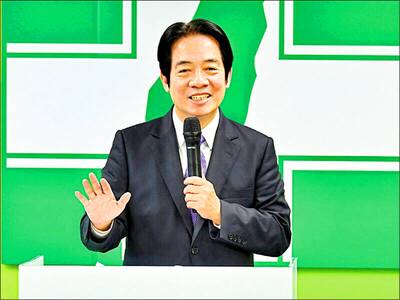
Ahead of incoming president William Lai’s (賴清德) inauguration on May 20 there appear to be signs that he is signaling to the Chinese Communist Party (CCP) and that the Chinese side is also signaling to the Taiwan side. This raises a lot of questions, including what is the CCP up to, who are they signaling to, what are they signaling, how with the various actors in Taiwan respond and where this could ultimately go. In the last column, published on May 2, we examined the curious case of Democratic Progressive Party (DPP) heavyweight Tseng Wen-tsan (鄭文燦) — currently vice premier
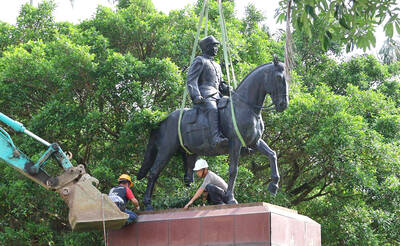
The last time Mrs Hsieh came to Cihu Park in Taoyuan was almost 50 years ago, on a school trip to the grave of Taiwan’s recently deceased dictator. Busloads of children were brought in to pay their respects to Chiang Kai-shek (蔣中正), known as Generalissimo, who had died at 87, after decades ruling Taiwan under brutal martial law. “There were a lot of buses, and there was a long queue,” Hsieh recalled. “It was a school rule. We had to bow, and then we went home.” Chiang’s body is still there, under guard in a mausoleum at the end of a path

Last week the Directorate-General of Budget, Accounting and Statistics (DGBAS) released a set of very strange numbers on Taiwan’s wealth distribution. Duly quoted in the Taipei Times, the report said that “The Gini coefficient for Taiwanese households… was 0.606 at the end of 2021, lower than Australia’s 0.611, the UK’s 0.620, Japan’s 0.678, France’s 0.676 and Germany’s 0.727, the agency said in a report.” The Gini coefficient is a measure of relative inequality, usually of wealth or income, though it can be used to evaluate other forms of inequality. However, for most nations it is a number from .25 to .50


 RSS
RSS