


In his prime, the astral singer-songwriter Donovan appeared to take a serene view of show business and its cutthroat ways. Not anymore. Nowadays, Donovan would like you to know that he never received proper credit for flower power, world music, new age music, the boxed-set album package, using LSD and the lyric "Love, Love, Love" before the Beatles did and playing folk-rock five months before Bob Dylan wielded an electric guitar at the 1965 Newport Folk Festival.
These claims -- legitimate, by the way -- do not emerge from total oblivion, but it's close. Donovan has spent decades hiding in plain sight. He never entirely stopped perfor-ming or recording, but he has not been part of the 1960s-nostalgia boom. Only now, with a memoir, a reissued collection of his music and a big hit (Catch the Wind) used in a car commercial, has he come back into view.
Donovan once wrote a song called Atlantis that marveled at a lost world. His own re-emergence prompts similar emotion. The Autobiography of Donovan is a very strange book (what else?) that revisits the fertile, trippy 1960s, the elaborately constructed aura of Donovan's beatitude, the wild incongruities of that era's popular culture (when the guest list for one Donovan party included Milton Berle, Jimmy Durante and the Doors) and the lingo that has become so quaint. "And, man, I was gratified when the fab chicks screamed," he writes in all seriousness about appearing on his first television show.
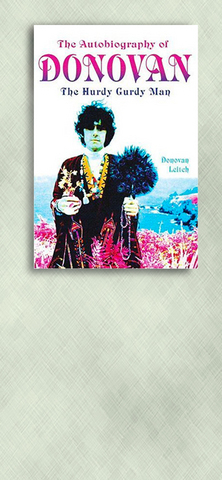
The overall language of this book is no less peculiar. It starts in the heavy Scottish dialect of his early years ("I used to sleep wi' ma mammy"). It can take a lofty, didactic tone, even when explicating the effects of marijuana ("Giggles and uncontrolled laughter are often signs of the natural relief that comes from letting go of the conditioning society forces on us"). It adopts the kinds of romantic euphemisms used in his song lyrics; My Lady of the Lemon Tree is Donovanese for hostile. And at times it even grasps for the hype that he once disdained. There's something desperate about a memoir that quotes ad copy about its subject's exciting talents.
Bumpy as it is, The Autobio-graphy of Donovan is also touching, illuminating and frank. If the author wistfully idealizes his glory days, he can also bring a brass-tacks honesty to describing them. "Yes, I took myself too seriously at times," he writes. "As I say, this was when no one else would." He repeatedly rebuts the complaint that there was anything artificial about either his mien or his music. "I was not in-vented by a manager," he writes. "I created my own sound and image from the heart and from the start."
As with Bob Dylan's memoir, some of this book's most interesting insights explain the inspiration for extremely well-known music. Donovan writes of wanting to deliver what he calls a Bohemian Manifesto. He also describes the unusual combinations of jazz, classical music, Indian ragas, Caribbean percussion and even heavy metal (those are future members of Led Zeppelin jamming in the midst of The Hurdy Gurdy Man) that his songs delivered so smoothly.
And he adds his version of what has turned out to be the Rashomon event of his era: the Indian idyll arranged by the Maharishi Mahesh Yogi. When he was introduced to the Maharishi, an aide used the phrase "like the Beatles" to describe Donovan. "Well," he writes wryly, "I was flattered to be compared to my friends."
Donovan has indicated that The Hurdy Gurdy Man describes the Maharishi. So why is The Hurdy Gurdy Man the subtitle of this book? His autobiography is similarly cavalier about a number of things, not least of them spelling. Jennifer Juniper, written to woo the sister-in-law of George Harrison, qualifies as one of the most successful musical seductions on record, but Donovan changes the spelling of his own song's title. Bob Dylan becomes "Bobbie." But he also becomes "the Hebrew shaman with the Celtic name." And Donovan, in gloves-off mode, contends that while Dylan is the better lyricist, "musically I am more creative and influential."
The Autobiography of Donovan stops all too short at the end of the 1960s.
But its defining event also occurs then. The book has been built around the author's search for his muse: Linda Lawrence, who met Donovan in 1965, was gun-shy about rock stars (after bearing a child and being abandoned by Brian Jones of the Rolling Stones) and inspired many surprisingly fizzy songs of amorous pursuit. (Sunshine Su-perman is the fizziest of them.) His happily-ever-after finale notes their wedding and progeny but continues to keep the last three and a half decades under wraps.
However time has treated Donovan personally, it has been kind to his music. And the music now gets the jump-start it needs to be enjoyed and admired anew. This book, with legitimate frustration but without hubris, reinstates that music's seminal influence and the underlying seriousness that has always been easy to miss.
"The constant gibes in the British press about my love of beauty has long left a false impression of my work," he maintains. "I was mocked as a simpleton when I sang of birds and bees and flowers like a child." He was also mocked for being wild about saffron, but it turns out that he loves saffron monks' robes and saffron cake with raisins. In any case, this book is where the mockery ends. And the last laugh begins.

What was the population of Taiwan when the first Negritos arrived? In 500BC? The 1st century? The 18th? These questions are important, because they can contextualize the number of babies born last month, 6,523, to all the people on Taiwan, indigenous and colonial alike. That figure represents a year on year drop of 3,884 babies, prefiguring total births under 90,000 for the year. It also represents the 26th straight month of deaths exceeding births. Why isn’t this a bigger crisis? Because we don’t experience it. Instead, what we experience is a growing and more diverse population. POPULATION What is Taiwan’s actual population?
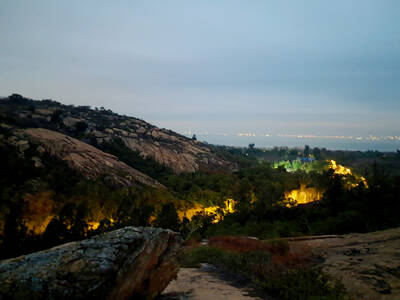
For the past five years, Sammy Jou (周祥敏) has climbed Kinmen’s highest peak, Taiwu Mountain (太武山) at 6am before heading to work. In the winter, it’s dark when he sets out but even at this hour, other climbers are already coming down the mountain. All of this is a big change from Jou’s childhood during the Martial Law period, when the military requisitioned the mountain for strategic purposes and most of it was off-limits. Back then, only two mountain trails were open, and they were open only during special occasions, such as for prayers to one’s ancestors during Lunar New Year.

A key feature of Taiwan’s environmental impact assessments (EIA) is that they seldom stop projects, especially once the project has passed its second stage EIA review (the original Suhua Highway proposal, killed after passing the second stage review, seems to be the lone exception). Mingjian Township (名間鄉) in Nantou County has been the site of rising public anger over the proposed construction of a waste incinerator in an important agricultural area. The township is a key producer of tea (over 40 percent of the island’s production), ginger and turmeric. The incinerator project is currently in its second stage EIA. The incinerator

It sounded innocuous enough. On the morning of March 12, a group of Taichung political powerbrokers held a press conference in support of Deputy Legislative Speaker Johnny Chiang’s (江啟臣) bid to win the Chinese Nationalist Party (KMT) primary in the Taichung mayoral race. Big deal, right? It was a big deal, one with national impact and likely sent shivers down the spine of KMT Chairwoman Cheng Li-wun (鄭麗文). Who attended, who did not, the timing and the messaging were all very carefully calibrated for maximum impact — a masterclass in political messaging. In October last year, the Democratic Progressive Party (DPP)


 RSS
RSS