


It is always rejuvenating to encounter a new poet. Every good poet is a new voice, and new voices are testimony to the continuing creativity of life itself. When societies no longer produce poets they are suffering from a kind of famine, an impoverishment that may not show on the surface but that renders the bones of its inhabitants brittle and its secret waters anemic to the taste.
Eddie Tay is from Singapore, and is currently studying the literature and culture of Singapore and Malaysia for a doctorate at Hong Kong University. A Lover's Soliloquy is his second collection of poems (his first, Remnants, appeared from Ethos Books in 2001).
Tay kicks off with a good book title -- lovers aren't meant to be alone, but in pairs. For a lover to be uttering soliloquies shows that something has gone wrong. Why is he alone? With a title like this we are immediately plunged into the subject matter, and already have some idea of what to expect.
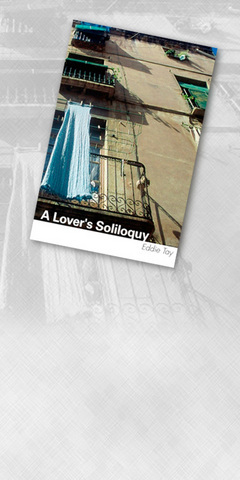
The book is divided into three sections. The first is a sequence of 15 poems with the same title as the book. Next come translations, also 15 in number, of poems by the Late Tang Dynasty love poet Li Shang-yin (李商隱), AD 813-858. Lastly come 24 heterogeneous items under the heading "Everyday Poems."
Poems in a sequence need not be self-explanatory -- maybe they take their meaning from their relation to others in the set. The poems in the A Lover's Soliloquy sequence are sometimes indirect, but together display a man abandoned or neglected by a loved one.
You will not find me in faces/of strangers you pick up/from streets, in clubs, in the gyms./You will see me only in the eyes/of a lover who looks back at you./There, we will ride the high winds.
The desolation of the modern city is there too, as perhaps you'd expect:
Shall I say, a city without metaphors is good/for there is no danger of misunderstanding?/Shall I die the way angels die/in a city where people live like ghosts?
The poems based on Li Shang-yin are the strongest in the book.
Suddenly, instead of the unsensual, not to say unpoetic, features of the modern Southeast Asian city, we have rivers, snow, tombstones, curtains, flowers, animals and open skies. The impression is unmistakble that Tay benefits from having another man's subject matter to work on. It seems to give him an extra dimension, historical material and situations already decided on to add to his own usual topics and tone of voice. An added richness is inevitable, the advent of his own ancestral territory -- China -- from which he is in some way exiled by living where he does.
He's said as much himself. "As a Chinese Singaporean writing in English, I'm a cultural hybrid. Or a cultural orphan, depending on how you look at it. I write in English, but I'm not English. I'm Chinese but I'm cut off from the Chinese tradition. I'm neither here nor there."
Tay calls these translations "versions" (just as 18th century English poets such as Alexander Pope and Samuel Johnson called their renderings of classical Greek and Roman poems "imitations"). With them, whatever he calls them, he seems in a very important sense to be coming home. Li Shang-yin was, if only judged from these renderings, a marvelous poet. In Tay's hands his poems are economical, full of evocative detail, and both ironic and impassioned at one and the same time. I read them over and over again.
Previous translations of Chinese classical poetry I have read are all from collections by Arthur Waley and Kenneth Rexroth. These versions by Eddie Tay read better than Rexroth's efforts (done, it has been demonstrated, from French translations, not the Chinese originals) and are certainly as good as Waley's justly celebrated renderings. Here the original Chinese is printed alongside them.
It may be that translation is Eddie Tay's true calling. But even working mostly as a poet in his own right, he shouldn't be afraid of including plenty of translated material in his books. Many fine poets, from Geoffrey Chaucer to Ezra Pound, translated a good deal, and drew distinctive strength and character from the authors they translated. Eddie Tay can do likewise, and is clearly already doing so.
The Malaysian poet Wong Phui Nam, reviewing Eddie Tay's first volume in Singapore's Straits Times, called the reworkings of older poetry that book's weakest section. (Strangely, it was also in three sections, also opened with a 15-poem sequence, and also contained renderings of Tang Dynasty poets in its middle section). By contrast, I think the versions of Li Shang-yin are this new volume's strongest pages.
The concluding single poems range from vignettes of domestic life in a variety of personas to a restless awareness of the ghosts of other artists who preceded him (TS Eliot and William Wordsworth are quoted, and Salvador Dali referred to). There's one poem about locking himself out of his apartment, another about a beauty queen (No pictures please. I'm not wearing make-up), another about Chinese religious offerings, another that makes you think Tay is thinking of Singapore when it ends, "No child dares climb these trees,/for chaos is not theirs to learn."
All in all, this is a very impressive collection. Eddie Tay should write more, and even more adventurously, ranging more widely. Not only translations need be set in ancient China, for instance. The A Lover's Soliloquy sequence ends with the speaker wondering if he should go to China, "rise in an unfamiliar room of calligraphy in a murderous century and roam in unfamiliar streets." Perhaps Eddie Tay should, imaginatively at least.
Publication Notes:
A lover's Soliloquy
By Eddei Tay
71 Pages
Sixth Finger Press

In late October of 1873 the government of Japan decided against sending a military expedition to Korea to force that nation to open trade relations. Across the government supporters of the expedition resigned immediately. The spectacle of revolt by disaffected samurai began to loom over Japanese politics. In January of 1874 disaffected samurai attacked a senior minister in Tokyo. A month later, a group of pro-Korea expedition and anti-foreign elements from Saga prefecture in Kyushu revolted, driven in part by high food prices stemming from poor harvests. Their leader, according to Edward Drea’s classic Japan’s Imperial Army, was a samurai

The following three paragraphs are just some of what the local Chinese-language press is reporting on breathlessly and following every twist and turn with the eagerness of a soap opera fan. For many English-language readers, it probably comes across as incomprehensibly opaque, so bear with me briefly dear reader: To the surprise of many, former pop singer and Democratic Progressive Party (DPP) ex-lawmaker Yu Tien (余天) of the Taiwan Normal Country Promotion Association (TNCPA) at the last minute dropped out of the running for committee chair of the DPP’s New Taipei City chapter, paving the way for DPP legislator Su
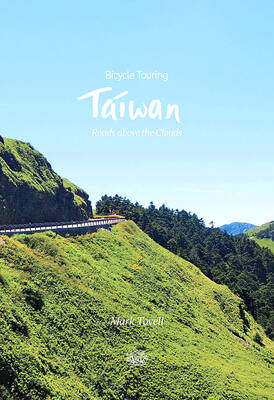
It’s hard to know where to begin with Mark Tovell’s Taiwan: Roads Above the Clouds. Having published a travelogue myself, as well as having contributed to several guidebooks, at first glance Tovell’s book appears to inhabit a middle ground — the kind of hard-to-sell nowheresville publishers detest. Leaf through the pages and you’ll find them suffuse with the purple prose best associated with travel literature: “When the sun is low on a warm, clear morning, and with the heat already rising, we stand at the riverside bike path leading south from Sanxia’s old cobble streets.” Hardly the stuff of your

Located down a sideroad in old Wanhua District (萬華區), Waley Art (水谷藝術) has an established reputation for curating some of the more provocative indie art exhibitions in Taipei. And this month is no exception. Beyond the innocuous facade of a shophouse, the full three stories of the gallery space (including the basement) have been taken over by photographs, installation videos and abstract images courtesy of two creatives who hail from the opposite ends of the earth, Taiwan’s Hsu Yi-ting (許懿婷) and Germany’s Benjamin Janzen. “In 2019, I had an art residency in Europe,” Hsu says. “I met Benjamin in the lobby


 RSS
RSS