


After the Taipei Golden Horse International Film Festival wrapped up this week, this year's film festival season will enjoy another boost with the arrival of the Latino American Film Festival (拉丁美洲影展).
Featuring 24 movies from across the continent, the festival opens up a window for audiences to see different aspects of Latin America other than Argentina's tango or Brazil's football team.
The festival, which started yesterday, will run to the new year and will stop off at four venues nationwide: SPOT -- Taipei Film House
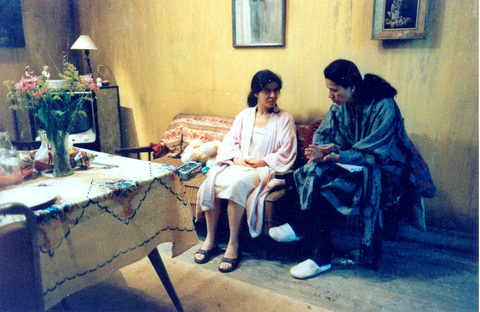
PHOTO COURTESY OF SPOT
As festival programmer Chang Chu-ti (
Arturo Ripstein, the director in focus, was born in Mexico City in 1943. Ripstein started his film career at the age of 19, working as an assistant director for Luis Bunuel on The Exterminating Angel (1962). In many of his films, the director explores the solitude of the human soul with a surrealistic bent, an aesthetic approach that has earned him a name as the successor of Bunuel, the cinema master of surrealism.
Adapted from the screenplay by Gabriel Garcia Marquez and Carlos Fuentes, Ripstein's directorial debut, Time to Die, initiated the director's long-term collaboration with the Latin American authors. The Realm of Fortune is based on Mexico writer Juan Rulfo's story about a poor peasant who gains wealth by raising gamecocks and loses his fortune when life takes an unexpected turn.
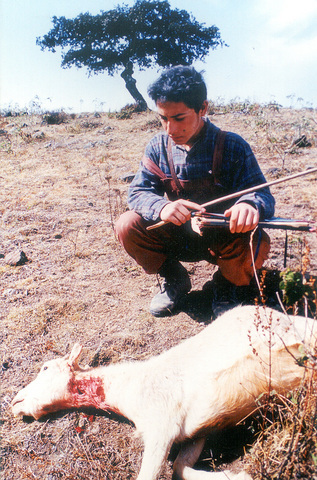
PHOTO COURTESY OF SPOT
Devine presents the story of a teenage girl named Tomasa who is chosen to give birth to the New Messiah by the leader of the New Jerusalem cult. Unable to handle the power and pressure, Tomasa declares herself the Whore of Babylon and makes male followers have sex with her.
The Ruination of Men tells a bizarre tale that begins with two peasants murdering a man who has two wives. After taking the body home, the murderers find themselves trapped in an eerie situation in which the dead man's wives refuse to share their deceased husband and fight over the corpse.
The program "Nouvelle Vague of Latino Cinema" introduces a bevy of talented filmmakers who strive to combat the cultural hegemony of Hollywood.

PHOTO COURTESY OF SPOT
Movie, Aspirin and Vultures follows two men, a German and a Brazilian, who travel through the backside in Brazil. They show a film to the locals, who have never seen cinema before, in an attempt to convince the peasants that the medicine they are hawking is the real deal.
Lost Embrace deals with the issues of immigration and identity. Set in the capital of Argentina where many young people want to find their ancestors' roots and obtain a foreign passport, the character Ariel wants to go back to Poland and to discover why his father abandoned the family to fight a war in Israel.
For those who have missed the cream of Latino cinema in recent years, the festival also offers a chance to review selected works on the big screen. Buena Vista Social Club and Musica Cubana trace the history of Cuban music and put the legendary musicians in the international spotlight. The Motorcycle Diaries by Walter Salles follows the road trip through South America made by a young Che Guevara who is later inspired to become a revolutionary. City of God is a well regarded violent gang flick that made Brazilian director Fernando Meirelles internationally famous overnight.
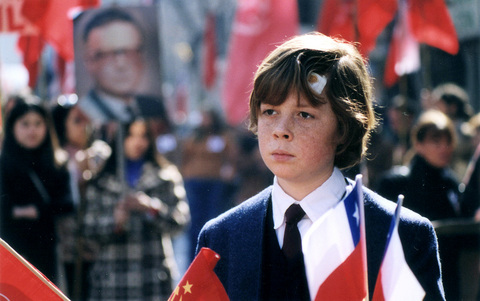
PHOTO COURTESY OF SPOT
Tickets are available from www.artsticket.com.tw. For detailed information on films and screening times visit www.twfilm.org/Latino/index.html.
Festival Notes:
What: Latino America Film Festival
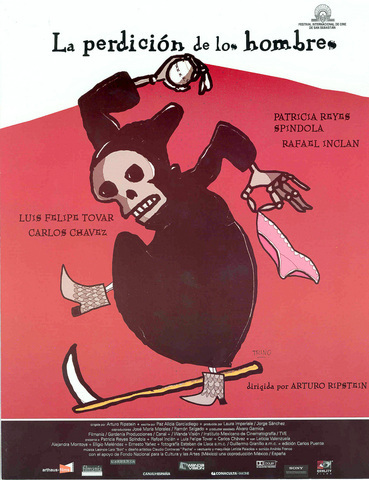
PHOTO COURTESY OF SPOT
When and Where:
Nov. 17 to Nov. 28, 2005, at SPOT -- Taipei Film House: 18, Zhongshan N Rd Sec 2, Taipei (台北市中山北路二段18號).
Nov. 29 to Dec. 4 at Taichung Universal Cinema City: 1-1, Zhonghua Rd Sec 1, Taichung (台中市中華路一段1-1號)
Dec. 6 to Dec. 18 at Kaohsiung Film Archive: 10 Hesi Rd, Yencheng district, Kaohsiung County (高雄縣鹽埕區河西路10號).
Dec. 21 to Jan. 1, 2006, at Hsinchu Municipal Image Museum: 65, Chungcheng Rd, Hsinchu City (新竹市中正路65號).
Tickets: NT$180 for members, NT$200 for non-members at SPOT -- Taipei Film House. NT$100 in Hsinchu. Entrance is free of charge in Kaohsiung.

In late October of 1873 the government of Japan decided against sending a military expedition to Korea to force that nation to open trade relations. Across the government supporters of the expedition resigned immediately. The spectacle of revolt by disaffected samurai began to loom over Japanese politics. In January of 1874 disaffected samurai attacked a senior minister in Tokyo. A month later, a group of pro-Korea expedition and anti-foreign elements from Saga prefecture in Kyushu revolted, driven in part by high food prices stemming from poor harvests. Their leader, according to Edward Drea’s classic Japan’s Imperial Army, was a samurai

The following three paragraphs are just some of what the local Chinese-language press is reporting on breathlessly and following every twist and turn with the eagerness of a soap opera fan. For many English-language readers, it probably comes across as incomprehensibly opaque, so bear with me briefly dear reader: To the surprise of many, former pop singer and Democratic Progressive Party (DPP) ex-lawmaker Yu Tien (余天) of the Taiwan Normal Country Promotion Association (TNCPA) at the last minute dropped out of the running for committee chair of the DPP’s New Taipei City chapter, paving the way for DPP legislator Su

It’s hard to know where to begin with Mark Tovell’s Taiwan: Roads Above the Clouds. Having published a travelogue myself, as well as having contributed to several guidebooks, at first glance Tovell’s book appears to inhabit a middle ground — the kind of hard-to-sell nowheresville publishers detest. Leaf through the pages and you’ll find them suffuse with the purple prose best associated with travel literature: “When the sun is low on a warm, clear morning, and with the heat already rising, we stand at the riverside bike path leading south from Sanxia’s old cobble streets.” Hardly the stuff of your
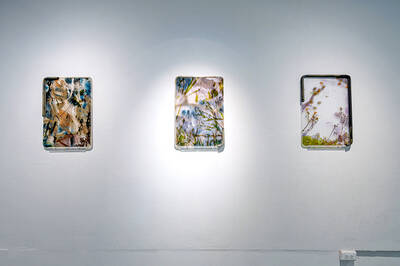
Located down a sideroad in old Wanhua District (萬華區), Waley Art (水谷藝術) has an established reputation for curating some of the more provocative indie art exhibitions in Taipei. And this month is no exception. Beyond the innocuous facade of a shophouse, the full three stories of the gallery space (including the basement) have been taken over by photographs, installation videos and abstract images courtesy of two creatives who hail from the opposite ends of the earth, Taiwan’s Hsu Yi-ting (許懿婷) and Germany’s Benjamin Janzen. “In 2019, I had an art residency in Europe,” Hsu says. “I met Benjamin in the lobby


 RSS
RSS