


They are the people who make designers' products look perfect. The unsung heroes of fashion are sometimes far removed from the design houses and catwalks, working in the realm of retail and confined to storefront windows.
"It's the challenge of making something designed for every day look like it would make any day special," said Wang Xiao-lan (
"The most important thing is, of course, to bring Isabelle's personal style to the fore," said Wang, whose arrangements generally go for the straightforward clothes-on-a-mannequin look. Such a style, she said, is the best way to show people the clothes without distracting them with other images. "People can pass by and imagine themselves in the outfit."
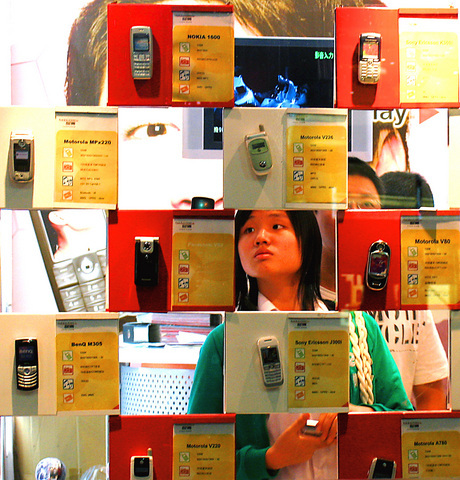
PHOTOS: DAVID MOMPHARD, TAIPEI TIMES
Other times, however a more radical approach is called for.
Window dressings are basically of three schools of thought. One takes a page from magazine design, literally, by blowing up the same ads found in glossy glamour rags to window size. Another is to prop up a mannequin and pull some clothes over it.
In the final school of thought, however, designers think outside the windowsill. More akin to museum installations than department store designs, these displays might include special lighting, sound, animatronics or even live models to catch the eye of a passersby.
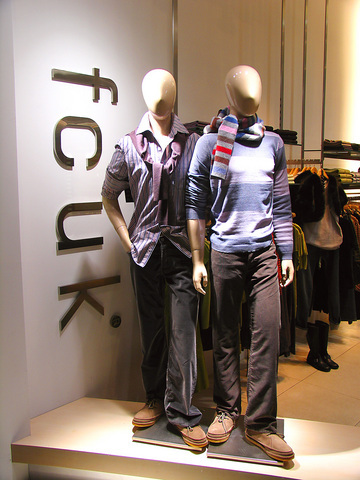
The height of the window dressing world is making up the massive glass enclosures of upscale boutiques like Gucci, Prada and Louis Vuitton; making NT$80,000 handbags look like a million bucks. Of course, these brand empires don't leave their windows to chance.
Instead, the flagship store in Paris or New York will distribute materials and instructions down to the centimeter on how their window displays in the rest of world should look, putting the onus on local window dressers to execute the plans. But the thrill of landing such work is dampened by the fact that you probably can't tell your friends what you're doing.
"Sorry," said Prada and Gucci representative Sudia Huang when asked about the process behind the stores' displays. "We don't share this type of information with the media."
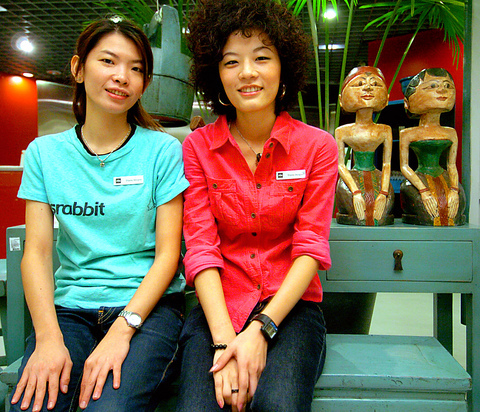
PHOTO: SEAN CHAO, TAIPEI TIMES
The glitziest of the world's glamour houses guard the ingredients that go into their displays as zealously as Colonel Sanders guarded his recipe for fried chicken. Huang said talking about design concepts or plans with anyone outside the company is grounds for dismissal. Even saying who photographs the clothes or dresses the windows is a no-no, and the freelance designers and photographers the company hires are legally sworn to secrecy.
Simon Doonan made a name for himself and ultimately landed a film deal for the rights to his book Confessions of a Window Dresser, a glass-steaming kiss-and-tell about his world-famous designs for the windows of Barney's New York department store. More than a memoir of an artist's insight into his work, the book told of working with designers such as Lagerfield, Lacroix, and Armani and of collaborating with the most notorious names in the art world: Mapplethorpe, Rauschenberg, and La-Chapelle.
While the windows of Taipei's department stores don't have the exposure of Barney's New York, the pressure on local designers is likely to increase with the expansion of the city's upscale retail real estate in the Da'an district (大安區). Here buildings of the Shinkong Mitsukoshi Department Store are going up at Sim City pace and boutiques are moving in while the paint is still wet. With the buildings looking similar the differences are accentuated by the window displays.
Visit Paul Smith's space here and you're greeted with a headless mannequin knitting the scarf he's wearing. At another boutique down the corridor, the clothes racks become a tidal wave of polished chrome that swirls around the store from the door to the changing booth to the cash wrap. Often the work of the designer moves into the store itself, choosing the store's furnishings and display tables and cases.
This is certainly true of another big-business boutique, Piin Home Furnishings, which has made a name for itself with its eye-catching in-store displays. Located on the upper floors of the department stores it occupies in its three current locations, Piin doesn't have street-side windows to lure customers, but spares no effort in creating a furniture fantasyland inside.
"We're given free-reign to create displays," said Riko Lee (
Lee said the greatest satisfaction comes inadvertently from
curious customers. Once, when hanging items from the ceiling using spools of red string, a visitor to the store asked where she could buy a spool.
"I had to tell her it was a display item," Lee said. "I'd bought the string at a fabric market because I thought it would have a lot of uses in the store displays. But to think someone would want to buy it is gratifying."

In late October of 1873 the government of Japan decided against sending a military expedition to Korea to force that nation to open trade relations. Across the government supporters of the expedition resigned immediately. The spectacle of revolt by disaffected samurai began to loom over Japanese politics. In January of 1874 disaffected samurai attacked a senior minister in Tokyo. A month later, a group of pro-Korea expedition and anti-foreign elements from Saga prefecture in Kyushu revolted, driven in part by high food prices stemming from poor harvests. Their leader, according to Edward Drea’s classic Japan’s Imperial Army, was a samurai

The following three paragraphs are just some of what the local Chinese-language press is reporting on breathlessly and following every twist and turn with the eagerness of a soap opera fan. For many English-language readers, it probably comes across as incomprehensibly opaque, so bear with me briefly dear reader: To the surprise of many, former pop singer and Democratic Progressive Party (DPP) ex-lawmaker Yu Tien (余天) of the Taiwan Normal Country Promotion Association (TNCPA) at the last minute dropped out of the running for committee chair of the DPP’s New Taipei City chapter, paving the way for DPP legislator Su

It’s hard to know where to begin with Mark Tovell’s Taiwan: Roads Above the Clouds. Having published a travelogue myself, as well as having contributed to several guidebooks, at first glance Tovell’s book appears to inhabit a middle ground — the kind of hard-to-sell nowheresville publishers detest. Leaf through the pages and you’ll find them suffuse with the purple prose best associated with travel literature: “When the sun is low on a warm, clear morning, and with the heat already rising, we stand at the riverside bike path leading south from Sanxia’s old cobble streets.” Hardly the stuff of your
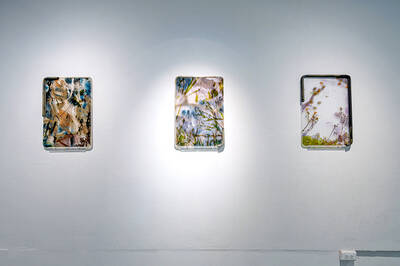
Located down a sideroad in old Wanhua District (萬華區), Waley Art (水谷藝術) has an established reputation for curating some of the more provocative indie art exhibitions in Taipei. And this month is no exception. Beyond the innocuous facade of a shophouse, the full three stories of the gallery space (including the basement) have been taken over by photographs, installation videos and abstract images courtesy of two creatives who hail from the opposite ends of the earth, Taiwan’s Hsu Yi-ting (許懿婷) and Germany’s Benjamin Janzen. “In 2019, I had an art residency in Europe,” Hsu says. “I met Benjamin in the lobby


 RSS
RSS