


In some parts of the world, like Germany, October is
synonymous with beer drinking. And with the emergence of microbreweries in Taiwan, it's becoming increasingly true of Taiwan, too. But what exactly is brewing in this cottage industry, and how do local beers rate?
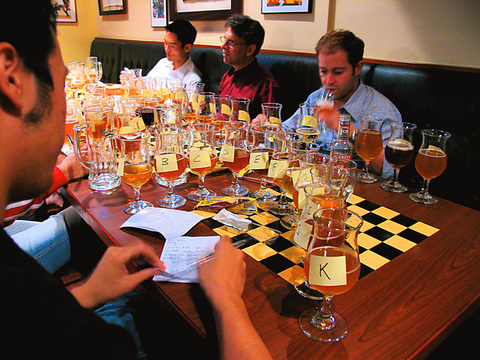
To find out, I conducted a blind taste test of beers made in Taiwan. Far from an exacting inquiry, I was more interested in finding out how a group of average beer drinkers would rate the average local brew.
PHOTOS: DAVID MOMPHARD, JULES QUARTLY, TAIPEI TIMES
All the pales, porters, pilsners, steams and stouts in the world can be divided into two basic beers: ale and lager.
When discussing the difference between the two, beer drinkers will usually talk about taste. But the basic difference between the two is in the way they're brewed. Ales use a yeast that ferments at the top of the vat and at higher temperatures. Lager ferments with a yeast that floats to the bottom and starts its business at lower temperatures.
Ale has been around the longer of the two, by about nine millennia. Lager is the new brew on the block, having first been rolled out of caves by German monks who sought to create a brew that would keep longer. By the mid-1840s, it was the toast of Europe.
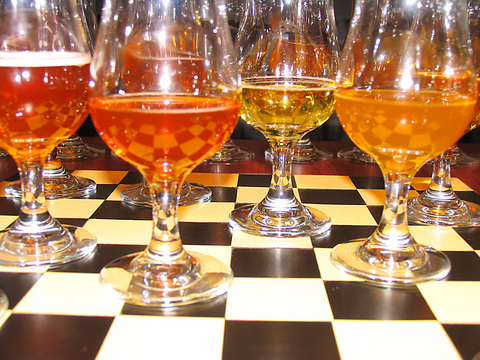
Despite ale's considerable head-start, lager now holds the top spot in terms of popularity, accounting for over 90 percent of all beer consumed worldwide.
Not coincidentally, the Taiwan Tobacco and Liquor Corporation, brewers of the country's lager, enjoys a near-90 percent share of the local market. The remaining percentage is taken up by imports and a growing number of microbrewers.
Rather than try to sip from Taiwan Beer's market share, local craft brewers have sought out those drinkers interested in "Belgian-style" beers. Most of these breweries double as restaurants. In Taipei, the microbreweries aren't brewing anything in-house, though, as such activity is illegal within the city's limits. The breweries are located elsewhere and the beer is shipped as needed.
The test
For our test, I gathered 10 beers from five local beer makers. Of the craft brewers, only North Taiwan Brewing Company is bottling its beer for sale in stores. All the other beers I rounded up the day of our tasting, whisking them to the refrigerator at The Brass Monkey.
Most of the microbreweries have at least a couple of varieties on tap. JB's offers both a stout and a steam beer. Le ble d'or offers a stout, Hefe-Weissbier and lager. Jolly has five selections, including their pale ale, Scotch ale, weizen, stout and pilsner. North Taiwan Brewing bottles Abbey Ale and White Beer.
Figuring that 10 beers were enough for one sitting, we tasted all but the stouts. The only other local brew included was Taiwan Draft, out of the bottle. For an added measure of mystery, I threw in a "bonus" import and asked the tasters to guess which it was.
The panelists were from a variety of backgrounds. They were: David Chen, a musician; Michelle Chen, a legal consultant; technical marketing engineer Matthew Dieckman; brain research scientist David Niddam; journalist Graham Norris; Jacques van Wersch, manager of the news department at Eastern Broadcast Corp; freelance designer Wu Yi-hsien; and Alex Yuan, a consular officer at the American Institute in Taipei.
I listed the beers they'd be drinking and gave the panelists a pad of paper on which to write their thoughts. They scored each entry on a scale of 1 (sewage) to 10 (manna). The beers were poured out of sight and served in glasses marked A through K.
The Results
As the beer started flowing so did the comments, though by the end not many were that clear. "Fruity" was a label given to many of the entries, with the exception of the lagers, the first of which the panelists easily identified as Taiwan Beer. When another rice-brewed lager (Budweiser) was set down immediately after it, they started second-guessing themselves.
"Even worse than Budweiser," Yuan said of Taiwan Beer, but said the next round [Budweiser] was "just a little better than [Taiwan Beer]." Niddam, our scientist, offered a note after the fifth round: "Impaired subjectivity. Beer starts to kick in. I'm trying to avoid increasingly better rating."
At the end of the tasting, Van Wersch pointed out that the beers were changing flavors as their temperatures changed. "In some cases, the warmer the beer, the better the flavor," he said.
The top-scorers of the evening were the Jolly beers, three of which took the top three spots, with Jolly Weizen at No. 1. They were the only beers to outscore Taiwan Beer.
And what of the fact that the "best" beer scored only six? Though the scores were uniformly average, the tasters' general comments ran more to the complimentary than the critical.
"I have to say, if these were all made in Taiwan, it's quite a wide selection of tastes," Norris said.
After the tally, I contented myself with polishing off the Jolly Weizen. Next time, though, I want to sit at the table.
The Label - K, Jolly Weizen
The Fizz - Tested the best despite being tasted last (or would that be because it was tasted last?). "Pretty good. But I'm not sober, so I can't tell," one judge said. Most other comments were illegible.
The Rating - 6.00
The Label - D, Jolly Pale Ale
The Fizz - "Like a woman that plays hard to get but relents in the end." Yuan said.
The Rating - 5.85
The Label - A, Jolly Pilsner
The Fizz - The first beer tasted and one of the more evenly rated. Norris said he'd enjoy it best on his balcony with a barbecue. If he had a balcony or a barbecue.
The Rating - 5.57
The Label - F, Taiwan Draft
The Fizz - "'F' is for formaldehyde," Van Wersch said. "Tastes like water," said daughter of a brewer, Michelle Chen. Norris said it was much more his cup of tea.
The Rating - 5.53
The Label - J, North Taiwan Abbey Beer
The Fizz - The penultimate beer had a "bite," according to Wu. David Chen said it tasted like "bitter bubblegum."
The Rating - 5.28
The Label - I, JB's Steam Beer
The Fizz - Reminded Niddam of "deep sofas, pretty girls and palm trees." Time for JB's to redecorate?
The Rating - 5.14
The Label - B, Le ble d'or Lager
The Fizz - Yuan described it as 'a sweet version of Sam Adams" but another judge said he'd "need chains and an anchor to hold this beast down."
The Rating - 4.78
The Label - E, Jolly Scotch Ale
The Fizz - "Dark, dark like a Taiwanese girl's emotions," was one comment. David Chen said it was too "sweet and intense" to drink an entire one.
The Rating - 4.71
The Label - G, Budweiser
The Fizz - Lots of references to water on this round. Niddam joked that it would taste better if he could add ice cubes.
The Rating - 4.64
The Label - H, Le ble d'or Hefe-Weissbier
The Fizz - "'H' is for Hoegaarden," Van Wersch said. Norris said he wouldn't do his washing up in it.
The Rating - 4.33
The Label - C, North Taiwan White Beer
The Fizz - "What's that Chinese medicine you take if you have diarrhea?" asked on judge. Another likened it to an "experimental licorice mix."
The Rating - 3.71
For information on where to purchase local microbrews
• JB’s bar and restaurant
148 Shida Rd., Taipei (北市師大路148號)
02 2364 8222
• Jolly Malty Drink Bar & Italian Kitchen
29 Chingcheng St., Taipei (北市慶城街29號)
02 8712 9098
• Jolly Thai Food & Malty Drink
423 Jinhu Rd., Neihu District, Taipei (北市內湖區金湖路423號)
02 2632 2229
• Le ble d’or
AsiaWorld, 100 Dunhua N. Rd., Taipei (還亞百貨, 北市敦化北路100號)
02 8712 8512
Miramar Center, 5F, 22 Jingyeh 3rd Rd., Taipei (美麗華 北市敬業三路22號五樓)
02 2175 3739
To find out where to buy North Taiwan Brewing's Abbey Ale and White Beer, call 02 2299 7591.

Taiwan’s English education system is being pulled apart by three opposing forces. Bilingual Nation 2030 pulls students toward English and global communication. Artificial Intelligence (AI) readiness pulls them toward digital judgment, verification and AI-mediated work. But Taiwan’s old exam culture pulls them back toward memorization, grammar drills, timed reading and correct answers. If the education system keeps using old exams to define success, it risks producing graduates who are neither genuinely bilingual nor genuinely AI-ready, but trained for tasks machines can already perform. The first force is Bilingual Nation 2030. Launched in 2018, the policy aimed to “help Taiwan’s workforce connect
It seems every few days one bumps into one of those “real man” comments in which Taiwan is urged to “face reality” or similar, and “make a deal,” with the speaker implying that soon it will be too late. “Deal” advocates always present themselves as having a superior grip on reality, and the manly ability to make the “hard choice.” Their testosterone-laden language often echoes that of Taiwan sellout advocates. Note that such commentary always specifies a process (“make a deal, work with, make progress”), never the end state of what occupation by a violent authoritarian colonialist state will entail. In
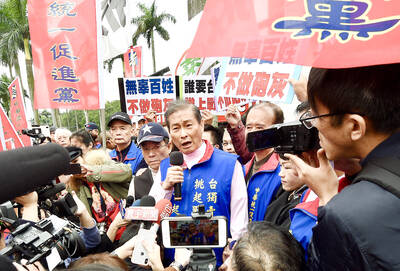
There are shadowy cabals plotting to sell out Taiwan to be annexed by China, by invasion if necessary. Fortunately, they are buffoons. In 2019, former Bamboo Union gangster and founder of the China Unification Promotion Party (CUPP), Chang An-le (張安樂, colorfully known as “White Wolf”), led a protest at the Legislative Yuan against comments made by then-premier Su Tseng-chang (蘇貞昌) that in the event of an attack by China, he would never surrender, but would protect the nation by fighting to the end, even if he only had a broom. Chang had party members bring a wooden casket that they
June 1 to June 7 "If all Taiwanese were as afraid of dying as you, then what would happen?” Physician Shih Chiang-nan (施江南) reportedly said this to his wife Chen Chiao-tung (陳焦桐) after she urged him to stop intervening on behalf of Taiwanese soldiers stranded overseas after serving in the Japanese Army during World War II. Shih had clashed with high-ranking officials over the issue, engaged in several heated arguments with Taiwan governor-general Chen Yi (陳儀) and allegedly shouted at general Ko Yuan-fen (柯遠芬), chief of staff of the Taiwan Garrison Command, over


 RSS
RSS