


For morning commuters, the hours trapped in gridlocked traffic are a ripe time for fantasies of drastic change. It is little wonder that many have pondered the notion of pedaling a bicycle to work.
But even for those who live in Sun Belt cities with ample bike lanes, this drive-time fantasy usually runs aground on bluntly practical shoals. There are laptop computers to lug and children to drop off at day care. There are potholes and thunderstorms. And, of course, there is the sweat riders work up, which clashes with an US$800 business suit.
For a growing number of bicycle fantasists, however, the obstacles no longer seem quite so insurmountable in the face of US$70 fill-ups at gas stations. Bike manufacturers have reported significant sales increases since the summer, when gas in many areas passed US$0.80 a liter.

PHOTOS NY TIMES
At the Interbike International Bicycle Expo, an industry convention late last month in Las Vegas,
commuting was a major "buzz topic," said Tim Blumenthal, the executive director of Bikes Belong Coalition, a trade association. He said the industry is seeing "a whole new breed of customer, people who haven't ridden bikes at all, coming in mainly because of eyeball shock at the gas pump."
Janelle Gunther, a scientist at Lawrence Livermore National Laboratory in California, is among the recent converts. "A couple weeks ago I was
joking with some friends and saying that when gas goes over US$0.80 liter, I won't pay it, I'll
refuse to use my car," Gunther, 35, recalled.
The next thing she knew, she was leaving her Toyota Camry in the driveway and pedaling the 8km to the lab. She figures she is saving about US$40 a week. She usually showers and changes at work, although more than once she has found herself scurrying into an early
morning meeting still clad in her Lycra cycling gear. "No one bats an eye," she said.
Bicycle sellers are unsure what percentage of the recent sales gains can be attributed to
commuters as opposed to recreational riders
inspired by another Lance Armstrong victory this summer in the Tour de France. But several sellers, including Chris Hornung, the chief
executive of Pacific Cycle in Madison, Wisconsin the largest distributor of bicycles in North America, including the Schwinn and Roadmaster brands -- said that the timing of the boom and the types of bikes that are selling indicate that commuters account for a healthy portion.
Hornung pointed out that it was sales of multigear adult cruiser bikes with medium-wide tires and cushy seats, "the sort commonly associated with commuting," that "jumped off the Richter scale," rocketing 20 percent in the week of Sept. 7 in the aftermath of Hurricane Katrina and the spike in gas prices.
At Breezer, in Sausalito, California, a manufacturer of comfort-oriented "transportation" bicycles -- they feature fenders, bells and cargo racks -- sales have risen 33 percent this year. During this past summer of fuel-price surges, sales were double those of the summer before, Joe Breeze, the company's founder, said.
Kevin Coggins, who owns a bike shop called the Spin Cycle in Cary, North Carolina, said inquiries about commuter bikes like Breezers are up. He also has noticed he has more company on the road each morning during his 45-minute bicycle commute from nearby Raleigh. "Normally when I ride to work, I see four or five people" in the bike lanes, he said. "Immediately after Katrina, I would see one or two dozen."
Skeptics who have weathered more than a few business cycles may be tempted to dismiss the sudden enthusiasm for pedal power as nothing more than a momentary spasm of household-budget anxiety that will pass the minute oil drops US$5 a barrel. (Recent studies indicating a relationship between certain bicycle seats and sexual dysfunction could also cool some of the enthusiasm.)
And in a country that worships horsepower, even the most ardent bicycle commuters
face an uphill battle pursuing a mode of
transportation traditionally associated with college professors or factory workers in Beijing. According to the most recent national figures, those of the 2000 census, only 489,000 Americans pedaled to work, compared with 97.1 million who drove alone.
In sprawling cities like Los Angeles and Houston, the great distance between home and office makes bicycling almost impossible. In New York City cyclists who do not fear being flattened by taxis must be fortunate enough to work in a building that provides bicycle storage.
Even in leafy college towns like Davis,
California, and bicycle-friendly cities like Cambridge, Massachusetts, the problems involved keep many from considering bicycling to work. Kyle Littlefield, 32, of Bryan, Texas, who works in marketing at the Texas A&M University Press, recently joined the ranks of bike commuters, but he and his wife are
already scrambling for a way to get their two young children to day care. "It's all contingent on my wife finding a carpool situation with one of her friends," Littlefield said.
Scott McGolpin, 42, a public works administrator in Santa Barbara,
California, said that his decision to cycle 22km to work, which saves on his Ford Expedition's US$50-a-tank habit, came at the cost of an hour of sleep every morning.
Advocates of bicycle commuting are hoping the apparent end of an era of cheap oil will provide momentum for cities to expand bike lanes and trails, install more bicycle racks on streets and buses, and perhaps even build bicycle stations like that in Chicago, where commuting riders can lock up their bikes, shower and change.
Elizabeth Preston, a spokeswoman for the League of American Bicyclists, a advocacy group in Washington, said that the federal transportation bill signed into law in August sets aside about US$1 billion for bike lanes and trails, "so the people who start commuting now will find better facilities and a more reliable infrastructure than the people in the 1970s did."
In some cases, taking on the additional challenge of bicycle commuting can be like a second job. Harry Brull, 56, an organizational psychologist in Minneapolis and an avid
recreational cyclist, said he had always wanted to leave his Audi at home in St. Paul and enjoy the bracing eleven-plus-kilometer ride along the Mississippi to his office downtown.
When gas hit US$0.80 a liter, he took it as the nudge he had been waiting for. He joined the Radisson hotel gym next to his office so he could shower. The weekend before his first trek, he stocked his office closets with suits and shirts.
"On Monday morning I got all excited," Brull said. "I made sure to put my computer in my messenger bag and gather all the papers I thought I would need." The plan came off
without a hitch, except for one detail. As he arrived in town glistening with sweat, he realized he had forgotten to pack his underwear.
While he plans to continue cycling, at least until the harsh Minnesota winter arrives, he acknowledged that his morning ride comes at a price in his jacket-and-tie profession.
"It does add another level of complexity to a life that's already complex enough," he said.

In late October of 1873 the government of Japan decided against sending a military expedition to Korea to force that nation to open trade relations. Across the government supporters of the expedition resigned immediately. The spectacle of revolt by disaffected samurai began to loom over Japanese politics. In January of 1874 disaffected samurai attacked a senior minister in Tokyo. A month later, a group of pro-Korea expedition and anti-foreign elements from Saga prefecture in Kyushu revolted, driven in part by high food prices stemming from poor harvests. Their leader, according to Edward Drea’s classic Japan’s Imperial Army, was a samurai

The following three paragraphs are just some of what the local Chinese-language press is reporting on breathlessly and following every twist and turn with the eagerness of a soap opera fan. For many English-language readers, it probably comes across as incomprehensibly opaque, so bear with me briefly dear reader: To the surprise of many, former pop singer and Democratic Progressive Party (DPP) ex-lawmaker Yu Tien (余天) of the Taiwan Normal Country Promotion Association (TNCPA) at the last minute dropped out of the running for committee chair of the DPP’s New Taipei City chapter, paving the way for DPP legislator Su
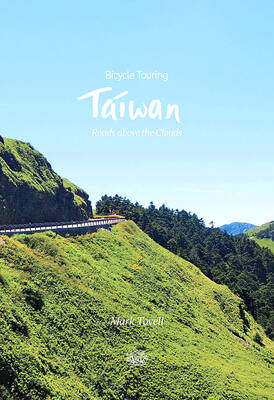
It’s hard to know where to begin with Mark Tovell’s Taiwan: Roads Above the Clouds. Having published a travelogue myself, as well as having contributed to several guidebooks, at first glance Tovell’s book appears to inhabit a middle ground — the kind of hard-to-sell nowheresville publishers detest. Leaf through the pages and you’ll find them suffuse with the purple prose best associated with travel literature: “When the sun is low on a warm, clear morning, and with the heat already rising, we stand at the riverside bike path leading south from Sanxia’s old cobble streets.” Hardly the stuff of your
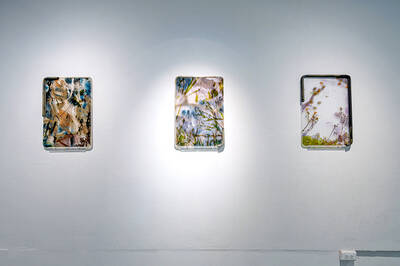
Located down a sideroad in old Wanhua District (萬華區), Waley Art (水谷藝術) has an established reputation for curating some of the more provocative indie art exhibitions in Taipei. And this month is no exception. Beyond the innocuous facade of a shophouse, the full three stories of the gallery space (including the basement) have been taken over by photographs, installation videos and abstract images courtesy of two creatives who hail from the opposite ends of the earth, Taiwan’s Hsu Yi-ting (許懿婷) and Germany’s Benjamin Janzen. “In 2019, I had an art residency in Europe,” Hsu says. “I met Benjamin in the lobby


 RSS
RSS