

Long before Taiwan joined the WTO, owners of bikes larger than 125cc were gearing up for the day when they could legally cruise the nation's highways and byways on their mighty two-wheeled chariots of fire. For hog enthusiasts, news that the government would lift the ban on big bikes was greeted with fanfare.
"I'm really happy about WTO entry ... Big bikes are going to be in big demand starting next year and it won't be a passing fad ...," said Peterson Hsueh (
Since the opening up of the nation's roads to hogs, however, bikers like Hsueh have found little to cheer about. Prior to the legalization of big bikes the Ministry of Transportation and Communications (MOTC) estimated that sales would reach somewhere in the region of 10,000 to 12,000 units per year.
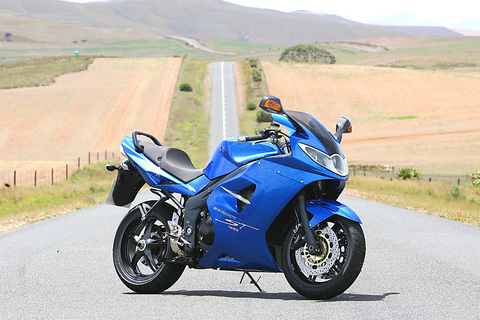
Both the MOTC and the National Police Agency said such a huge influx of hogs on Taiwan's roads would lead to increased traffic congestion, more traffic accidents and a jump in the number of roadside fatalities.
Needless to say, this did not come true. There have been a few accidents, but thankfully nobody has died and big bikes have certainly not become the on-road irritatants they were once thought they may become.
There are currently only 10,000 registered bikes with engine capacities of 250cc or more plying the nation's roads. According to Mark Tsai (
"We sell an average of between 120 and 180 units per year," he said. "Riders still can't walk in off the street, buy a bike and drive it away. Bikes are expensive, there are additional levies and costs and various emissions and engine tests need to be carried out before any new bike can take to the road."
As a result of a heavily publicized demonstration by hog owners a year ago the annual road tax was cut from NT$24,000 to NT$7,000. Buying a big bike and keeping it on the road in Taiwan remains a pleasure that only the rich can enjoy. Import duties stand at between 30 percent and 75 percent, depending on engine capacity. The cost of registering and securing a license plate for a new import bike costs in the region of NT$80,000 and the average retail cost of a big bike is between NT$400,000 and NT$ 1million. For some the price is just a little too high.
"I could buy two bikes in the US for the price of one in Taiwan," said hog enthusiast and drummer for China Blue, Dino Zavolta. "Then there's the problem with parking them. I mean you're not going to leave a bike like that on the street. It'll get ripped off and then what?"
Of course, with 10,000 registered bikes nationwide not everyone shares Zavolta's pessimism over ownership of a big bike. Taiwan's most popular bikes are Japanese brands, with Honda leading the pack, closely followed by Yamaha, Suzuki and Kawasaki.
"It's not surprising that Honda and so on are the top sellers in Taiwan. Riders are more familiar with Japanese bikes and, of course, before they were legalized the vast majority of bikes were smuggled in from Japan," said Triumph's Edward Chen (
The Japanese may currently hold pole position, but European rivals haven't pulled into the pits just yet. The leading European contender is BMW, which, according to Tsai, is slowly coming up behind Honda's taillights. But then, like its Japanese rivals BMWs are easily obtainable from most independent dealerships nationwide and can cost as little as NT$450,000.
While sales remain brisk at smaller dealerships, dealers like Triumph and Ducati have taken to importing specialist high-end models in order to attract a different type of customer. The NT$600,000 1,050cc Triumph Speed Triple, the bike ridden by Tom Cruise in Mission Impossible II and the 1,000cc Ducati 999R, are manufactured to order.
To date sales of the Speed Triple number less than 10 nationwide, but Triumph, which has only moved 200 bikes since operations began in Taiwan almost three years ago, feels that by offering riders something special it will be able counter the mass-produced Nipponese onslaught and slice out its own lucrative corner of the market.
"When we started we moved a lot of Bonnevilles," Chen said. "The age of the riders at that time was about 50, but it's come down recently and now we're seeing people aged from 30 to 40 who want to purchase something special that they can't get anywhere else."
The same is true of Ducati, which, since opening its Taiwan branch two-and-a-half years ago has sold an almost equal number of units. But in seemingly true Italian style the European bike manufacturer is in no particular hurry to increase business.
"Business is going up slowly but surely. We're not selling big numbers, but we're looking at Taiwan as a long, rather than a short term market," Ducati's Jack Wang (王書武) said. "People who know about bikes will, regardless of how much cheaper certain non-European models are, continue to buy Ducati."
The most powerful specialist bike currently kicking up a racket on the streets is the behemoth 2,300cc Triumph Rocket III. Costing a cool NT$1.1 million, the bike is proving a big hit with riders. Regardless of the fact that there's nowhere to go in Taiwan where they can legally test its ability to go from 0kph to 100kph in 2.8 seconds there are currently 10 Rocket IIIs plying the nations highways and byways.
Bikers looking for the costliest ride are purchasing the six-speed 1,000cc Ducati 999S. It might not be as gutsy as its British-made rival, but the Italian mean machine has a top speed in excess of 200kph and will set a would-be buyer back a hefty NT$1.4 million. With fewer than five units on the road the 999S is in a minority, albeit a very fast one.
Of course, neither of the aforementioned retail costs include import tax and additional charges such as emission and engine tests. Add all that up and riders need to fork out at least NT$2 million for a machine on which they will never be able to move out of second gear.
The inability to hit top gear on a hog in Taiwan is, in fact, one of the largest stumbling blocks to the widespread use of big bikes. The government's refusal to amend traffic laws to compensate for bikes greater than 250cc has raised the ire of enthusiasts like Wang.
Owners who choose to bring their hogs into urban areas are still forced to abide by the same traffic laws as riders of scooters. And, with the exception of routes 68 and 72 in the Hsinchu and Miaoli area -- where for a trial period bikers are currently allowed to travel at 80kph -- they are not allowed to exceed 60kph on surfaced roads.
For Wang, these restrictions have proven too much to bear. Once the proud owner of a half-a-dozen big bikes, several of which were "antiques" dating from the 1950s, he has since sold them all.
"It just got too much. Sure the laws have been changed, but the end result certainly hasn't lived up to the expectations we once had," he said. "You still can't ride big bikes [in Taiwan] like you should and how they deserve to be ridden."
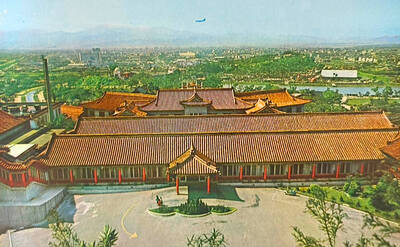
Sept. 21 to Sept. 27 When the Shah of Iran became the Grand Hotel’s (圓山大飯店) first head-of-state guest in 1958, it was hardly the landmark it is known as today. A Chinese-style, two-story structure with just 36 rooms built on the former site of the Taipei Shinto Shrine, the hotel was still referred to as its original name, the Taiwan Hotel (台灣大飯店), in an official newsreel detailing Mohammad Reza Pahlavi’s visit. The video lavished praise on the hotel, pointing out its “beautiful architecture and magnificent appearance” and noting that it had just been renovated. After being greeted personally by then-president
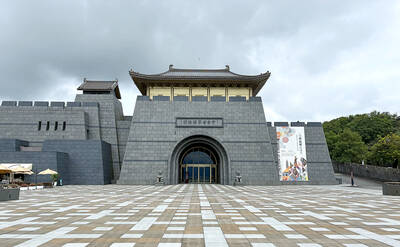
The one-day trip begins at the geographical center of Taiwan: Puli Township’s (埔里) Hutou Mountain Geographic Center of Taiwan Monument (臺灣地理中心碑), embedded at the foot of Nantou County’s dense forested slopes. It sits entrenched in forest vegetation amid the tall, spindly bodies and spiky heads of the betel nut trees; the air is cool, and its surroundings are mostly silent save the sounds of late-season cicadas. Roughly two minutes from the first destination, and after a bend in Yongfeng Road (永豐路), there’s a glimpse of a resplendent golden dome on the horizon. It’s the cap of the 135m-tall main building of the
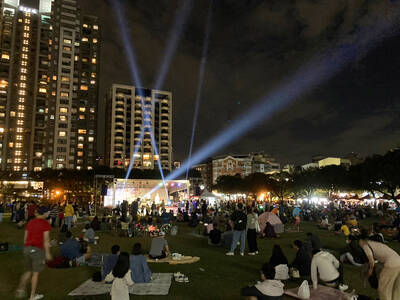
Two years ago, the music came to an abrupt halt at one of Taiwan’s largest independent music festivals. The problem: a single noise complaint. The DJ’s high-energy tunes had exceeded the allowed sound limit. As per regulation, the performance took a several-minute pause and then continued, this time at a slightly lower decibel. And then last year, the same event, Compass Taichung International Food and Music Festival, was unexpectedly canceled due to sponsorship issues. Such are the woes of trying to organize outdoor music festivals these days. “It makes it so much harder to put on a festival,” said Courtney Donovan Smith, co-publisher
Focus Taiwan reported on the Kuai Kuai land sale, with a narrative centered on the famed snack factory’s workers. But buried in it was a glimpse of the way Taiwan’s land markets are being relentlessly reshaped by the multiple pressures of sagging traditional industry fortunes and surging AI and related electronics industries. Kuai Kuai’s owner, the San-ti Group, sold the factory and the land it sits on in Taoyuan’s Zhongli District (中壢). According to Taoyuan Confederation of Trade Unions Secretary-General Tracy Sun (孫語謙), who was quoted in the piece, rising land prices, especially for industrial land, tempt factory owners to sell


 RSS
RSS