


When Wu Tun-ho (吳敦厚) lost his hearing after a fever at age 13, he feared he'd also lost his ability to earn a living. In the years that followed, however, Wu discovered he had a talent for crafting and painting traditional Chinese paper lanterns. Now in his mid-80s, Wu is recognized both in Taiwan and abroad as the guardian of an art that nearly disappeared.
Finding Wu's shop in the historic township of Lukang (
Helping him is Wu Yi-de (

PHOTO: DAVID MOMPHARD, TAIPEI TIMES
Among the younger Wu's duties is recounting the many stories that are illustrated by photos of famous figures
adorning the shop walls.
"Master Wu was not always famous," Wu said, sounding more like an apprentice than a son. "In 1971, a Japanese delegation saw his lanterns and invited him to exhibit them in Japan. He was given a gift of calligraphy personally written by Tanaka Kakuei," who would become Japan's premier the following year. The calligraphy and a photo of Tanaka signing it hang above Wu's workbench.
The recognition he earned in Japan, however, didn't translate into recognition at home until a decade later. Literature Nobel Prize-winner Alexander Solzhenitsyn had seen Wu's lanterns exhibited outside Taiwan and, during a high-profile visit to Taiwan in 1982, asked his hosts in the Government Information Office if he could meet Wu. But the officials had never heard of him.
"We received many phone calls from ministers and legislators wanting to know who my father was," the younger Wu recalled. "When Solzhenitsyn visited it was very exciting. All kinds of government officials came with him and hundreds of our neighbors came over to see what the commotion was about. After that, my father became Lukang's most famous resident."
Wu has since been bestowed all varieties of honors and awards, including being recognized as an "artist at the top of his field" by every president since Chiang Ching-kuo (蔣經國). With each award he's received, Wu has in turn given his guest a personally handcrafted lantern.
"The honors are very nice, but my greatest joy has been a simple life of making lanterns," the elder Wu said through his son. Along with being his apprentice, the younger Wu doubles as his father's public-relations representative, faithfully translating what he says to visitors who have a hard time understanding and communicating in a sign language the family has developed over the decades. To make interviews easier, media are asked to write their questions on paper for Wu to answer, though it's the younger Wu who does all the talking.
Part of the appeal of Wu's lanterns is the lengthy process that goes into crafting them. Painting is only the last step in a long process. Each of Wu's lanterns is crafted the same way lanterns were first made thousands of years ago, starting with a hand-woven bamboo frame that is covered with three layers of paper and coated with a kind of sticky rice soup which serves as water-proofing. After the paper dries to a hard finish, the lantern is given a base coat of paint -- usually yellow or red -- and allowed to dry again.
When the base coat dries, Wu then paints intricate scenes of dragons, tigers and Chinese immortals -- always by hand, never with a template. It's an art he's perfected since he opened his shop 64 years ago at age 17. It's also the skill that has, arguably, garnered him most of his acclaim. Tigers and immortals carry equal stature and expressiveness in Wu's painting.
Of course, you don't have to be a president or Nobel laureate to take home a piece of Wu's art. And despite international acclaim, his lanterns remain reasonably priced, ranging from US$15 (NT$500) for a small hand-painted lantern to US$270 (NT$9,000) for a meter-tall masterpiece.
Wu Yi-de says that since he does most of the work at the family's workshop, which doubles as their home, the older lanterns crafted by the elder Wu have become collector's items.
With each purchase comes a lesson in the traditional role of the various shapes and colors: Pear-shaped lanterns are meant to be hung indoors at the apex of a pitched roof, cylindrical lanterns are to be hung along eaves, round lanterns that are hung outside doorways bear the homeowner's name, ones made for businesses are red in order to bring good fortune.
"Yellow lanterns are for temples. It isn't appropriate to hang them in your house. Also, lanterns with dragon designs are bad for the home -- you should never have dragons in your home," the younger Wu said. "But I don't know if these rules apply to Westerners."
Wu Tun-ho's lantern shop is located in Changhua County's (
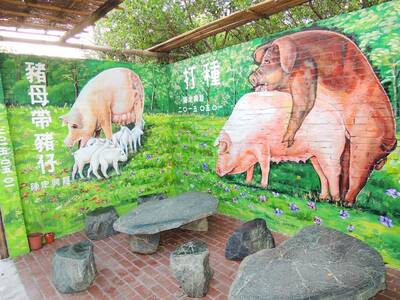
May 6 to May 12 Those who follow the Chinese-language news may have noticed the usage of the term zhuge (豬哥, literally ‘pig brother,’ a male pig raised for breeding purposes) in reports concerning the ongoing #Metoo scandal in the entertainment industry. The term’s modern connotations can range from womanizer or lecher to sexual predator, but it once referred to an important rural trade. Until the 1970s, it was a common sight to see a breeder herding a single “zhuge” down a rustic path with a bamboo whip, often traveling large distances over rugged terrain to service local families. Not only
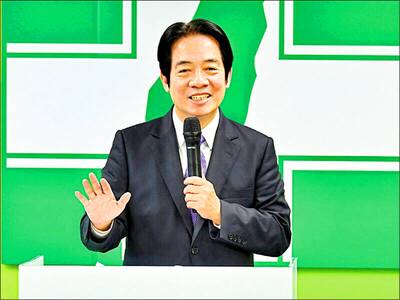
Ahead of incoming president William Lai’s (賴清德) inauguration on May 20 there appear to be signs that he is signaling to the Chinese Communist Party (CCP) and that the Chinese side is also signaling to the Taiwan side. This raises a lot of questions, including what is the CCP up to, who are they signaling to, what are they signaling, how with the various actors in Taiwan respond and where this could ultimately go. In the last column, published on May 2, we examined the curious case of Democratic Progressive Party (DPP) heavyweight Tseng Wen-tsan (鄭文燦) — currently vice premier
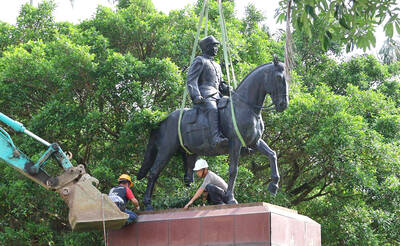
The last time Mrs Hsieh came to Cihu Park in Taoyuan was almost 50 years ago, on a school trip to the grave of Taiwan’s recently deceased dictator. Busloads of children were brought in to pay their respects to Chiang Kai-shek (蔣中正), known as Generalissimo, who had died at 87, after decades ruling Taiwan under brutal martial law. “There were a lot of buses, and there was a long queue,” Hsieh recalled. “It was a school rule. We had to bow, and then we went home.” Chiang’s body is still there, under guard in a mausoleum at the end of a path

Last week the Directorate-General of Budget, Accounting and Statistics (DGBAS) released a set of very strange numbers on Taiwan’s wealth distribution. Duly quoted in the Taipei Times, the report said that “The Gini coefficient for Taiwanese households… was 0.606 at the end of 2021, lower than Australia’s 0.611, the UK’s 0.620, Japan’s 0.678, France’s 0.676 and Germany’s 0.727, the agency said in a report.” The Gini coefficient is a measure of relative inequality, usually of wealth or income, though it can be used to evaluate other forms of inequality. However, for most nations it is a number from .25 to .50


 RSS
RSS