


On April 4, 2003, Glen Keane, one of the Walt Disney Company's most respected animators, summoned about 50 of his colleagues to a third-floor conference room on the lot here in California to discuss the war brewing at the studio. Disney's animators had settled into two opposing camps: those who were skilled in computer animation and those who refused to give up their pencils.
Keane, a 31-year veteran who created the beast from Beauty and the Beast and Ariel from The Little Mermaid, was a Disney traditionalist. But after a series of experiments to see if he could create a computer-animated ballerina, his opposition softened. So he invited the 50 animators to discuss the pros and cons of both art forms, calling his seminar "The Best of Both Worlds."
For an hour, Keane painstakingly ticked through the pluses and minuses of each technique while the other animators listened quietly. After a few tentative questions, the crowd burst into chatter, as animators shouted over one another, some arguing that computers should not replace people while others expressed fears that they would be forced to draw by hand.
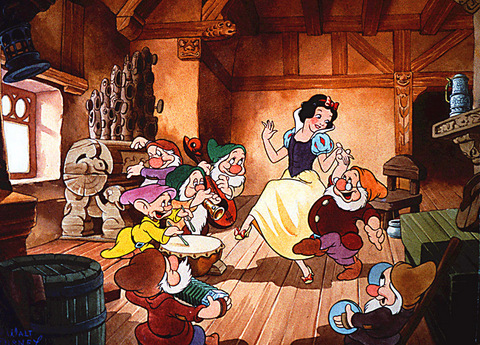
PHOTO: NY TIMES
In a recent interview, Keane recalled that Kevin Geiger, a computer animation supervisor, then stood up and demanded of him, "If you can do all this cool stuff that you're talking about -- that you want to see in animation -- but you have to give up the pencil to do it, are you in?" Keane hesitated before answering: "I'm in."
Three weeks later, the company's animators were told that Disney would concentrate on making computer-animated movies, abandoning a 70-year-old hand-drawn tradition in favor of a style popularized by more successful, newer rivals like Pixar Animation Studios and DreamWorks Animation. The results were nothing short of a cultural revolution at the studio, which is famous for the hand-drawn classics championed by its founder Walt Disney, like Snow White and the Seven Dwarfs and Peter Pan.
This November, some two and a half years after that decision, Disney will release Chicken Little, the first of four computer-animated films being developed at the newly reorganized studio. The company is hoping that this movie, along with others like Meet the Robinsons, American Dog and Keane's Rapunzel Unbraided, will return a reinvigorated Disney to its past glory.
There is a lot more than pride, however, riding on their success. Animation was once Disney's heart, a profitable lifeline that fed the company's theme park, book and home video divisions. And reviving profits is as essential to Disney these days as regaining its storied reputation.
Just last week, the company said it expected its studio to lose as much as US$300 million in the fourth quarter because of poor performance in its live-action division. Overall, the Disney Co had net income of US$2.27 billion in the first three quarters of fiscal 2005 on the strength of its ABC network and its ESPN sports cable channel.
"From a psychological standpoint, Chicken Little is very important for Disney," said Hal Vogel, a financial analyst who has covered Disney for years. "Everything is touched by animation and if they don't refresh it, it becomes frayed at the edges."
The box-office numbers show how far the sky has fallen. The studio reached the height of its most recent popularity with the 1994 release of The Lion King, which brought in US$764.8
million at the worldwide box office. By contrast, the last nine animated movies Disney either made or acquired took in only US$758.3 million combined. The Incredibles, the film created by Pixar last year, brought in US$630 million, nearly as much as Disney's last eight animated movies.
So it should come as no surprise that when Keane stood up and made his passionate plea in 2003, Disney was in the midst of an identity crisis. It had to reinvent itself -- or wither.
"When everybody feels pretty good about themselves, and you have Champagne coming out of the water fountain, it's almost like we've got to burn the place down," said Mark Dindal, the director of Chicken Little, in an interview in August that also included the directors of Disney's three other current animated-film projects.
But the competition in animated films is now tougher than ever. It is also fraught with enough sibling rivalry to make the wicked stepsisters in Cinderella blush. To begin with, there's Jeffrey Katzenberg, who left Disney in 1994 after a spat with the chief executive, Michael Eisner, to become a co-founder of DreamWorks SKG. The studio's offshoot, DreamWorks Animation, is now one of Disney's fiercest rivals.
Then there is Steven Jobs, the founder of Apple Computer and the Pixar chief executive who took a swipe at Disney last year, calling its animated sequels "embarrassing." Jobs also sparred with Eisner, despite the fact that the two companies have been partners since 1991. (That deal was brokered by Katzenberg.) Jobs agreed only recently to resume talks with Disney about a new distribution agreement that would start in 2007.
Against such a backdrop, Chicken Little is almost certain to be one of the most scrutinized movies of its kind, not only by moviegoers, but also by investors, competitors and fellow animators alike.
SECOND GUESSING
This is not the first time that Disney has faltered. After Walt Disney died of lung cancer in 1966, the studio was in a state of paralysis, as animators second-guessed themselves about what kind of movies Disney would have made if he were alive. The studio released a string of mediocre films in the 1970s and early 1980s. And frustrated young animators, like the director Tim Burton and John Lasseter, who created Toy Story at Pixar, where he is now creative director, left Disney.
So, by 1984, when Katzenberg joined Disney to oversee its film business and animation, the studio was a shambles. He is credited with a turnaround, releasing animated blockbusters like The Little Mermaid, Beauty and the Beast, Aladdin and, most famously, The Lion King.
But in 1994, at the height of Disney's resurgence, Katzenberg left because Eisner would not appoint him Disney's president. That year he helped to create DreamWorks SKG, where he set up an animation studio of his own.
The move put Disney on the defensive. Disney executives say Katzenberg recruited heavily from the company, driving up salaries. And the studio lost some of its creative spark after his departure. Disney, too, was facing increasing competition: Pixar released its first computer-animated movie in 1995, the hit Toy Story.
By 1998, Disney's animation division had ballooned to 2,200 employees, far more than the company could afford, given that it was churning out fewer blockbusters. In 2001, Disney began laying off animators and closing studios. Ultimately, two of three employees in the division would lose their jobs as Disney closed offices in Paris, Orlando, Florida, and Tokyo.
David Stainton seemed an unlikely candidate to become president of Walt Disney Feature Animation in 2003. In the early 1990s, he worked in creative development and later ran the Paris studio. Stainton, who has an MBA from Harvard, was best known for running Disney's television animation division and overseeing the company's direct-to-video and sequels business, both of which were profitable but lacked the sex appeal of original theatrical films.
Stainton, who became Disney's third animation chief in as many years, was not prepared for the trouble he encountered his first week. He said he was warned that the movie My Peoples, a tale of star-crossed lovers that combined live action and animation, needed an overhaul. By contrast, he was told that the computer-animated Chicken Little was a winner.
"I was sitting there at the screening room watching it and I thought, `Oh my God! What am I going to do?"' Stainton, who is 43, recalled in an interview in his office last month. "This is the movie that's working? I honestly almost started to cry."
Stainton shut down My Peoples. As for Chicken Little, Stainton said he told Mark Dindal, the director who began the project in 2001, that the story line wouldn't work: it was about a young girl who went to summer camp to build confidence so she wouldn't overreact.
At the same time, Stainton was contemplating what to do about the standoff between Disney's two camps of animators: the techies and the traditiona-lists. When he was hired, Stainton said, both Eisner and Richard Cook, the chairman of Walt Disney Studios, said they wanted Disney movies to be wittier, contemporary computer-animated comedies with a dramatic twist (in other words, said one Disney executive, more like DreamWorks' Shrek).
So, on April 4, Keane held his "Best of Both Worlds" seminar. And at the end of that month Stainton lobbed another grenade. He told more than 525 employees gathered at a town hall meeting that the studio would stop making hand-drawn movies for the foreseeable future. Those interested in computer-generated animation could sign up for a six-month "CG boot camp."
"What I was saying to them was, `You've got to embrace it or there isn't going to be a place for you,'" Stainton said.
The announcement did little to soothe the warring camps. Some traditionalists refused to sit with the computer set at lunch, Disney executives recalled. But this changed.
"How hungry were they?" Dindal said, referring to Snow White's animators. "It's fun to be at a place where everybody's hungry for something, as opposed to being well fed.

In late October of 1873 the government of Japan decided against sending a military expedition to Korea to force that nation to open trade relations. Across the government supporters of the expedition resigned immediately. The spectacle of revolt by disaffected samurai began to loom over Japanese politics. In January of 1874 disaffected samurai attacked a senior minister in Tokyo. A month later, a group of pro-Korea expedition and anti-foreign elements from Saga prefecture in Kyushu revolted, driven in part by high food prices stemming from poor harvests. Their leader, according to Edward Drea’s classic Japan’s Imperial Army, was a samurai

The following three paragraphs are just some of what the local Chinese-language press is reporting on breathlessly and following every twist and turn with the eagerness of a soap opera fan. For many English-language readers, it probably comes across as incomprehensibly opaque, so bear with me briefly dear reader: To the surprise of many, former pop singer and Democratic Progressive Party (DPP) ex-lawmaker Yu Tien (余天) of the Taiwan Normal Country Promotion Association (TNCPA) at the last minute dropped out of the running for committee chair of the DPP’s New Taipei City chapter, paving the way for DPP legislator Su

It’s hard to know where to begin with Mark Tovell’s Taiwan: Roads Above the Clouds. Having published a travelogue myself, as well as having contributed to several guidebooks, at first glance Tovell’s book appears to inhabit a middle ground — the kind of hard-to-sell nowheresville publishers detest. Leaf through the pages and you’ll find them suffuse with the purple prose best associated with travel literature: “When the sun is low on a warm, clear morning, and with the heat already rising, we stand at the riverside bike path leading south from Sanxia’s old cobble streets.” Hardly the stuff of your

Located down a sideroad in old Wanhua District (萬華區), Waley Art (水谷藝術) has an established reputation for curating some of the more provocative indie art exhibitions in Taipei. And this month is no exception. Beyond the innocuous facade of a shophouse, the full three stories of the gallery space (including the basement) have been taken over by photographs, installation videos and abstract images courtesy of two creatives who hail from the opposite ends of the earth, Taiwan’s Hsu Yi-ting (許懿婷) and Germany’s Benjamin Janzen. “In 2019, I had an art residency in Europe,” Hsu says. “I met Benjamin in the lobby


 RSS
RSS