


The island of Manhattan in the US was formed over the course of more than 500 million years, shaped by metamorphic pressure, continental drift, glacial deposits, erosion, and rampant real estate development.
The island of Robert Smithson was formed over about a week, in a ragged-looking barge yard on Staten Island, shaped by a public art group, a landscape architect, a contractor, an engineer, a project manager and various other dedicated conceptual art workers using a 9m to 27m flat-decked barge, 10 trees, 3 huge rocks, a bunch of shrubs, rolls of sod, a whole lot of dirt and even more ingenuity.
The result, which will begin daily travels today along Manhattan's shores, is much more than just a week's work. It is the culmination of more than 30 years of sporadic efforts to build the ambitious floating artwork that Smithson sketched out in a rough drawing three years before he died in a plane crash in 1973, an image that showed a tiny, forested, man-made island being towed by tugboat with the city's skyline in the distance.
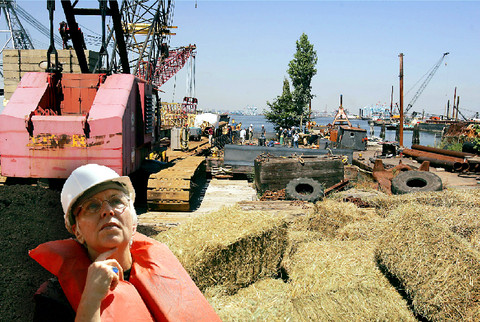
PHOTO: TAIPEI TIMES
Smithson tried to find backers to build the project, which he called "Floating Island," but had no luck. In the years after his death, other admirers and artists also tried unsuccessfully to get the project going.
But last fall, as the Whitney Museum of American Art was preparing for the arrival of a traveling Smithson retrospective, the museum, along with the public arts organization Minetta Brook and Smithson's estate, began serious discussions about making the island a reality. The artist Nancy Holt, Smithson's widow, became involved. The James Cohan Gallery, which represents the estate, contributed money and helped round up donors. And by spring the planners set to work to try to answer the question the project had always asked implicitly: How do you build an island from scratch?
Practical questions
How, for example, do you ensure that 6m or 9m-tall trees, unearthed and with no root systems to speak of, stand up straight and do not topple in a stiff wind? What kind of barge should be used? If it is a flat barge, how do you keep the dirt from falling off? What happens if it rains and the barge soaks up tonnes of water? What happens if someone tries to board the island, in the name of art piracy or stunt publicity? What happens if the Coast Guard says no to the whole thing?
Diane Shamash, the director of Minetta Brook, which has created several other technically challenging artworks around the Hudson River over the last several years, said the Smithson project was the most complex one the group had ever taken on. It was made more difficult because there was no real blueprint to follow except Holt's memories and Smithson's rudimentary sketch, which was very specific in some areas (pointing out, for example, that there should be moss growing on one boulder), yet vague in others (no exact dimensions; no color scheme; only rough ideas about topography and placement of bushes and trees that Smithson might have wanted).
"He's not alive and so you can't ask him, `Were you thinking of a 10.5m tree or something a little shorter?"' Shamash said. "We just had to do our best to try to realize it according to the image he gave us."
She and others describe Floating Island as a kind of anti-Gates,
referring to the saffron-colored extravaganza by Christo and Jeanne-Claude that blanketed Central Park last winter.
In part this is simply because of the modest scale and cost of the island project -- about US$200,000, compared with the US$21 million said to have been paid to create The Gates. It is also because, as public artworks, The Gates and Floating Island are like a split personality: The Gates invited public interaction and was, in effect, completed by it; the island, reflecting Smithson's intellectual and generally chilly aesthetic, floats at a distance, inaccessible.
But Smithson's project is just as intimately connected to Central Park, which he regarded, in all its artificial pastorality, as a conceptual artwork of its own. While not nearly as monumental as Smithson's most famous work, Spiral Jetty, a 457m-long curlicue of basalt jutting into the Great Salt Lake in Utah, the island -- which resembles a rectangular chunk of Central Park, neatly cookie-cuttered out -- is a twist on Smithson's career-long fascination with displacement. This generally meant taking art outdoors and bringing pieces of the land back indoors, into galleries. In the case of Floating Island, the displacement is all outdoors. As a paean to Central Park, it can be seen as a kind of artificial model of an artificial model of nature.
On paper, it all looked great. But the task of building the island and making it seaworthy was another matter. Shamash enlisted the help of an adventurous engineer, Nat Oppenheimer, whom she had worked with before on complex public art projects.
"There's no building code and no one office that covers any of this kind of work," he explained at one project
meeting, and then smiled. "But at the same time, usually at the last minute, someone shows up and says, `Uh uh, you can't do that."'
`Floating cinema'
Diana Balmori, a landscape architect, signed on. Jon Rubin, a filmmaker who created another waterborne project called "Floating Cinema" in 1980, joined the team and started consulting tide tables and calling barge and tugboat companies. Holt, who fiercely guards Smithson's legacy, was consulted on almost every detail.
The logistical dance that ensued at times resembled a cross between a heart transplant and the mounting of a Broadway musical. A barge yard had to be found in a location that would allow the trees, from a nursery in New Jersey, to be delivered quickly, to reduce wilting and damage. The trees had to be chosen very early on, because by late summer the selection at many nurseries would be slim. In the drawing Smithson specified that the trees should be common to the New York region, and long debates began over which were native and which were not.
Holt suggested finding shrubs that would attract birds, but Balmori was not optimistic. "The middle of the river is not the most popular place for birds," she said. At times, aesthetic considerations had to bow to practical ones: Guide wires were planned as extra support for the trees, despite worries that they might be visible.
Then there was the rocks. "We talked to a stone salesman, and he's found us a big stone," Balmori reported, deadpanning. "We're not particularly happy with this stone." (The three rocks eventually were borrowed from Central Park, to which they will be returned; the trees will also be planted in Central Park after the island ends its run.)
`Is it alive?'
By the first week of September, Holt had arrived in New York from her home in New Mexico and all of the pieces started coming together at a barge yard on Staten Island, where Smithson, a great lover of urban decay, would have felt right at home.
The first arrival was the blackish dirt, almost 50 tonnes of it, from a composting heap in Fairfield, New Jersey, and 18 tonnes of hay bales, which would be hidden underneath the dirt to provide bulk but less weight. Next the trees
arrived -- maple, beech, birch, bur oak, sycamore -- and were plunked by crane onto the barge. A dogwood -- later referred to by everyone as "the unfortunate dogwood" -- arrived looking closer to firewood than living tree and had to be replaced. The willow did not look much better.
"Is it alive?" asked Holt, who arrived on the second day of construction, wielding a camera and a discerning eye, and began politely but firmly to demand changes. "Oh, it's alive," Balmori assured, as the two women stood together wearing hard hats and life jackets, their eyes fixed worriedly on the yellowing tree.
Holt allowed that Smithson might not have worried much about yellowing trees because as fall approaches that is what trees do. The moss on the rock he had wanted had to be abandoned for a similar reason: The summer heat usually burns such growth away.
Anthony Kerley, the crane operator and yard manager for the company that owns the barge yard, looked on patiently, awaiting decisions with a cigarette dangling from his lip. Asked what he thought of the project, he grinned slyly. "I think it's kind of different, you know what I mean?" he said. "It's interesting, for sure."
By early this week, the island began to look not only shipshape but also
remarkably like Smithson's drawing. Shrubs -- witch hazel, chokeberry, hydrangea, blueberry, sumac -- added to the strange verisimilitude. Four extra trees were added, at a cost of several thousand dollars. An ailing sycamore went the way of the dogwood. A
damaged steel panel was replaced. And on a test-run voyage on Wednesday, lo and behold, birds began to land on the island. "The only pity about this is that Smithson isn't going to get to see it built," Shamash said.

In late October of 1873 the government of Japan decided against sending a military expedition to Korea to force that nation to open trade relations. Across the government supporters of the expedition resigned immediately. The spectacle of revolt by disaffected samurai began to loom over Japanese politics. In January of 1874 disaffected samurai attacked a senior minister in Tokyo. A month later, a group of pro-Korea expedition and anti-foreign elements from Saga prefecture in Kyushu revolted, driven in part by high food prices stemming from poor harvests. Their leader, according to Edward Drea’s classic Japan’s Imperial Army, was a samurai

The following three paragraphs are just some of what the local Chinese-language press is reporting on breathlessly and following every twist and turn with the eagerness of a soap opera fan. For many English-language readers, it probably comes across as incomprehensibly opaque, so bear with me briefly dear reader: To the surprise of many, former pop singer and Democratic Progressive Party (DPP) ex-lawmaker Yu Tien (余天) of the Taiwan Normal Country Promotion Association (TNCPA) at the last minute dropped out of the running for committee chair of the DPP’s New Taipei City chapter, paving the way for DPP legislator Su
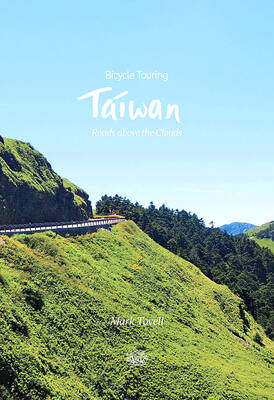
It’s hard to know where to begin with Mark Tovell’s Taiwan: Roads Above the Clouds. Having published a travelogue myself, as well as having contributed to several guidebooks, at first glance Tovell’s book appears to inhabit a middle ground — the kind of hard-to-sell nowheresville publishers detest. Leaf through the pages and you’ll find them suffuse with the purple prose best associated with travel literature: “When the sun is low on a warm, clear morning, and with the heat already rising, we stand at the riverside bike path leading south from Sanxia’s old cobble streets.” Hardly the stuff of your

Located down a sideroad in old Wanhua District (萬華區), Waley Art (水谷藝術) has an established reputation for curating some of the more provocative indie art exhibitions in Taipei. And this month is no exception. Beyond the innocuous facade of a shophouse, the full three stories of the gallery space (including the basement) have been taken over by photographs, installation videos and abstract images courtesy of two creatives who hail from the opposite ends of the earth, Taiwan’s Hsu Yi-ting (許懿婷) and Germany’s Benjamin Janzen. “In 2019, I had an art residency in Europe,” Hsu says. “I met Benjamin in the lobby


 RSS
RSS