


Police posts with their road barriers, flying squirrels, dead foxes full of maggots, snow on the peaks, a cold mist in the afternoon, Hakka shopkeepers half-way down the valley, the cry of a red turtledove, a faithful dog and a clapped-out old motorcycle, the smoking stove, red maple leaves, spring water trickling through the snow, a backpack containing only salt, rice wine and betel nuts, the hot sun and the cold shade, ants in your rifle and the prospect of a deer roasted over the fire at the end of the day -- this is the mountain world described in some of these stories, essays and poems by Taiwan's indigenous writers.
Other things they evoke include a buxom wife at home, gripes about the government and its restrictions on hunting, corrupt police, industrial roads versus hunting tracks, and thinking in Aboriginal myths yet needing to have a Chinese name. Only a few adventurous Taiwanese city-dwellers know a little of this world that lies at the center of their island (and the best season for visiting it is just beginning). But for Taiwan's upland Aborigines, certainly the older of them, these images are the parameters of life itself.
Taiwan's central mountains are a hard place. They're characterized by resplendent views and long hours of hard hiking. But intransigence characterizes them too. Taken in small doses they are infinitely refreshing, but for those who live there, life is usually hard indeed.
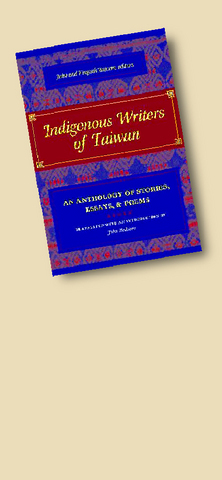
The publishers claim that Indigenous Writers of Taiwan is the first collection in English ever of Taiwanese Aboriginal writing, and there's no reason to disbelieve them. The Japanese, however, appear to have been the first to investigate and translate much of the material then available, followed by local Chinese-speaking scholars. In one of the essays a Puyama writer, describing his 79-year-old mother, remembers her saying that the colonizing Japanese were to be both feared and respected. She remembered their sense of honor and their obedience to their laws. She didn't like their severity, but their contribution to her tribe, she said, couldn't be denied.
The contents of this anthology are mostly taken from the last 20 years or so, and are all translations from Chinese. The Aboriginal tribes originally had no written forms for their languages, though some were created by Dutch and other missionaries. Nonetheless, Chinese is what these writers write in today. The editors say they chose the material from "a stack of books, magazines and newspapers about four feet high."
It has to be said that there are no great masterpieces in this book. The Nobel prize-winning American novelist Saul Bellow was widely attacked when he once remarked "Where is the Papuan Proust? Where is the Zulu Tolstoy? I'd like to read them."
The answer should surely be two-fold: that small language-groups are statistically unlikely to produce great writers, and that novels such as those Proust and Tolstoy wrote were a product of European liberal civilization in the 18th and 19th centuries and can't necessarily be transplanted.
Of course, all literary forms are nowadays effectively international, so maybe a Taiwanese indigenous literary giant will emerge. But in a global context ethnic origins are increasingly irrelevant, so such an eventuality would probably not attract much attention to Taiwan's Aborigines even if it occurred.
In his introduction, John Balcom makes the point that simply resisting the dominant culture doesn't necessarily define who one is. In the opening story, Topas Tamipima's The Last Hunter, the hunter in question kills a buck muntjac, only to have it confiscated by an ethnically-Chinese policeman at a check-point. This is clearly symbolic of the Aboriginal situation as a whole, and brings into focus the point Balcom is making.
That all Taiwanese Aboriginal literature to date has been published in Chinese only highlights the irony of the situation. It is true that a couple of writers have published bilingual editions (in Chinese and their mother language). But Balcom quotes one writer, Rimui Aki, a teacher of the Atayal language, as saying that there simply isn't an audience for works written in her native tongue, though she does sometimes communicate with friends in it on the Internet.
The issues of identity and loss of rights are again highlighted in some strong poems by the blind Paiwan poet Monaneng. In one, I Don't Really Know, the speaker describes collecting traditional vegetables to offer the ancestors at harvest time, only to be told by the Forestry Bureau that they had been purloined from an area that was its property.
Another, The Hundred-Pacer Snake is Dead, refers to the Taiwan snake that is lethal before you've taken 100 paces after being bitten. The speaker sees it in a bottle of medicinal wine, with a label "Aphrodisiac" attached. He goes on to imagine a man in the big city strutting through a red-light district proud of his new-found virility, only to have it satisfied by "the descendent of the hundred-pacer snake, a young Paiwan girl."
This book, smartly produced by Columbia University Press, will put Taiwan's indigenous writers on the map for a new class of reader, namely people from outside Taiwan who don't even know there are Aboriginal people living here at all. Locally, it may go some way to correcting the image of the Aboriginal people themselves, up to now more often associated with their music than with communication by means of pen and paper. The irony is, of course, that after the Taiwanese, the indigenous people themselves are the least likely to read these translations. But on the evidence of these texts, they have enough other worries to keep them busy and occupy their minds.

In late October of 1873 the government of Japan decided against sending a military expedition to Korea to force that nation to open trade relations. Across the government supporters of the expedition resigned immediately. The spectacle of revolt by disaffected samurai began to loom over Japanese politics. In January of 1874 disaffected samurai attacked a senior minister in Tokyo. A month later, a group of pro-Korea expedition and anti-foreign elements from Saga prefecture in Kyushu revolted, driven in part by high food prices stemming from poor harvests. Their leader, according to Edward Drea’s classic Japan’s Imperial Army, was a samurai

The following three paragraphs are just some of what the local Chinese-language press is reporting on breathlessly and following every twist and turn with the eagerness of a soap opera fan. For many English-language readers, it probably comes across as incomprehensibly opaque, so bear with me briefly dear reader: To the surprise of many, former pop singer and Democratic Progressive Party (DPP) ex-lawmaker Yu Tien (余天) of the Taiwan Normal Country Promotion Association (TNCPA) at the last minute dropped out of the running for committee chair of the DPP’s New Taipei City chapter, paving the way for DPP legislator Su
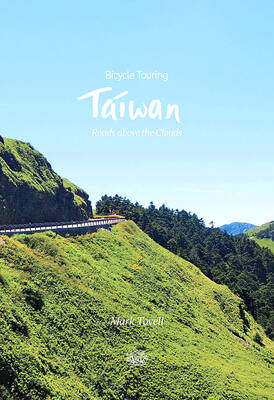
It’s hard to know where to begin with Mark Tovell’s Taiwan: Roads Above the Clouds. Having published a travelogue myself, as well as having contributed to several guidebooks, at first glance Tovell’s book appears to inhabit a middle ground — the kind of hard-to-sell nowheresville publishers detest. Leaf through the pages and you’ll find them suffuse with the purple prose best associated with travel literature: “When the sun is low on a warm, clear morning, and with the heat already rising, we stand at the riverside bike path leading south from Sanxia’s old cobble streets.” Hardly the stuff of your

Located down a sideroad in old Wanhua District (萬華區), Waley Art (水谷藝術) has an established reputation for curating some of the more provocative indie art exhibitions in Taipei. And this month is no exception. Beyond the innocuous facade of a shophouse, the full three stories of the gallery space (including the basement) have been taken over by photographs, installation videos and abstract images courtesy of two creatives who hail from the opposite ends of the earth, Taiwan’s Hsu Yi-ting (許懿婷) and Germany’s Benjamin Janzen. “In 2019, I had an art residency in Europe,” Hsu says. “I met Benjamin in the lobby


 RSS
RSS