


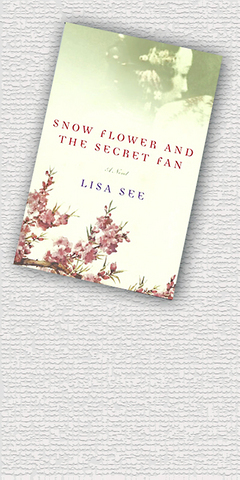
Delicate and brutal by turns, this poignant novel of friendship between two women provides an insight, from the perspective of a contemporary woman writer of Chinese origin living in the US, into what was probably the lot of the vast majority of women in early 19th century China.
It's essentially the story of two women -- Lily, the narrator, and Snow Flower. Allocated to each other by a matchmaker, they are destined to be laotong, or kindred spirits, and to provide comfort for each other throughout the many crucial stages of their lives. As they become better acquainted, Snow Flower initiates Lily into a system of code-writing used solely between women.
Lily has one main desire, to earn love and respect of her family, yet the odds are stacked heavily against her. As a woman, success can only be achieved through iron obedience, first to her husband and later to her sons. Dismal edicts occur throughout the novel on the irrevocability of custom, with its Three Obediences and Four Virtues. As women, there is little chance of these two enjoying a long-lasting companionship, everyone being too caught up in the current of the marriage stakes. In fact, a thread of sadness over the plight of women in general runs through this entire novel.
At an elder sister's marriage ceremony, local onlookers chant "Carrying a daughter out is just like throwing out water!" while Lily herself laments what might have been. "Elder Sister, my heart cries to lose you. If we had been sons, we would not be torn apart."
The mother has scant comfort to offer her.
"You married out. You go to another village, Your mother-in-law is cruel. Your husband doesn't care for you ... But every daughter marries away ... Everyone goes along with it. You can cry and beg to come home, we can grieve after you have gone, but you -- and we -- have no choice."
An old saying clinches matters, "If a daughter doesn't marry out, she's valueless; just as if fire doesn't raze the mountain, the land won't be fertile."
bound by tradition
When the time arrives for Lily to have her feet bound, she's made aware of the prestige of a successful procedure. A pair of perfectly bound feet, including broken bones, can surpass the value of an exquisite face. They can also enhance their owner's marriage prospects.
In a climate where, amidst constant admonitions emphasizing the need for suffering if a woman is to hold on to beauty, the promise that one's feet might one day become one's fortune acts as the only carrot during the girls' agonizing ordeal. "My small feet would be offered as proof to my prospective in-laws of my personal discipline and my ability to endure the pain of childbirth," writes Lily. "My small feet would show the world my obedience to my natal family, particularly to my mother. They would also make a good impression on my future mother-in-law."
Urged on by the need to enhance her family's status through an advantageous marriage, Lily has a meeting with one of two local matchmakers, Madame Wang. (The other, Madame Gao, is Madame Wang's sworn enemy, and because they share the same coarseness, the two matchmakers provide comic relief in the form of barbs hurled at each other). Throughout all this, Lily is warned of something not being entirely well with the family circumstances of her laotong and is made even more concerned by the disparity between their allotted marriage partners.
While Lily is to marry the nephew of a scholar who had been well rewarded for his services by the emperor, Snow Flower's match is a humble butcher whose slaughtering activities make his profession unclean. Snow Flower's anguished cry of "Don't pity me! I don't want it!" is a foretaste of the rift that soon develops between the two women.
As Lily's prospects steadily advance, Snow Flower's deteriorate. They both give birth to sons, but Snow Flower loses her second child. While Snow Flower's husband beats her, Lily and her husband become the new Master and Lady Lu. Despite Lily's best efforts to offer consolation and encouragement, Snow Flower's sudden announcement that she is considering entering into a "sworn sisterhood" strikes Lily with the force of a dagger plunged into her heart.
Feeling devastated by Snow Flower's perceived betrayal, Lily goes about the business of cutting her from her affections. During the frenzy of accusation and counter-accusation that follows, Lily is too inflamed to realize just how alienated she has become from the love she has always needed.
making amends
Eight years later, on receiving a visit from Snow Flower's daughter, Lily learns that Snow Flower's supposed miscarriage was in fact cancer of the womb, and now a cure is impossible. Consumed with pain from being witness to Snow Flower's agony, Lily's heart melts into desperate remorse.
Realizing she still has time to reverse some of the harm she had caused the person she loves most in the world, she embarks on improving the position of Snow Flower's son, eventually securing a profession for him unconnected with butchering. Still restless to square the circle, Lily contracts a betrothal between Snow Flower's granddaughter and her own grandson.
The main driving force behind all the remorse that had taken hold of Lily stems from an observation -- conceivably the most telling in the book -- made by one of Snow Flower's sworn sisters.
"She loved you as a laotong should for everything you were and everything you were not. But you had too much man-thinking in you. You loved her as a man would, valuing her only for following men's rules."
This is an astute comment for a society where women were warped, both physically and mentally, into acting as tradition dictated and, above all else, by men's rules.
This is a strongly emotional novel and will affect many readers similarly. Some critics have commented on its lesbian implications, but it's real strength is as a protest against social conditions prevailing in the China of old. Fortunately, whatever the woes of China today, bound feet and the universal disregard of the wishes of the young are not among them.

In late October of 1873 the government of Japan decided against sending a military expedition to Korea to force that nation to open trade relations. Across the government supporters of the expedition resigned immediately. The spectacle of revolt by disaffected samurai began to loom over Japanese politics. In January of 1874 disaffected samurai attacked a senior minister in Tokyo. A month later, a group of pro-Korea expedition and anti-foreign elements from Saga prefecture in Kyushu revolted, driven in part by high food prices stemming from poor harvests. Their leader, according to Edward Drea’s classic Japan’s Imperial Army, was a samurai

The following three paragraphs are just some of what the local Chinese-language press is reporting on breathlessly and following every twist and turn with the eagerness of a soap opera fan. For many English-language readers, it probably comes across as incomprehensibly opaque, so bear with me briefly dear reader: To the surprise of many, former pop singer and Democratic Progressive Party (DPP) ex-lawmaker Yu Tien (余天) of the Taiwan Normal Country Promotion Association (TNCPA) at the last minute dropped out of the running for committee chair of the DPP’s New Taipei City chapter, paving the way for DPP legislator Su

It’s hard to know where to begin with Mark Tovell’s Taiwan: Roads Above the Clouds. Having published a travelogue myself, as well as having contributed to several guidebooks, at first glance Tovell’s book appears to inhabit a middle ground — the kind of hard-to-sell nowheresville publishers detest. Leaf through the pages and you’ll find them suffuse with the purple prose best associated with travel literature: “When the sun is low on a warm, clear morning, and with the heat already rising, we stand at the riverside bike path leading south from Sanxia’s old cobble streets.” Hardly the stuff of your
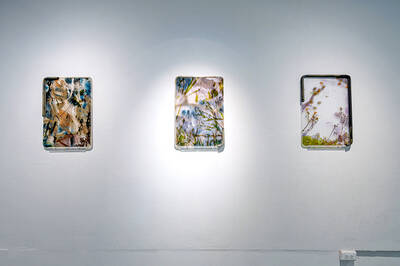
Located down a sideroad in old Wanhua District (萬華區), Waley Art (水谷藝術) has an established reputation for curating some of the more provocative indie art exhibitions in Taipei. And this month is no exception. Beyond the innocuous facade of a shophouse, the full three stories of the gallery space (including the basement) have been taken over by photographs, installation videos and abstract images courtesy of two creatives who hail from the opposite ends of the earth, Taiwan’s Hsu Yi-ting (許懿婷) and Germany’s Benjamin Janzen. “In 2019, I had an art residency in Europe,” Hsu says. “I met Benjamin in the lobby


 RSS
RSS