


Movie studios typically advertise on television and in newspapers in search of the biggest possible opening-weekend audience. For a new film, The Constant Gardener, Focus Features is intent on building its audience in a different way: by taking aim at readers of niche Web sites and blogs.
Focus, an art-house unit of Universal Pictures, has bought ads for The Constant Gardener on the political blog Won-kette, as well as the Web sites of politically oriented publications like Harper's, The Nation and National Review.
James Schamus, a co-president of the studio, says that such sites draw the sort of people most likely to appreciate the film, a conspiracy thriller based on a John le Carre novel about pharmaceutical companies operating in Africa.
"We looked for the places that sophisticated moviegoers seek out to find things that interest them," Schamus said. "These are the people who are engaged with the world, who are informed about the big conspiracies going on out there."
Ever since the release of The Blair Witch Project in 1999, movie studios have strived, and failed, to replicate the groundbreaking Internet campaign that made that film a marketing phenomenon. These new ad campaigns on the Web suggest that studios are becoming more determined to identify and reach niche audiences online.
An independent distributor, ThinkFilm, has taken a similar approach with the dirty-joke documentary The Aristocrats, buying prominent banners at the bawdy gossip sites Gawker.com and Defamer.com, as well as sites like The Onion and CollegeHumor.com.
ThinkFilm's vice president for marketing, David Fenkel, said, "Some movies just lend themselves to online advertising. The Aristocrats is dirty, it's obscene and it's unrated, which is sort of like the Internet itself."
Seth Godin, an author and speaker on marketing, said that Focus was "clearly ahead of the curve" in seeking an audience based on online behavior. Godin cited a report from comScore Media Metrix, saying that blog readers visit almost twice as many Web pages as the average Internet user. "We know that people visiting a blog are more likely to take action" he said, "to click on a link or buy online."
In particular, the ads for The Constant Gardener seem to seek out people who distrust multinational corporations. The banner contains the taglines "The corruption is contagious" and "The conspiracy is global," and links to the film's Web site, where snippets of dialogue about "payoffs, cover-ups, unmarked graves" can be heard in the trailer.
Joseph Jaffe, the president of Jaffe, a marketing consulting firm in Connecticut, agreed. "The movie is about getting people to talk about a social issue," he said. "Blog readers want to be able to respond and add their own points of view.
"The goal is to find and engage a very small subset of influential thinkers and opinion leaders."
The Aristocrats ad also invites visitors to submit their own version of the film's unprintable joke. ThinkFilm, which has an advertising budget well below the US$30 million that major studios typically spend, is hoping that this interactive component can propel an ad throughout the Web, creating a cost-effective campaign.
Fenkel would not disclose the budget for the Aristocrats campaign but said Web advertising came in at roughly 5 percent of the total ad budget, higher than the industry average of 2.2 percent last year.
But as Jaffe noted, even studios with ample budgets have used interactive strategies, as New Line did for Wedding Crashers with its Trailer Crashers game allowing users to insert images of themselves into the movie trailer. "You can be sure that a good percentage of people who saw the movie came across this game online," Jaffe said.
Web advertisements will not eclipse print and broadcast ads anytime soon. But at a time when blanket ad purchases seem ready to decline in tandem with box office receipts, studios may look more and more to the Internet to find audiences.
"It's the opposite of buying a spread in a newspaper or a slew of 30-second slots on TV," Jaffe said. "Studios need to stop trying to reach the most people and focus on reaching the best people."

In late October of 1873 the government of Japan decided against sending a military expedition to Korea to force that nation to open trade relations. Across the government supporters of the expedition resigned immediately. The spectacle of revolt by disaffected samurai began to loom over Japanese politics. In January of 1874 disaffected samurai attacked a senior minister in Tokyo. A month later, a group of pro-Korea expedition and anti-foreign elements from Saga prefecture in Kyushu revolted, driven in part by high food prices stemming from poor harvests. Their leader, according to Edward Drea’s classic Japan’s Imperial Army, was a samurai

The following three paragraphs are just some of what the local Chinese-language press is reporting on breathlessly and following every twist and turn with the eagerness of a soap opera fan. For many English-language readers, it probably comes across as incomprehensibly opaque, so bear with me briefly dear reader: To the surprise of many, former pop singer and Democratic Progressive Party (DPP) ex-lawmaker Yu Tien (余天) of the Taiwan Normal Country Promotion Association (TNCPA) at the last minute dropped out of the running for committee chair of the DPP’s New Taipei City chapter, paving the way for DPP legislator Su
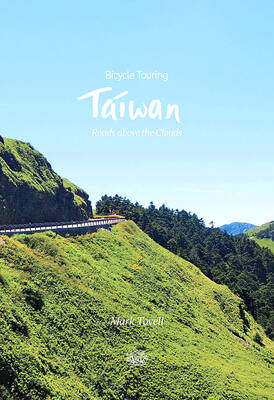
It’s hard to know where to begin with Mark Tovell’s Taiwan: Roads Above the Clouds. Having published a travelogue myself, as well as having contributed to several guidebooks, at first glance Tovell’s book appears to inhabit a middle ground — the kind of hard-to-sell nowheresville publishers detest. Leaf through the pages and you’ll find them suffuse with the purple prose best associated with travel literature: “When the sun is low on a warm, clear morning, and with the heat already rising, we stand at the riverside bike path leading south from Sanxia’s old cobble streets.” Hardly the stuff of your
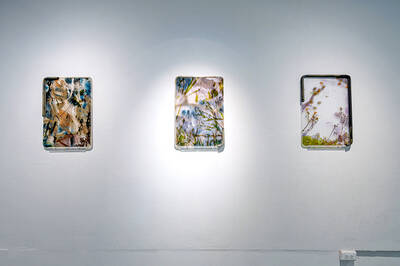
Located down a sideroad in old Wanhua District (萬華區), Waley Art (水谷藝術) has an established reputation for curating some of the more provocative indie art exhibitions in Taipei. And this month is no exception. Beyond the innocuous facade of a shophouse, the full three stories of the gallery space (including the basement) have been taken over by photographs, installation videos and abstract images courtesy of two creatives who hail from the opposite ends of the earth, Taiwan’s Hsu Yi-ting (許懿婷) and Germany’s Benjamin Janzen. “In 2019, I had an art residency in Europe,” Hsu says. “I met Benjamin in the lobby


 RSS
RSS