


Condemned buildings seem unlikely places for a good night out. Except in Budapest, where kerts, or "ruin gardens," fully exploit the long Hungarian summer and the city's decrepit glory.
Every year, new open-air nightclubs and bars appear in demolished or abandoned properties. There you can lounge the night away secluded in the crumbling courtyard of what, a hundred years ago, was the home of a wealthy Magyar gentleman. Some gardens are simple affairs with chairs, candles and a bar. Others are more elaborate, and feature barbecues, dance floors, live music, DJs, film screens and exhibitions by young artists.
Threatened by officialdom -- the city's district authorities are strict with their permits and, with elections looming, complaints by neighbors can mean a quick end to a successful enterprise -- these hidden bars pop in and out of existence. By next summer your favorite hangout may have disappeared, migrated to the other side of town, or have become a heaving meat market populated by intoxicated teenagers. So, sadly, gardens such as Mumus -- a stylish place with a Middle Eastern feel that was popular last year -- vanish. Or, as the fashionable Szoda Courtyard did, they change location to solve the problem.

PHOTO: AGENCIES
A result of this impermanence is that gardens put little effort into signposting, making them impossible to find if you do not have an exact address.
I am meeting a friend in West-Balkan, located in a street behind the Corvin cinema. I spend half an hour looking for the place. In that time I walk past the entrance at least three times without noticing it. Nothing suggests there is a popular bar here. Finally, I decide to try my luck. Opening a door, I peek through the gatehouse to see parasols and colored lights in the distance.
West-Balkan is leafy and green. Of the original structure only the gatehouse, gate and courtyard remain. The tall, decaying walls of surrounding buildings lend it an atmosphere of long lost grandeur. Like many gardens, West-Balkan is a quirky place: a huge pair of tinfoil legs dangles from the trees.
Another consequence of locals' complaints are the bouncers, who admonish patrons to keep quiet as they leave the bars. At least they make it simpler to find a garden in the dimly-lit, narrow streets of Budapest's VIIth district. If you see a lone figure sitting on a bar stool in the middle of an otherwise empty road, you know you are on the right track.
This is how I manage to find Szimpla Kert. It comes as a surprise to discover this packed, heaving place coming in from the calm side street. In the summer heat, the disintegrating brick arches leading to the bar give Szimpla a Mediterranean feel. Despite the southern mood, you fully appreciate that you are in the center of Europe. The 20-somethings to 30-somethings here are as likely to speak Russian, Polish or Bulgarian as Hungarian, English, French or German.
Though the future is uncertain, new courtyard bars appear all the time. Tuzraktar ("Fire Warehouse") only started business this summer, but is already one of the most splendid nightly hotspots in town. The walls of this vast yard of a former medical equipment store are covered in giant abstract murals. It is a venue for artists.
"Come and watch the air dance," a young woman says as she leads me behind a heavy black curtain. There, a trapeze artist dances high above the ground between two wings of the building.
Although Tuzraktar is an artsy place, the row of Pilsner Urquell beer taps betrays the intention to make serious money. To Budapest's with-it crowd, such commercial success is almost worse than non- existence, and they cite Zold Pardon as an example of a garden bar selling out. It started in 1999 as a shack on a patch of grass by the River Danube. Now, it is the Hungarian capital's number-one party zone.
To a visitor, however, this just underlines the vibrant nature of Budapest nightlife. Yet this same dynamism is the biggest danger to the garden bars. With Hungary's recent accession to the European Union stimulating growth, office blocks and luxurious apartments are more profitable investments than cosy drinking holes in ruined courtyards. This uncertainty only emphasizes the transient character of the gardens.
Whether you go there as a respite from the sweltering afternoon heat, or to party till daybreak, knowing it won't last will make you appreciate your secret summer hideout all the more.

In late October of 1873 the government of Japan decided against sending a military expedition to Korea to force that nation to open trade relations. Across the government supporters of the expedition resigned immediately. The spectacle of revolt by disaffected samurai began to loom over Japanese politics. In January of 1874 disaffected samurai attacked a senior minister in Tokyo. A month later, a group of pro-Korea expedition and anti-foreign elements from Saga prefecture in Kyushu revolted, driven in part by high food prices stemming from poor harvests. Their leader, according to Edward Drea’s classic Japan’s Imperial Army, was a samurai

The following three paragraphs are just some of what the local Chinese-language press is reporting on breathlessly and following every twist and turn with the eagerness of a soap opera fan. For many English-language readers, it probably comes across as incomprehensibly opaque, so bear with me briefly dear reader: To the surprise of many, former pop singer and Democratic Progressive Party (DPP) ex-lawmaker Yu Tien (余天) of the Taiwan Normal Country Promotion Association (TNCPA) at the last minute dropped out of the running for committee chair of the DPP’s New Taipei City chapter, paving the way for DPP legislator Su

It’s hard to know where to begin with Mark Tovell’s Taiwan: Roads Above the Clouds. Having published a travelogue myself, as well as having contributed to several guidebooks, at first glance Tovell’s book appears to inhabit a middle ground — the kind of hard-to-sell nowheresville publishers detest. Leaf through the pages and you’ll find them suffuse with the purple prose best associated with travel literature: “When the sun is low on a warm, clear morning, and with the heat already rising, we stand at the riverside bike path leading south from Sanxia’s old cobble streets.” Hardly the stuff of your
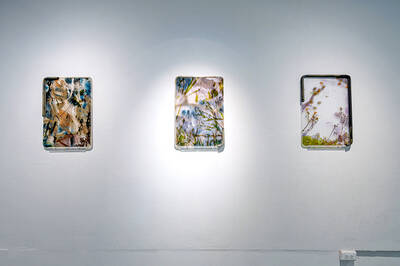
Located down a sideroad in old Wanhua District (萬華區), Waley Art (水谷藝術) has an established reputation for curating some of the more provocative indie art exhibitions in Taipei. And this month is no exception. Beyond the innocuous facade of a shophouse, the full three stories of the gallery space (including the basement) have been taken over by photographs, installation videos and abstract images courtesy of two creatives who hail from the opposite ends of the earth, Taiwan’s Hsu Yi-ting (許懿婷) and Germany’s Benjamin Janzen. “In 2019, I had an art residency in Europe,” Hsu says. “I met Benjamin in the lobby


 RSS
RSS