


Every five days, a country market converges in a horn-honking, pig-squealing clamor on the old arching stone bridge that spans the river coursing through here.
For as long as anyone can remember, the biggest crop in this valley has been its tall, thick corn. But in the last two years, a new crop, qinghao, or sweet wormwood, has been crowned king, driven by a desperate need in the tropical world for new malaria treatments.
The rugged valleys and steep gorges along the Apeng River here in central China have long been a symbol of idyllic remoteness. Even China's dazzling economic takeoff had done little to change that, until the World Health Organization approved a malaria treatment using artemisinin, the active ingredient of the qinghao plant, in 2001.
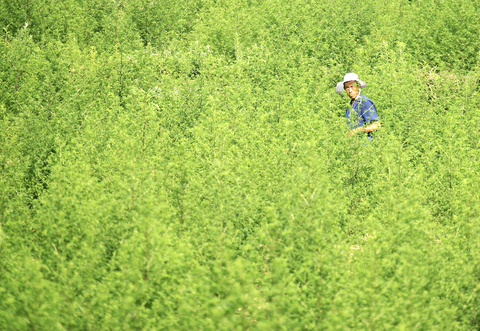
Since then, the plant's market value has nearly quadrupled. In the process, qinghao has become an unlikely driver of globalization in these parts, sending peasants scouring the mountainsides to harvest the wild bush.
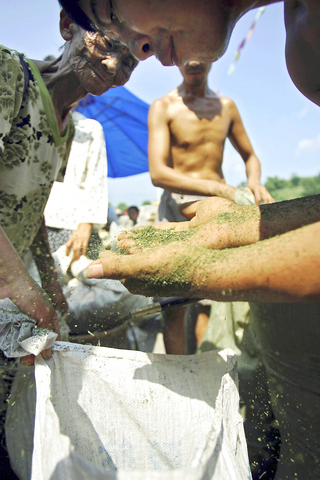
Just as eager to cash in, farmers are replacing plots of corn, tobacco and potato with the herb, which is bought and sold from bulging burlap sacks amid frenzied market day crowds by dealers wielding brass handheld scales.
Despite China's long history and ancient medical traditions, artemisinin-based drugs are the first Chinese pharmaceutical product to be broadly distributed internationally, beyond more traditional remedies like ginseng.
In antiquity, it was written that parts of this southeastern region of
Chongqing Province were so isolated that the people here did not know what dynasty they lived under. Today, mounting a full-court press driven in part by demand for the drug, the Chinese government is rushing to remedy that, building the first highways into the area, along with a rail line and a small airport.
Confusion over dynasties seems to have given way nowadays to confusion over all the fuss being made over sweet wormwood, an ancient folk remedy for colds and fevers, even as trade in the herb begins to line people's pockets.
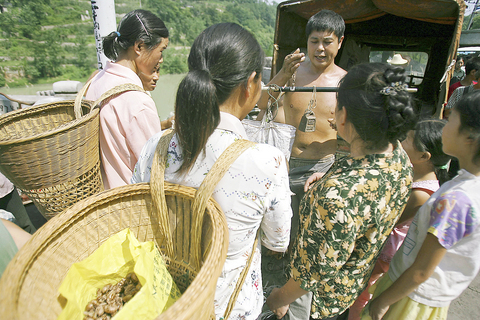
"I don't know what medicine this makes," said Sun Lingui, a 23-year-old qinghao dealer who had staked out a prime position on the bridge here on a recent market day. He sold the herb along with a bushel full of dried beetles that he said were a remedy for respiratory problems.
"I know it is used to extract something called artemisinin," Sun added. "Anyway, it is for some kind of medicine, and I hear that tropical countries all need it."
Sun said he had gleaned the little he knew about the plant from a television program, which spoke of the herb's rapidly increasing value and alluded to its health benefits. What those benefits were, he, like the peasants surrounding him, could not quite recall.
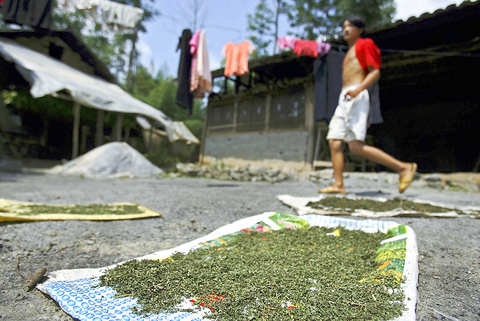
The fact that this traditional Chinese drug, which the peasants of this village say is good for everything from sniffles to healing wounds, is the greatest recent hope in global efforts to fight malaria, which kills more than a million people each year, mostly in Africa, is scarcely appreciated here.
With established anti-malarial medicines rapidly losing their effectiveness, the World Health Organization recommended in 2001 that countries afflicted with the disease switch to a combination therapy based in part on the Chinese drug. After a slow start in adopting artemisinin-based drugs, demand has skyrocketed in the last two years, with projections that 300 million doses will be needed next year.
Ding Derong, a scientist with China's Southwest Agriculture University who has studied artemisinin for 30 years, said that 30,000 tonnes to 40,000 tonnes of the crop would be needed to meet that demand, but that only 20,000 were likely to be harvested.
"This is a very easy thing to plant and grow, but it is hard to cultivate good quality seeds," Ding said. "At first, farmers will choose cheap seeds over good ones. The result is there will be a lot of disorder."
Jiang Yifei, spokeswoman of the Holley Corp, the largest Chinese producer of artemisinin, said the biggest challenge in increasing production was "organizing farmers to start standardized cultivation."
Holley supplies the Swiss pharmaceutical giant Novartis with artemisinin. Novartis uses the active ingredient from the herb to produce the drug Coartem, which it supplies at cost to the World Health Organization for distribution.
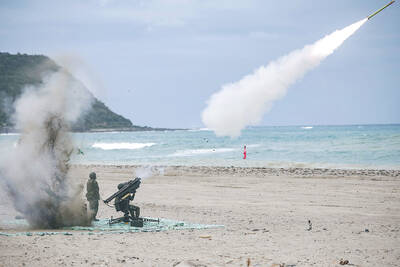
In late October of 1873 the government of Japan decided against sending a military expedition to Korea to force that nation to open trade relations. Across the government supporters of the expedition resigned immediately. The spectacle of revolt by disaffected samurai began to loom over Japanese politics. In January of 1874 disaffected samurai attacked a senior minister in Tokyo. A month later, a group of pro-Korea expedition and anti-foreign elements from Saga prefecture in Kyushu revolted, driven in part by high food prices stemming from poor harvests. Their leader, according to Edward Drea’s classic Japan’s Imperial Army, was a samurai

The following three paragraphs are just some of what the local Chinese-language press is reporting on breathlessly and following every twist and turn with the eagerness of a soap opera fan. For many English-language readers, it probably comes across as incomprehensibly opaque, so bear with me briefly dear reader: To the surprise of many, former pop singer and Democratic Progressive Party (DPP) ex-lawmaker Yu Tien (余天) of the Taiwan Normal Country Promotion Association (TNCPA) at the last minute dropped out of the running for committee chair of the DPP’s New Taipei City chapter, paving the way for DPP legislator Su
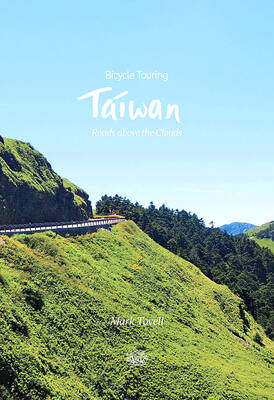
It’s hard to know where to begin with Mark Tovell’s Taiwan: Roads Above the Clouds. Having published a travelogue myself, as well as having contributed to several guidebooks, at first glance Tovell’s book appears to inhabit a middle ground — the kind of hard-to-sell nowheresville publishers detest. Leaf through the pages and you’ll find them suffuse with the purple prose best associated with travel literature: “When the sun is low on a warm, clear morning, and with the heat already rising, we stand at the riverside bike path leading south from Sanxia’s old cobble streets.” Hardly the stuff of your
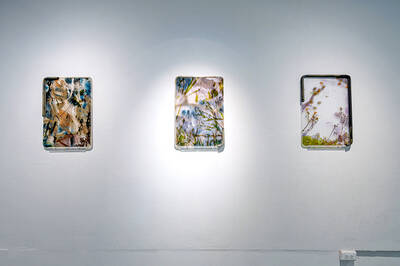
Located down a sideroad in old Wanhua District (萬華區), Waley Art (水谷藝術) has an established reputation for curating some of the more provocative indie art exhibitions in Taipei. And this month is no exception. Beyond the innocuous facade of a shophouse, the full three stories of the gallery space (including the basement) have been taken over by photographs, installation videos and abstract images courtesy of two creatives who hail from the opposite ends of the earth, Taiwan’s Hsu Yi-ting (許懿婷) and Germany’s Benjamin Janzen. “In 2019, I had an art residency in Europe,” Hsu says. “I met Benjamin in the lobby


 RSS
RSS