


Dai Yichen is in the third row, far right side, her feet kicking and scraping against the wood floor with other students in her tap dance class. The rehearsal hall fills with a noise as pounding and repetitive as a hailstorm.
Yichen is lanky and a little awkward. She sidesteps and thrusts her shoulder in a suggestive move that no one in the class gets quite right. But she keeps trying. As the teacher calls forward different lines of dancers, Yichen stands off to the side, practicing her footwork. She watches herself, unsmiling, in a floor-to-ceiling mirror that betrays every stumble.
Her dream is to one day perform on a Chinese equivalent of Broadway, though one does not yet exist.
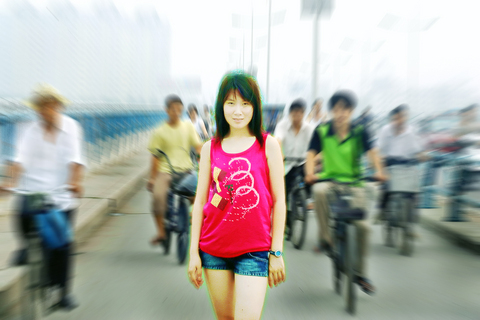
Yichen, 17, is one of 30 students at a private fine arts school on the outskirts of Beijing who are far removed from the days when Mao demanded that culture serve the Communist Party. They are studying how to perform in US-style musicals, an academic major about as improbable as American teenagers dedicating themselves to Peking Opera.
It is an example of the changes engulfing China that a teenager like Yichen has been far more influenced by the musical Cats than by the Communist Youth League. While China is far too vast and divided between rich and poor for any one teenager to be considered typical, Yichen is representative in that her generation is expected to have opportunities unlike any before them.
But those opportunities bring pressure. Yichen's parents are among the new class of urban professionals who can afford to indulge their daughter's passion. Her mother is a journalist at a cultural newspaper. Her father is a businessman. The fine arts boarding school Yichen attends is an unimaginable chance for the overwhelming majority of Chinese students, whose families cannot come close to paying the annual tuition of US$4,000, almost four times China's per capita income.
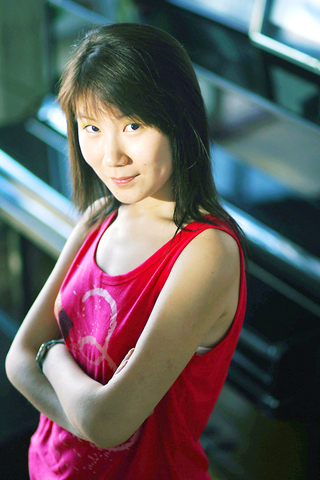
PHOTOS: NY TIMES
"It is hard for me to describe how I feel when I sing, but I'm completely devoted to it," she said of why she wanted to enroll. "My teacher says I'm always lost in my song."
Her mother, Gao Xiaoli, who unwittingly sparked her daughter's interest by bringing home videos of Cats and other Broadway shows, understands that China, even as it becomes more affluent, is not an indulgent country. The transition to a market economy has brought rising incomes and choices, but also fierce, unblinking competition.
"There are so many singers studying in this country now," Gao said. "You have to be very good."
Anyone outside China would not hesitate in labeling Yichen's generation. They are the first to come of age in the aftermath of the government's violent repression of protesters at Tiananmen Square in June 1989.
That event seared China and still influences how the country is perceived by the outside world. But for many teenagers like Yichen it is an invisible marker. Media discussion of the crackdown is banned, as the government has tried to blot out that incident from history.
Yichen would have barely been a year old at the time. "I've never heard of it," she said quietly.
Instead, the day that transformed her life came when she was 4 and her parents divorced. Divorce was a rarity then, and Yichen instantly became different from her peers.
"My friends told me I should try to bring them back together," Yichen recalled. "But I never dared speak of it, and my mother wouldn't hear of it. I sometimes envied friends with two parents."
Yichen is no longer a rarity. She said nearly half the students in her class were from divorced families. Many of their parents broke up after the government loosened laws to make divorce far easier.
"Yichen is a very innocent child, and it is probably too early to explain it to her," Gao said. "I will when she gets to the age where she can fall in love and get married."
If the Chinese government still tightly controls political speech, the media are now filled with entertainment news. The lives of Taiwanese pop singers or Chinese soccer stars fill newspapers. Celebrities adorn buses, billboards and packages of crackers.
Yichen first thought her path into that world would be through modeling. She spent three years at a modeling school before concluding that she was not tall enough and had slight imperfections in her skin.
She started school late, and despite her age, she will be entering 10th grade this fall. Her plans now include finishing high school and applying to Beijing's top conservatory. Then, possibly, she would like to study in the US or Europe. If musicals do not work out, she says she might try singing pop songs.
None of it will be easy. Her class recently held auditions for a musical staged on state television. She auditioned for a leading role but lost the part because her teacher thought she was too passive. "I cried and cried," she said.
School dominates her daily life. She begins classes at 6:45am, breaks for meals and concludes at 8:20pm. Her spare time is spent studying. But when she does have a free moment, she goes with friends to karaoke clubs to sing, as if they were the stars they aspire to become. She paints three of her fingernails yellow and grimaces when asked why she doesn't paint them all.
Unfashionable, she answered.
In many ways she is the innocent her mother describes, or perhaps just a typical teenager. She said she pays no attention to politics and has never thought about joining the Communist Party. She also sounds very traditional when asked what she thinks she must do to succeed in the new China.
"As long as I study hard and love my parents, I'm quite content with what I have," she said. She added, "My mother's expectations are high. She wants me to grow into a person with talent and education, with manners and a career."
One thing she has not done for her mother recently is sing. But when asked to sing for a foreign reporter, the quiet, unassuming girl did not hesitate. She first sang in English and blushed when she stumbled on some of the lyrics. But when she sang a Chinese pop ballad, her voice filled the empty rehearsal hall with a clear, lovely sound. She was lost in her song.

In late October of 1873 the government of Japan decided against sending a military expedition to Korea to force that nation to open trade relations. Across the government supporters of the expedition resigned immediately. The spectacle of revolt by disaffected samurai began to loom over Japanese politics. In January of 1874 disaffected samurai attacked a senior minister in Tokyo. A month later, a group of pro-Korea expedition and anti-foreign elements from Saga prefecture in Kyushu revolted, driven in part by high food prices stemming from poor harvests. Their leader, according to Edward Drea’s classic Japan’s Imperial Army, was a samurai

The following three paragraphs are just some of what the local Chinese-language press is reporting on breathlessly and following every twist and turn with the eagerness of a soap opera fan. For many English-language readers, it probably comes across as incomprehensibly opaque, so bear with me briefly dear reader: To the surprise of many, former pop singer and Democratic Progressive Party (DPP) ex-lawmaker Yu Tien (余天) of the Taiwan Normal Country Promotion Association (TNCPA) at the last minute dropped out of the running for committee chair of the DPP’s New Taipei City chapter, paving the way for DPP legislator Su

It’s hard to know where to begin with Mark Tovell’s Taiwan: Roads Above the Clouds. Having published a travelogue myself, as well as having contributed to several guidebooks, at first glance Tovell’s book appears to inhabit a middle ground — the kind of hard-to-sell nowheresville publishers detest. Leaf through the pages and you’ll find them suffuse with the purple prose best associated with travel literature: “When the sun is low on a warm, clear morning, and with the heat already rising, we stand at the riverside bike path leading south from Sanxia’s old cobble streets.” Hardly the stuff of your

Located down a sideroad in old Wanhua District (萬華區), Waley Art (水谷藝術) has an established reputation for curating some of the more provocative indie art exhibitions in Taipei. And this month is no exception. Beyond the innocuous facade of a shophouse, the full three stories of the gallery space (including the basement) have been taken over by photographs, installation videos and abstract images courtesy of two creatives who hail from the opposite ends of the earth, Taiwan’s Hsu Yi-ting (許懿婷) and Germany’s Benjamin Janzen. “In 2019, I had an art residency in Europe,” Hsu says. “I met Benjamin in the lobby


 RSS
RSS