


It's time someone exposed the limitations of the books currently being issued under the authorship of the Dalai Lama. What I want to say is not that they express ideas other than his. My objection is that the ethical and political positions taken in these books are likely to infuriate even the most mildly ra-dical of readers.
To call these books anodyne is putting it mildly. The truth, rather, is that they are non-committal almost beyond belief. If the views expressed in The Art of Happiness at Work are in truth the Dalai Lama's, then I have to say that I find his views cautious in the extreme. But maybe they have been filtered for consumption in the mid-western states of the US, by his co-author, who runs a psychiatric practice in Phoenix,
Arizona.
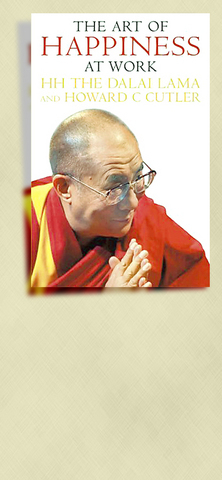
I opened this book with moderate expectations of stirring words. It has long occurred to me that if the world's major religions announced that it was a sin to work in the manufacture of all armaments, then the chances for world peace would take a giant leap forward. What, I wondered, would one of the world's most esteemed Buddhist leaders have to say on the subject? Buddhists, after all, are said to be opposed to the taking of all life, even a mosquito's. What would His Holiness have to say about people taking a job producing weapons, some of them certainly capable of causing mass destruction, in the arms industry?
It's necessary to look at the bigger picture, the Dalai Lama says when confronted with the issue. Unless there's a fundamental change in society as a whole, he argues, "for defense purposes for the society, or even on the global level, nations do need weapons for security purposes. Especially in the American case, you look at the fact that in the world there are totalitarian regimes who are against democracy. I think so long as those nations are there, the American military power must remain." (page 164)
Democracy? Tibet has never been a democracy. And arms for democracy? Haven't we heard this somewhere before?
Again, "... there are Western European nations who produce weapons, but use them mainly for defensive purposes and do not abuse them. And similarly, the example of the United States, although the Russian threat is no longer there, so long as a totalitarian regime like China exists with a huge military power, some kind of deterrent power is necessary."
This is of course cogent realpolitik but hardly in line with traditional Buddhist thought on the use of force.
This cautious, tolerant approach extends throughout the book. The issue of mind-numbing, repetitive labor is raised -- a job on a production line, for instance, where there is no chance for the individual to make any choices (except to quit), or to interact significantly with his co-workers. Well, says the Dalai Lama, perhaps if such a worker spends time with his family and friends after hours, then such work might be tolerable. No strong stand against inhuman conditions in the workplace either, then.
In fact there are no strong stands against anything. The Buddhist concept of "right livelihood" is referred to, but it would seem that in His Holiness's view almost any work will fit this description if the individual's mental attitude to it is right.
Money too -- what matters is not how much you have but your attitude to wealth in general. This is in line with much spiritual teaching worldwide, though many will remember another great teacher saying it is harder for a rich man to get to heaven than for a camel to go through the eye of a needle.
It's little wonder the Dalai Lama is so popular with the leaders of the rich nations. He can be guaranteed not to upset the apple-cart. He makes the right noises about China, strongly supports Taiwan (for which, of course, he deserves the greatest credit), and doesn't ask anyone to protest about having to do any kind of work whatsoever.
It seems to me that the Dalai Lama is in danger of being maneuvered into being no threat to anyone, a harmless emblem we can pin on our lapels to convince ourselves that we have support on the high moral ground when we take a conservative view on almost anything. He disarms us with his smiles and his jokes, is capable of being all things to almost all men, and when really knotty problems arise tends to resort to formulas such as, "This is a very complicated question."
I cannot therefore recommend this book. It is true that it represents an advance on earlier items such as The Many Ways to Nirvana (reviewed in Taipei Times Oct. 17, 2004). This time he has a co-author who narrates the whole book, describing his conversations with the great man and using ample quotations. Howard Cutler follows his subject from India to Washington, collecting comments and answers to questions wherever he can. This is preferable to collections of lectures -- the Dalai Lama is not a born writer, and anyway English is not his mother tongue.
But Cutler shapes the narrative, creating in the process what the likes of Rupert Murdoch call "product." It's a story, and it begins with the Dalai Lama claiming that what he does himself, in his many hours of meetings and so on, is actually "nothing." Cutler initially claims not to understand this, but by the book's end he finally comprehends what the wise, smiling presence really means by this enigma. But I'll leave you to find out for yourself the exact nature of this particular jewel in the heart of the lotus.

In late October of 1873 the government of Japan decided against sending a military expedition to Korea to force that nation to open trade relations. Across the government supporters of the expedition resigned immediately. The spectacle of revolt by disaffected samurai began to loom over Japanese politics. In January of 1874 disaffected samurai attacked a senior minister in Tokyo. A month later, a group of pro-Korea expedition and anti-foreign elements from Saga prefecture in Kyushu revolted, driven in part by high food prices stemming from poor harvests. Their leader, according to Edward Drea’s classic Japan’s Imperial Army, was a samurai

The following three paragraphs are just some of what the local Chinese-language press is reporting on breathlessly and following every twist and turn with the eagerness of a soap opera fan. For many English-language readers, it probably comes across as incomprehensibly opaque, so bear with me briefly dear reader: To the surprise of many, former pop singer and Democratic Progressive Party (DPP) ex-lawmaker Yu Tien (余天) of the Taiwan Normal Country Promotion Association (TNCPA) at the last minute dropped out of the running for committee chair of the DPP’s New Taipei City chapter, paving the way for DPP legislator Su
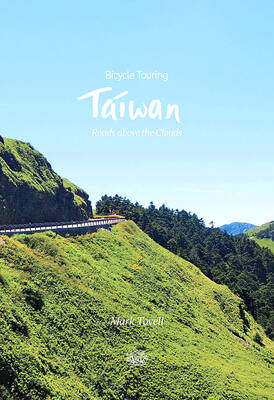
It’s hard to know where to begin with Mark Tovell’s Taiwan: Roads Above the Clouds. Having published a travelogue myself, as well as having contributed to several guidebooks, at first glance Tovell’s book appears to inhabit a middle ground — the kind of hard-to-sell nowheresville publishers detest. Leaf through the pages and you’ll find them suffuse with the purple prose best associated with travel literature: “When the sun is low on a warm, clear morning, and with the heat already rising, we stand at the riverside bike path leading south from Sanxia’s old cobble streets.” Hardly the stuff of your
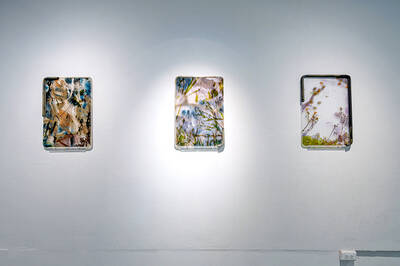
Located down a sideroad in old Wanhua District (萬華區), Waley Art (水谷藝術) has an established reputation for curating some of the more provocative indie art exhibitions in Taipei. And this month is no exception. Beyond the innocuous facade of a shophouse, the full three stories of the gallery space (including the basement) have been taken over by photographs, installation videos and abstract images courtesy of two creatives who hail from the opposite ends of the earth, Taiwan’s Hsu Yi-ting (許懿婷) and Germany’s Benjamin Janzen. “In 2019, I had an art residency in Europe,” Hsu says. “I met Benjamin in the lobby


 RSS
RSS